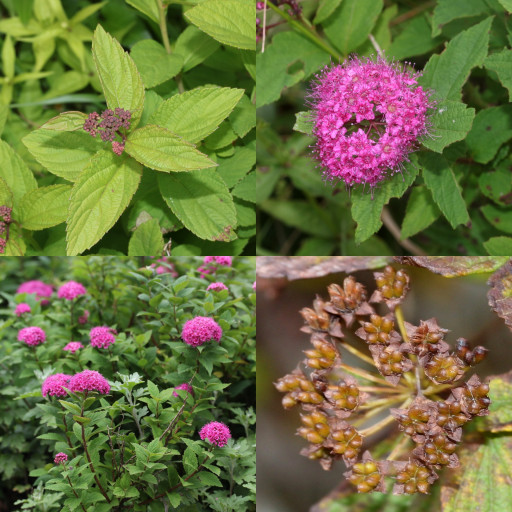
Plant Overview
Often called the "Japanese Meadowsweet," this resilient shrub is a darling of the landscaping world for its "plant it and forget it" nature. Originally hailing from the mountains of East Asia, it creates a cloud of pink or white blossoms that look like delicate lace draped over vibrant foliage. It is the perfect choice for adding a pop of candy-colored texture to garden borders or foundation plantings.
🔍 How to Identify
- 🌸 Floral Clusters: Tiny, five-petaled flowers are gathered in flat-topped "corymbs" that look like fuzzy, miniature umbrellas.
- 🍃 Toothed Leaves: The foliage is oval-shaped with sharply serrated (saw-toothed) edges, often emerging in shades of bronze or lime before turning deep green or gold.
- 🪵 Woody Habit: A multi-stemmed shrub that typically forms a neat, rounded mound, though it can become "leggy" or sparse if left unpruned for several seasons.
🏡 In Your Garden
- ✂️ Pruning Strategy: This plant is a "new wood" bloomer, meaning it sets its flower buds on the stems it grows in the current year. To keep it from looking wild and to encourage a massive flower show, give it a hard "haircut" in late winter or very early spring.
- 🦋 Pollinator Magnet: While it’s tough as nails against pests, it is a softie for local wildlife. Bees and butterflies flock to the nectar-rich florets throughout the mid-to-late summer months.
- 🌍 Adaptability: It isn't picky about soil types and can handle urban pollution well. However, it produces the most vibrant leaf colors and dense blooms when basking in full sun; too much shade makes the foliage turn a dull, muddy green.
⚠️ Safety & Toxicity
- 🐾 Pet Friendly: Spiraea japonica is generally considered non-toxic to cats, dogs, and horses, making it a safe landscape choice for households with adventurous pets.
- 👶 General Safety: While it is not poisonous, the plant is not meant for consumption. Ingesting large quantities of any ornamental shrub can cause mild stomach upset, so it’s best to keep it off the menu for curious children.
✨ Fun Fact
The genus name "Spiraea" comes from the Greek word speira, meaning "wreath" or "spiral." In ancient times, the long, flexible flowering branches were frequently woven into garlands and floral crowns for summer festivals.

Detailed Care Instructions
Goldflame spirea is a cultivar of Japanese spirea, which is not native to the United States. In fact, because it reseeds itself freely, it is considered invasive in many states. Native alternatives to introduced spirea species are white meadowsweet (Spirea alba) and steeplebush (Spirea tomentosa).
What's the difference between Goldflame spirea and Gold Mound spirea?
Both are similar cultivars of Japanese spirea with golden foliage but Gold Mound spirea is more compact, reaching only 2 to 3 feet in height.
Do spireas loose their leaves in winter?
Spireas are deciduous but hardy shrubs. In the fall, the foliage turns coppery orange before dropping off.
| Color | Pink |
| Soil Ph | Acid, Alkaline, Neutral |
| Humidity | Normal |
| Soil Type | Clay |
| Bloom Time | Late Spring |
| Difficulty | Medium |
| Plant Type | Deciduous Shrub |
| Hibernation | Cold Period |
| Mature Size | 2 To 3 Feet Tall; 3 To 4 Feet Wide |
| Native Area | Japan |
| Temperature | Min 18°C |
| Sun Exposure | Partial To Full Sun |
| Hardiness Zones | 4, 5, 6, 7, 8 |
To grow Spiraea Japonica, also known as Japanese Spiraea or Japanese Meadowsweet, you can follow these steps:
- Choose the right location: Spiraea Japonica thrives in full sun to partial shade conditions. Select a well-draining spot in your garden that receives at least 6 hours of direct sunlight.
- Prepare the soil: Ensure the soil is loose, fertile, and well-draining. Amend the soil with organic matter like compost or aged manure to improve its quality.
- Planting: Dig a hole slightly larger than the root ball of your Spiraea Japonica plant. Place the plant in the hole, making sure that the top of the root ball is level with the soil surface. Backfill the hole with soil and gently firm it around the plant.
- Watering: After planting, give the plant a thorough watering. Then, water the plant regularly, keeping the soil consistently moist. However, avoid overwatering, as this could lead to root rot.
- Mulching: Apply a layer of organic mulch around the base of the plant to help retain moisture in the soil, suppress weed growth, and regulate soil temperature.
- Pruning: Spiraea Japonica benefits from regular pruning to maintain its shape and promote healthy growth. Prune the plant in early spring before new growth appears. Remove any dead, damaged, or diseased branches, as well as any crossing branches or overly dense growth.
- Fertilizing: Feed your Spiraea Japonica plant in early spring with a balanced, slow-release fertilizer. Follow the package instructions for the correct application rate.
- Pests and diseases: Spiraea Japonica is generally resilient to pests and diseases, but it can occasionally be affected by aphids, spider mites, or powdery mildew. Monitor the plant regularly and take appropriate action if you notice any signs of infestation or disease.
By following these guidelines, you should be able to successfully grow Spiraea Japonica and enjoy its lovely flowers and foliage in your garden.

Place in a window with dappled sun or a spot in the middle of a room. Or directly in a window facing west or east.

Watering this plant requires you to ensure that the soil surrounding it is consistently moist. This can be achieved by watering deeply, ensuring that you saturate the root zone at least once a week. It is important to note that watering requirements may vary depending on the climate and soil conditions. Additionally, you can determine if your plant needs water by monitoring the soil moisture level, which can be done by sticking your finger into the soil to check for dryness. When watering, it is advisable to avoid wetting the leaves and stem as this may lead to diseases. Watering in the early morning or late afternoon is best as it allows the plant to absorb moisture before the heat of the day evaporates it.
To fertilize this plant, you should apply a balanced all-purpose fertilizer in early spring before new growth appears. Use about 2-3 pounds of fertilizer per 100 square feet of plant area. Another option is to use compost or well-rotted manure as a top dressing around the base of the plant. Water the plant after fertilizing to help the nutrients soak into the soil. Avoid fertilizing after mid-summer as it may stimulate new growth that won't have time to harden off before winter.
The ideal soil for Spiraea Japonica plant is a well-draining soil with plenty of organic matter. A neutral to slightly acidic soil pH is preferred. The soil should be moist but not waterlogged. The plant prefers a soil that is rich in nutrients and minerals. A sandy loam soil with good drainage and plenty of organic matter is ideal. Avoid using heavy clay soils or soils that are prone to waterlogging as this can cause root rot. It is recommended to add compost or well-rotted manure to the soil before planting to improve soil fertility.
Spiraea Japonica is a plant that can be propagated using several methods. The most common method is through stem cuttings. To do this, you will need to identify a healthy stem on the plant that is at least 4 inches long. Cut the stem using a sterilized pair of scissors or pruning shears. Remove the leaves from the lower half of the stem and dip the cut end into rooting hormone. Place the stem in a potting mix that is moist and well-drained. Keep the soil moist and place the pot in a bright area, but not direct sunlight. The roots should develop within 3-4 weeks.
Another way to propagate Spiraea Japonica is through division. To do this, dig up the plant and carefully separate it into smaller sections, making sure each section has roots and shoots.
Alternatively, the plant can be propagated by layering. To do this, bend a lower branch of the plant to the ground and bury a section of it in soil. Make sure it is securely anchored with rocks or dirt. After a few months, the buried section of the branch should have rooted. Cut it off from the parent plant and plant it in a new location.
Propagation of Spiraea Japonica can also be achieved by collecting its seeds. However, this method is not commonly practiced as the seeds are difficult to germinate and take a long time to grow into plants.
Common pests of the japanese spiraea include Scale insect, spider mites, aphids, larvae. Make a habit of checking your japanese spiraea frequently for pests so that any infestations can be caught and managed early.








