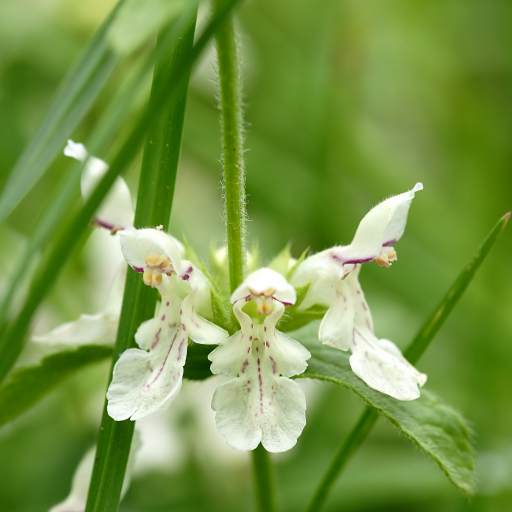
Plant Overview
Commonly known as the Annual Woundwort, this charming member of the mint family is a traveler of sunny fields and open meadows. While it might look like a humble wildflower to the untrained eye, its pale, creamy blossoms have historically been prized by herbalists for their supposed healing properties. It is a resilient, sun-loving species that brings a touch of wild, rustic beauty to limestone-rich landscapes across Europe and Asia.
🔍 How to Identify
- 📏 Square Stems: True to its family (Lamiaceae), the plant features a distinct four-angled, square stem that is slightly hairy and stands upright.
- 🌿 Opposite Leaves: The light green leaves are oval-shaped with gently notched edges (crenate) and grow in pairs directly across from one another along the stem.
- 🌸 Creamy Flowers: Look for small, tubular blooms that are pale yellow or whitish-yellow, often arranged in "whorls" (circles) around the upper part of the stem.
🏡 In Your Garden
- ☀️ Sun & Soil: This plant is an opportunist that thrives in disturbed, alkaline soils; it is often found "volunteering" in fallow fields or gravelly garden edges where other plants struggle.
- 🐝 Pollinator Buffet: It is a high-value nectar source for long-tongued bees and butterflies, making it a wonderful addition to a "wild" corner of your garden or a dedicated pollinator meadow.
⚠️ Safety & Toxicity
- ✅ General Safety: Stachys annua is generally considered non-toxic to humans, cats, and dogs.
- 🩹 Skin Sensitivity: While its name "Woundwort" stems from its historical use in folk medicine to treat cuts, the fine hairs on the leaves can occasionally cause very mild skin irritation for those with highly sensitive skin.
✨ Fun Fact
The genus name Stachys comes from the Ancient Greek word for "ear of grain," describing the way the flower spikes stand tall and clustered, mimicking the appearance of a head of wheat or barley.

Detailed Care Instructions
To grow Stachys annua, also known as lamb's ear, you can follow these steps:
- Choose the right location: Select a spot in your garden that receives full sun to partial shade. Stachys annua can tolerate a wide range of soil conditions but prefers well-draining soil.
- Prepare the soil: Loosen the soil in the planting area and remove any weeds or debris. Add organic matter such as compost to improve soil fertility and drainage.
- Sow the seeds: Stachys annua can be grown from seeds. Sow the seeds directly into the prepared soil in early spring or fall. Gently press the seeds into the soil, ensuring they are buried no more than 1/8 to 1/4 inch deep.
- Water regularly: Keep the soil evenly moist until the seeds germinate. Once the plants are established, water them regularly, providing about an inch of water per week. However, be cautious not to overwater as excessive moisture can lead to root rot.
- Mulch: Apply a layer of organic mulch around the plants to help conserve soil moisture and suppress weed growth. Avoid placing mulch directly against the plant stems, as it may promote rotting.
- Maintain: Stachys annua is a relatively low-maintenance plant. Remove any weeds that sprout around the plants to prevent competition for nutrients and water. Additionally, prune back any dead or yellowing foliage to maintain a tidy appearance.
- Propagate: Stachys annua can spread through self-seeding or by division. To prevent self-seeding, remove the spent flower spikes before they produce seeds. If you wish to propagate the plant through division, divide the clumps in early spring or fall, ensuring each division has sufficient roots and foliage.
By following these steps, you can successfully grow Stachys annua in your garden.

Place in a bright room that is sun drenched almost all day. Or directly in a south-facing window.

To water this plant, ensure that the soil around it is dry to the touch before giving it a good soaking. Water deeply, making sure to saturate the root zone. Avoid getting water on the leaves and try to water early in the morning or in the evening when the sun is not too strong. Be careful not to overwater as this can lead to root rot. Regular watering is important during the growing season, but reduce the amount of water in the winter when growth slows down.
To fertilize Stachys Annua, you should apply a balanced fertilizer with equal amounts of nitrogen, phosphorus, and potassium every 4-6 weeks during its growing season. Use a slow-release fertilizer to avoid burning the plant. Water the plant before and after fertilizing to prevent fertilizer burn and ensure that the nutrients reach the roots of the plant.
The soil suitable for this plant should be well-draining, with a good amount of organic matter. A pH level of 6.5 to 7.5 is ideal. The soil should be deep, with good water retention capacity but not too soggy or waterlogged. The plant prefers a fertile, loamy soil that is neither too heavy nor too light in texture. It likes a soil that is rich in nutrients, particularly nitrogen, phosphorous, and potassium. For best growth, the soil should be regularly amended with compost or other organic matter. Avoid planting this species in compact or clay soils as these are not ideal for proper root development.
To propagate this plant, first locate and identify the suitable part of the plant for taking cuttings. This may include stems, leaves or roots. Using a sharp, sterile garden tool, take a section of the plant material that is around four to six inches in length.
Remove any leaves or flowers from the lower half of the cutting and dip the end into a rooting hormone powder or liquid. This will encourage the cutting to form roots. Place the cutting in a pot of well-draining soil or in a propagation tray. Keep the soil or tray moist and provide humidity by covering with a plastic bag or propagator lid.
Keep the cutting in a bright, but indirect light, and away from direct sunlight and drafts. Within a few weeks, the cutting should start to develop roots. Once the roots are well-formed, the cutting can be transferred to a larger pot or planted out in the garden. Water well and continue to care for the plant as usual.








