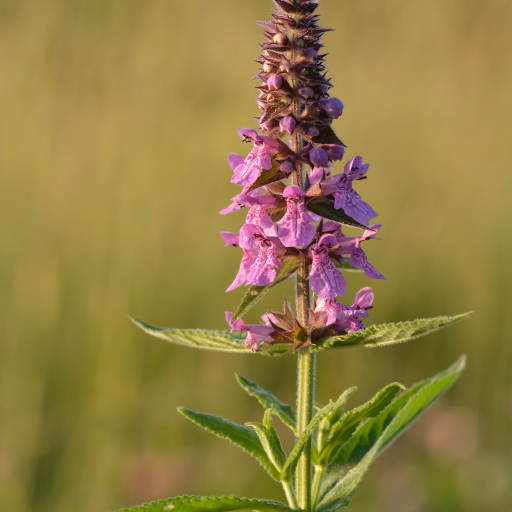
Plant Overview
Often called the "Clown’s Heal" or "Marsh Betony," Stachys palustris is a resilient perennial that acts as a beacon for pollinators in soggy landscapes. While it lacks the refreshing scent of its peppermint cousins, it carries a deep history as a primitive first-aid kit for ancient woodsmen and soldiers. This plant is a true survivor of the wetlands, thriving in mud and muck where other garden favorites would simply drown.
🔍 How to Identify
- 🌿 The Stem: Look for the tell-tale "square" stem typical of the mint family. It is usually hollow and covered in fine, downward-pointing hairs that feel slightly rough to the touch.
- 🍃 The Leaves: The leaves are long, narrow, and shaped like a spearhead with serrated (saw-like) edges. They grow in pairs directly opposite each other and have almost no stalks at the top of the plant.
- 🌸 The Bloom: In mid-to-late summer, it produces striking spikes of mottled purple-pink flowers. Each flower has a distinct "hooded" upper petal and a larger, patterned lower lip, arranged in neat circular tiers.
🏡 In Your Garden
- 💧 The "Wet Feet" Rule: As the name suggests, this plant is a specialist for boggy areas, pond edges, or that one corner of your yard that never seems to dry out. It struggles in dry, sandy soil.
- 🏃 Space Invader: It spreads through vigorous underground runners (rhizomes). While this makes it excellent for stabilizing eroding banks, it can be quite "enthusiastic" in a small garden. Consider planting it in a buried container if you want to keep it from wandering.
- 🐝 Pollinator Magnet: It is an essential nectar source for long-tongued bees. Because the flowers are structured like little landing pads, they are a favorite for heavy bumblebees.
⚠️ Safety & Toxicity
- ✅ Status: Generally considered non-toxic to humans and common household pets like dogs and cats.
- 🩹 Historical Context: While it was historically used to staunch bleeding (hence "Woundwort"), you should avoid applying crushed wild plants to open wounds or consuming them. Some people may experience mild skin irritation from the bristly hairs on the stem.
✨ Fun Fact
The quirky nickname "Clown’s Heal" was coined by the famous 16th-century herbalist John Gerard. He named it after witnessing a "clown" (an archaic term for a rustic laborer) heal a massive leg wound with the plant's leaves in just a few days, after the laborer refused Gerard's expensive professional medical help!

Detailed Care Instructions
To grow Stachys Palustris, also known as marsh woundwort or marsh hedge-nettle, follow these steps:
- Choose a suitable location: Stachys Palustris prefers moist to wet soil conditions, so select a spot in your garden that stays consistently moist, such as along the edge of a pond or in a damp, low-lying area.
- Prepare the soil: The soil should be rich, fertile, and well-drained. Remove any weeds or grass from the planting area and loosen the soil with a garden fork or tiller. If the soil is heavy clay, add organic matter such as compost or well-rotted manure to improve drainage.
- Sow or transplant: You can grow Stachys Palustris from seeds or transplants. If sowing seeds, sprinkle them lightly on the soil surface and press them gently into the soil. If using transplants, dig a small hole slightly larger than the root ball, place the plant in the hole, and carefully backfill with soil, ensuring the crown of the plant is level with the soil surface.
- Water: Water the newly planted Stachys Palustris thoroughly, keeping the soil consistently moist but not waterlogged. During dry spells, continue to water regularly to maintain moisture levels.
- Provide shade or partial shade: While Stachys Palustris can tolerate full sun, it generally prefers some shade or partial shade, especially during the hottest part of the day. If your garden receives full sun, consider planting it where it can benefit from the shade of taller plants or trees.
- Mulch: Apply a layer of organic mulch, such as wood chips or straw, around the base of the plant to help conserve moisture, suppress weeds, and insulate the roots.
- Fertilize: Stachys Palustris typically does not require heavy fertilization. However, you can apply a balanced, slow-release fertilizer in early spring to promote healthy growth.
- Maintenance: Remove any weeds that may compete for nutrients and regularly check for pests or diseases. Deadhead spent flowers to encourage continuous blooming. Divide overcrowded clumps every few years to maintain plant health and vigor.
By following these tips, you can successfully grow Stachys Palustris in your garden or landscape.

Place in a bright room that is sun drenched almost all day. Or directly in a south-facing window.

To water this plant, first assess the soil moisture by gently sticking your finger about two inches into the soil. If it feels dry, it's time to water. Use a watering can or hose with a gentle spray attachment to moisten the soil evenly. Avoid watering the leaves directly, as this can lead to fungal diseases. The frequency of watering will depend on environmental factors such as temperature and humidity, as well as the size and age of the plant. Ideally, the soil should be kept evenly moist but not waterlogged. Allow excess water to drain away from the pot or soil. During hot and dry spells, you may need to water this plant more frequently to prevent wilting.
To fertilize this plant, apply a balanced slow-release fertilizer in early spring before new growth begins. You can also apply a liquid fertilizer diluted to half strength every 2-3 weeks during the growing season. Be sure to water thoroughly after fertilizing to prevent burn. Avoid fertilizing after mid-summer to allow the plant to prepare for winter dormancy.
Stachys Palustris prefers to grow in moist soil that is well-drained, with a pH level that is slightly acidic to neutral. The soil should be rich in nutrients and organic matter, as this will help the plant to establish and grow well. It is important to avoid soil that is too heavy or compacted, as this can impede drainage and lead to root rot. Choosing a loamy soil that is light and airy, with good water retention capacity, can be beneficial for promoting healthy growth and development. The soil should also be able to maintain consistent moisture levels, as this plant prefers moist conditions throughout the growing season. Amending the soil with organic compost or fertilizers can also help to improve soil quality and support healthy plant growth.
Stachys Palustris plant can be propagated through division or by taking stem cuttings.
To propagate through division, carefully dig up the plant and gently separate the clumps of roots. Cut away any dead or damaged parts of the plant, and replant the healthy clumps in a new location or pot.
To propagate through stem cuttings, take a cutting from a healthy, mature plant. Cut a 3-4 inch section of stem with several leaves, and remove the bottom set of leaves. Place the cutting in a pot with moist soil or in a glass of water for a few weeks until roots begin to develop. Once the roots are established, the plant can be transplanted to a new location or pot.
It is important to keep the soil around the plant or cutting moist and in a partially shaded area until it has fully rooted and begins to grow.








