Plant Overview
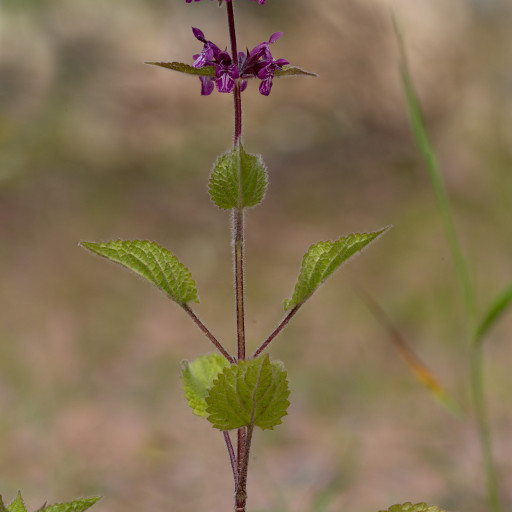
Known as the Hedge Woundwort, this hardy woodland native has a bit of a split personality. While its striking spikes of deep purple flowers look elegant in a wild garden, its leaves release a pungent, "rubbery" scent when bruised or crushed. Historically, it was a staple in the medieval apothecary’s kit, prized as a "vulnerary" (a wound-healer) for its ability to stop bleeding and knit flesh back together.
🔍 How to Identify
- 🌿 The Leaves: Heart-shaped with serrated edges, they look remarkably like stinging nettle leaves but lack the sting. They are soft, hairy, and arranged in opposite pairs.
- 🌸 The Flowers: Deep magenta or beetroot-purple blossoms grow in whorls around a tall spike. If you look closely, the bottom "lip" of each flower features intricate white markings that act as landing strips for bees.
- 📐 The Stem: Like most members of the Mint family, the stem is distinctly square-shaped and covered in fine, downward-pointing bristles.
🏡 In Your Garden
- ☁️ Shadow Dweller: This plant is a specialist of the "dappled shade." It thrives in the tricky, darker corners of a yard where other flowers might fail, particularly under the canopy of deciduous trees.
- 🌱 Spreading Nature: It spreads via underground runners (rhizomes). While it isn't considered a destructive invader, it is "assertive." It’s best used in wilder, naturalistic garden areas rather than tight, formal flower beds where it might crowd out delicate neighbors.
⚠️ Safety & Toxicity
- ✅ Status: Generally non-toxic to humans and pets.
- 👃 Details: While safe, the plant is not culinary. Its strong, somewhat unpleasant odor when touched usually acts as a natural deterrent for curious pets. The fine hairs on the stems may cause very mild skin irritation for those with highly sensitive skin, but it is not a "stinger."
✨ Fun Fact
Despite its smell, the Hedge Woundwort is a favorite of the Carder Bee. These bees are among the few insects strong enough to force their way into the tightly-closed petals to reach the nectar hidden deep inside!

Detailed Care Instructions
To grow Stachys sylvatica (Hedge Woundwort) plants, follow these steps:
- Obtaining the plant: You can either purchase young plants from a nursery or propagating through seeds or division.
- Planting location: Choose a suitable location that receives partial shade to full shade. This plant prefers moist, well-draining soil. Prepare the planting area by loosening the soil and removing any weeds or debris.
- Planting: If transplanting young plants, dig a hole slightly larger than the root ball and place the plant in the hole at the same depth it was in the nursery pot. Fill the hole with soil, lightly press down, and water generously. If growing from seeds, sow them directly in the planting area and lightly cover with soil. Water the area gently after planting.
- Watering: Keep the soil consistently moist but not waterlogged. Water the plants regularly especially during dry periods. However, avoid overwatering, as this can cause root rot.
- Mulching: Apply a layer of organic mulch around the plants to retain moisture, suppress weed growth, and regulate soil temperature.
- Fertilizing: Stachys sylvatica generally doesn't require much fertilizer. However, you can feed it with a balanced, slow-release fertilizer in early spring.
- Pruning: Trim back any dead or damaged foliage in early spring to encourage new growth. You can also prune the plants lightly after flowering to maintain their shape.
- Pests and diseases: Stachys sylvatica is relatively resistant to pests and diseases. However, keep an eye out for snails, slugs, or powdery mildew and take appropriate measures if necessary.
- Division: After a few years, you can divide mature Stachys sylvatica plants to promote better growth and prevent overcrowding. Dig up the plant carefully, separate the root clumps, and replant them in suitable locations.
- Winter care: Generally hardy, Stachys sylvatica plants can withstand moderate winters. However, providing a layer of mulch around the base of the plants can offer extra protection during colder months.
Remember to research specific care instructions for your specific growing zone and climate, as they may vary slightly.

Place in a bright room that is sun drenched almost all day. Or directly in a south-facing window.

To water this plant, you should first check the soil moisture level by sticking your finger into the soil up to your second knuckle. If the soil feels dry, it's time to water it. When watering, aim to moisten the soil around the root system without overwatering or leaving the soil waterlogged. Avoid watering the foliage or leaves of the plant, as this can lead to disease issues. Use a watering can or hose with a gentle spray attachment to water the soil evenly. Water the plant in the early morning or late afternoon to reduce evaporation and stress on the plant. Monitor the soil moisture level regularly and adjust your watering schedule as needed based on weather conditions and the plant's individual needs.
To fertilize this plant, apply a balanced fertilizer in the early spring before new growth appears. A slow-release fertilizer can also be applied in the fall. Be sure to follow the recommended application rate on the fertilizer label and water the plant thoroughly after fertilizing. Avoid over-fertilizing, as this can lead to excessive growth or foliage burn.
Stachys sylvatica prefers well-draining soil that is moist but not waterlogged. It thrives in a loamy or sandy soil that is rich in organic matter. The pH level of the soil should be neutral to slightly acidic. Avoid using heavy or clay soils as they will hold too much moisture and cause the plant to rot. Additionally, the soil should be fertile and nutrient-rich, as Stachys sylvatica is a heavy feeder. You can amend the soil with compost or well-aged manure before planting to ensure it has enough nutrients.
To propagate this plant, you can take stem cuttings in the summer or fall, making sure to cut just below a node. Remove the lower leaves and dip the cut end into rooting hormone before planting in a pot with well-draining soil. Keep the soil consistently moist and in a warm and bright location, but out of direct sunlight. Once the cuttings begin to root and develop new growth, you can transplant them into individual pots or outside in a suitable location.








