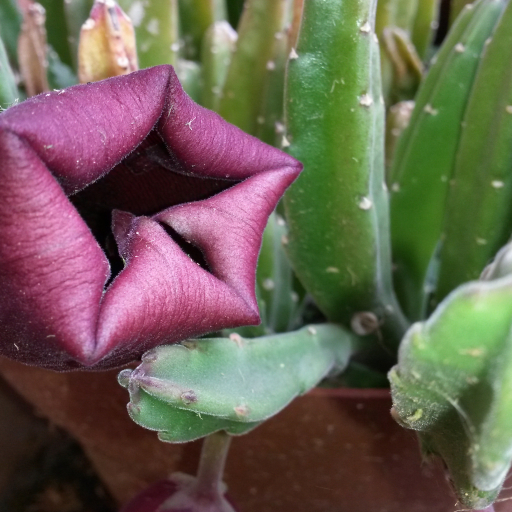
Plant Overview
Often called the "Black Bell," Stapelia leendertziae is a show-stopper that looks like it belongs in a gothic fairytale. Native to the rocky outcrops of South Africa, this succulent exchanges the typical "sweet" floral scent for something much more macabre. It is a prized possession for collectors who love plants with a dark, dramatic flair and a bit of a rebellious personality.
🔍 How to Identify
- 🌿 Velvety Stems: The plant grows in clumps of upright, four-angled stems. They are soft and fuzzy to the touch, lacking the sharp spines found on many desert cacti.
- 🔔 The Deep Bell: While most Stapelia species have flat, star-shaped flowers, this one produces large, pendulous bells. These blooms can reach up to 4 inches in length and hang downward.
- 🌑 Dark Pigment: The interior of the flower is a rich, wrinkled burgundy or royal purple that appears almost pitch-black in the shade.
🏡 In Your Garden
- 🏜️ Drainage is Non-Negotiable: Because the stems are essentially water-storage tanks, the plant is highly susceptible to root rot. Use a gritty cactus mix and terracotta pots to help moisture evaporate quickly.
- 🌬️ Airflow & Aroma: When the bells open, they emit a faint scent of decaying meat. This "carrion" smell is designed to attract flies for pollination. Because of this, it’s best enjoyed on a sunny patio or a well-ventilated porch rather than in a small, enclosed room.
- ☀️ Light Nuance: It loves bright, indirect light. If the stems turn a reddish-purple color, the plant is telling you it's getting a bit too much sun "stress," and you should move it to a slightly shadier spot.
⚠️ Safety & Toxicity
- 🐾 Pet Friendly: Great news for animal lovers—Stapelia leendertziae is generally considered non-toxic to cats, dogs, and horses.
- 🧴 Sap Sensitivity: While not poisonous, the milky sap inside the stems can cause mild skin irritation for some people. It’s a good idea to wear gloves or wash your hands after pruning or taking cuttings.
✨ Fun Fact
The plant is a master of "olfactory mimicry." It doesn't just look like dark meat; it emits chemicals that mimic the smell of a dead animal to trick blowflies into laying their eggs inside the flower. The flies get covered in pollen, and the plant gets pollinated without offering the flies any actual food!

Detailed Care Instructions
| Humidity | Normal |
| Lighting | Full Sun |
| Toxicity | Poisonous |
| Difficulty | Easy |
| Hibernation | Medium |
| Temperature | 20°C - 27°C |
| Hardiness Zones | 11 - 12 |
To grow Stapelia Leendertziae plant, you can follow these steps:
- Obtain a healthy cutting or seeds from a reputable source. Seeds can be found online or at specialty succulent nurseries.
- Choose a well-draining pot or container with multiple drainage holes. Ensure it is large enough to accommodate the plant's root system.
- Fill the container with a well-draining succulent or cactus soil mix. You can also create your own mix by combining equal parts of potting soil, perlite, and sand.
- If planting from seeds, sow them on the soil surface and gently press them in. If using cuttings, let the cut end dry for a few days to prevent rotting.
- Place the pot in a location that receives bright, indirect sunlight. Avoid direct sun, as it can scorch the plant.
- Water the soil thoroughly until water drains out of the bottom of the container. Allow the soil to dry out completely between waterings, as excessive moisture can lead to root rot.
- Stapelia Leendertziae prefers warmer temperatures between 60-80°F (15-27°C). Avoid exposing the plant to temperatures below 50°F (10°C).
- Fertilize the plant sparingly during the growing season with a diluted succulent fertilizer. Follow the instructions on the fertilizer package for application rates and frequency.
- If desired, you can propagate Stapelia Leendertziae by stem cuttings. Allow the cut end to dry for a few days and then plant it in a suitable succulent or cactus soil mix.
- Monitor the plant for any signs of pests, such as mealybugs or scale insects. If detected, treat with insecticidal soap or neem oil according to the product instructions.
With proper care and attention, your Stapelia Leendertziae plant should thrive and produce its unique star-shaped flowers.

Place in a bright room that is sun drenched almost all day. Or directly in a south-facing window.

To water this specific plant, you should wait until the soil is completely dry and then give it a thorough watering. It is important not to over-water this plant as it does not like to sit in wet soil for extended periods of time. When watering, make sure to pour the water directly onto the soil and not onto the leaves or stem. Also, avoid letting water accumulate in the pot's saucer, as this can cause root rot. In general, it is recommended to water this plant once every 1-2 weeks during the growing season and reduce watering during the winter months when it goes into dormancy.
To fertilize this plant, mix a balanced all-purpose fertilizer with water according to package instructions. Apply the solution to the soil around the plant once a month during the growing season (usually spring and summer). Be sure to dilute the fertilizer properly and avoid getting it on the plant's stems or leaves, as it may cause damage.
When growing the plant, it is important to use soil that is well-draining and has good aeration. A mixture of sand, perlite, and peat moss should be used in equal parts to create a soil that is ideal for the plant. Additionally, it is important to ensure that the soil is slightly acidic, with a pH between 5.5 and 6.5. The plant should be watered sparingly, only when the soil is completely dry to the touch, and should not be allowed to sit in standing water. When fertilizing the plant, a low-nitrogen fertilizer with a balanced NPK ratio should be used.
Stapelia Leendertziae is a plant species that belongs to the genus Stapelia. It is a succulent plant that is native to southern Africa. Propagating the Stapelia Leendertziae plant is relatively easy, and it can be done through stem cuttings. Here are the steps to propagate this plant species:
Step 1: Get a healthy and mature stem from the Stapelia Leendertziae plant, preferably one that has not flowered yet. Use a sharp, sterilized knife or scissors to make a clean cut as close to the base of the stem as possible.
Step 2: Allow the stem cutting to dry out for a few days in a warm and dry location out of direct sunlight. This will prevent the cutting from rotting as it develops its roots.
Step 3: Prepare a well-draining soil mixture. You can use a cactus soil mix or a mixture of equal parts peat moss and sand.
Step 4: Plant the stem cutting into the soil mixture, burying it up to a third of its length. Make sure the soil is moist but not waterlogged.
Step 5: Place the planted stem cutting in a warm and bright location, but out of direct sunlight. Avoid placing it in a drafty location or near heating vents.
Step 6: Water the cutting only after the soil has completely dried out. Overwatering can cause the cutting to rot.
Step 7: After a few weeks, small roots should start to develop from the base of the stem cutting. Once the roots are well developed, the new plant can be transplanted into a bigger pot with a well-draining soil mix.
With proper care, the new plant should grow into a healthy and mature Stapelia Leendertziae plant in a few months.
Common pests of the stapelia leendertziae include Scale insect, mealybugs, spider mites, thrips. Make a habit of checking your stapelia leendertziae frequently for pests so that any infestations can be caught and managed early.








