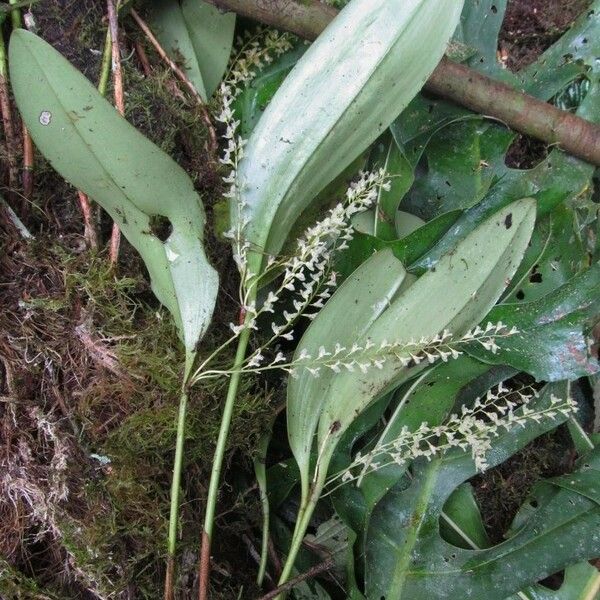
Plant Overview
Known as the "Frosty Stelis," this miniature orchid looks as though it was plucked from a winter landscape despite its tropical origins. Found in the misty, high-altitude cloud forests of Central and South America, it is a prized jewel for "micro-orchid" collectors. Its name, gelida, is Latin for "ice-cold," referring to the shimmering, crystalline texture that makes its flowers appear covered in a fine layer of hoarfrost.
🔍 How to Identify
- 🌸 The Flowers: Produces upright, slender spikes (racemes) crowded with dozens of tiny, triangular blossoms that are typically cream-colored or translucent white.
- ❄️ Crystalline Texture: Under a magnifying glass, the flowers reveal a glistening, pebbled surface that sparkles like sugar or ice crystals.
- 🍃 Foliage: Features thick, leathery, spoon-shaped leaves that grow in dense, upright tufts, lacking the bulbous stems (pseudobulbs) seen in many other orchids.
🏡 In Your Garden
- ☁️ Cloud Forest Vibes: Because it originates in high-altitude mists, this plant thrives on high humidity and constant air movement; it prefers "cool" temperatures and will struggle in stagnant, hot rooms.
- 💧 Thirsty Nature: Unlike desert cacti, this orchid has no water-storage organs. It prefers to stay consistently damp (like a wrung-out sponge) and should never be allowed to dry out completely.
⚠️ Safety & Toxicity
- 🐾 Non-Toxic: Stelis gelida is generally considered safe and non-toxic for cats, dogs, and humans.
- 🌱 Delicate Structure: While not poisonous, the plant is physically fragile. Its thin flower spikes and brittle leaves can be easily damaged by curious pets or heavy-handed pruning.
✨ Fun Fact
Most flowers use colorful petals to attract pollinators, but in the Stelis genus, the petals are actually microscopic. The "petals" you see are actually sepals that have evolved into a perfect, geometric triangle to create a landing pad for tiny gnats and flies!

Detailed Care Instructions

Place in a window with dappled sun or a spot in the middle of a room. Or directly in a window facing west or east.

Some plants require more regular watering than others, which should be done every few days. It's critical to maintain the soil moist all of the time. The water requirements of the same plant placed in pots with varying sizes will differ. Because the water in the smaller pot evaporates faster than the water in the larger pot, it will require more watering. Regardless of pot size, the surface should constantly be maintained moist.








