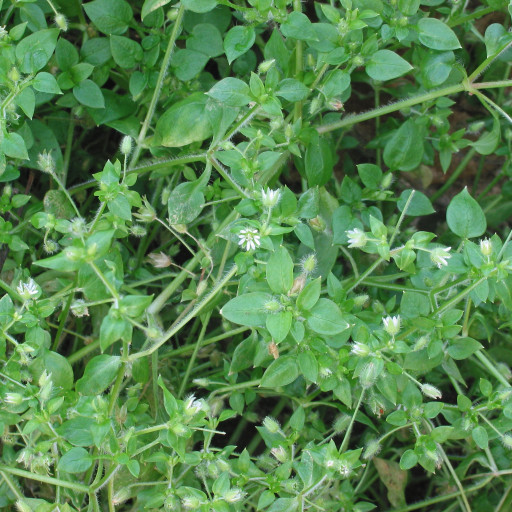
Plant Overview
Often called "Starweed" or "Satin-flower," Common Chickweed is a delicate, sprawling resident of gardens and meadows worldwide. While many gardeners see it as a pesky intruder, this resilient plant is actually a nutrient-dense herb with a long history in folk medicine and foraging. Its name stems from its popularity as a favorite snack for chickens and wild birds.
🔍 How to Identify
- ⭐ The Tiny Stars: Look for very small, white flowers with five petals. Each petal is so deeply lobed that it looks like ten separate petals at first glance.
- 🧶 The Hairy Line: A unique identifier is a single, thin line of fine hairs running down one side of the stem. This line miraculously switches sides at every pair of leaves.
- 🍃 Egg-Shaped Leaves: The leaves are small, smooth, and oval-shaped with pointed tips, growing in opposite pairs along the stem.
🏡 In Your Garden
- 🌱 Soil Indicator: Chickweed is a "living laboratory." If it is thriving in your garden, it’s a sign that your soil is highly fertile, moist, and rich in nitrogen.
- 💧 Cool-Season Carpet: Unlike most garden plants, Chickweed loves the cold. It often appears in late winter or early spring, acting as a natural "green mulch" that prevents soil erosion before your summer crops take over.
⚠️ Safety & Toxicity
- 🥗 Status: Edible and generally safe. It is often used in salads (tasting like sweet corn) or as a soothing skin balm.
- 🐕 Details: While safe for humans and most pets, it contains small amounts of saponins. Large quantities could lead to a mild stomach upset for sensitive grazers. As always, ensure it hasn't been sprayed with lawn chemicals before touching or harvesting.
✨ Fun Fact
Common Chickweed is a natural weather forecaster! Its leaves and flowers are highly sensitive to humidity; they will fold up and "sleep" when rain is approaching or when the sun begins to set.

Detailed Care Instructions
To grow Stellaria media, also known as chickweed, follow these steps:
- Choose a suitable growing location: Chickweed can thrive in both partial shade and full sun. Ensure that the soil is well-drained and has a pH level between 5.5 and 7.5.
- Prepare the soil: Loosen the soil with a garden fork or tiller to a depth of 6-8 inches. Remove any weeds or rocks from the area.
- Sow the seeds: Scatter the seeds evenly over the prepared soil surface. Chickweed seeds germinate easily, so there is no need to cover them with soil.
- Water the seeds: Lightly mist the soil with water to ensure even moisture. Avoid overwatering, as chickweed prefers consistently moist but not waterlogged soil.
- Maintain the plants: Once the seedlings emerge, thin them to ensure they have enough space to grow. Leave about 4-6 inches of space between each plant.
- Water regularly: Keep the soil moist by watering the plants regularly. Avoid letting the soil dry out completely, as this can inhibit growth.
- Control weeds: While chickweed is a fast-growing plant, it can be easily outcompeted by other weeds. Regularly remove any nearby weeds to prevent them from overshadowing or crowding the chickweed plants.
- Harvesting: Chickweed leaves and stems are edible and can be harvested for culinary uses. Harvest the plant when it is young and tender, typically before it starts developing flowers.
By following these steps, you can successfully grow Stellaria media and enjoy its benefits.

Place in a window with dappled sun or a spot in the middle of a room. Or directly in a window facing west or east.

To properly water this particular plant, you should ensure that the soil remains consistently moist but not waterlogged. This can be achieved by watering it deeply once a week, allowing the soil to drain completely, and then keeping a watchful eye on the soil's moisture levels throughout the week. If the soil feels dry to the touch, the plant should be watered again. If possible, use water that has been allowed to reach room temperature before watering the plant, as this can help prevent shock to the plant's roots. Additionally, be careful not to get water on the leaves or stems of the plant, as this can lead to rot or disease.
To fertilize this plant, apply a balanced, all-purpose liquid fertilizer every two weeks during the growing season. Be sure to follow the recommended dosage on the fertilizer packaging. Additionally, top-dress the soil with compost once a year to improve soil fertility. Avoid fertilizing during the plant's dormant period.
The ideal soil for this plant contains a mix of sand, loam, and clay. It should have good drainage, be able to retain moisture, and have a slightly acidic pH level. Adding organic matter such as compost or leaf mulch can also improve soil quality. Avoid using soils that are overly compacted or too heavy in clay content, as this can lead to poor root development and suffocation. Additionally, the soil should not be too rich in nutrients as this can cause excessive foliage growth rather than flowering.
To propagate this plant, you will need to take stem cuttings from a mature plant. Choose a healthy stem that is about 4-6 inches long and remove the leaves from the bottom 2 inches of the stem. Dip the cut end of the stem in rooting hormone and then plant it in a moist potting mix. Cover the pot with a plastic bag to create a humid environment and keep the soil moist. After 2-3 weeks, the cutting should develop roots and can be transplanted into a larger pot or into the garden. Make sure to keep the new plant well-watered and in a shady spot until it has adjusted to its new environment.








