Plant Overview
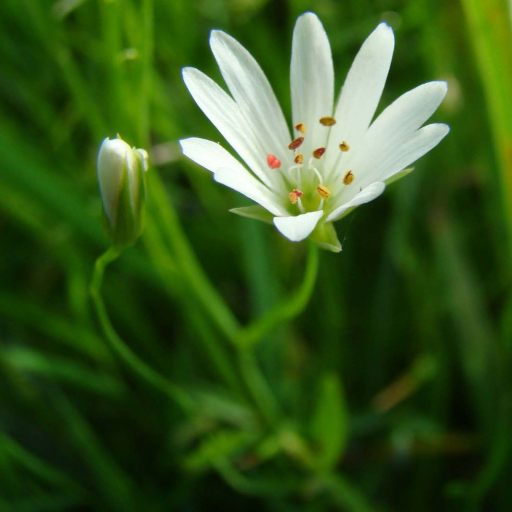
The Marsh Stitchwort, often referred to as the "Star of the Fens," is a delicate perennial that thrives where many other plants would struggle with "wet feet." This slender beauty is a classic indicator of healthy, untouched wetlands, painting damp meadows with a constellation of tiny, brilliant white blooms during the height of summer. Because it is increasingly rare in the wild due to habitat loss, spotting one is often a treat for conservationists and hikers alike.
🔍 How to Identify
- 🌸 Deeply Cleft Petals: The most striking feature is the flower; it has five white petals, but each is split so deeply toward the base that it looks like the plant has ten narrow petals.
- 🍃 Glaucous Foliage: Unlike its common garden cousins, the leaves of the Marsh Stitchwort have a distinctive waxy, blue-green or grayish hue (known as being "glaucous") and are very narrow and grass-like.
- 📐 Square, Scrambling Stems: The stems are relatively weak and slightly square in cross-section. It doesn't grow tall on its own but rather "scrambles" upward by leaning on sturdier surrounding grasses for support.
🏡 In Your Garden
- 💧 The "Soggy Root" Rule: If you are incorporating this into a bog garden or a wildlife pond edge, remember that it is a specialist. It requires soil that stays consistently moist to wet; it will wilt and fail almost immediately if the soil dries out during a heatwave.
- ☀️ Sun Seeker: While many stitchworts love the shade of a forest, Stellaria palustris craves light. It needs a spot with plenty of sun to produce its signature starry flowers, though it appreciates having its roots kept cool by the surrounding damp earth and mulch.
⚠️ Safety & Toxicity
- 🌿 Low Toxicity: The Marsh Stitchwort is generally considered non-toxic to humans and is not known for causing skin irritation upon contact.
- 🐾 Pet Sensitivity: While not classified as a "poisonous plant," members of the Stellaria genus contain saponins. If ingested in large quantities by cats, dogs, or horses, it could lead to mild digestive upset or lethargy. It is best to keep curious grazers away.
✨ Fun Fact
The name Stellaria is derived from the Latin word for "star," but this plant is also a biological "alarm bell." Because it is highly sensitive to changes in water levels and pollution, its sudden disappearance from a marsh often warns ecologists that the local water table is dropping or the ecosystem is becoming unhealthy.

Detailed Care Instructions
Stellaria palustris, also known as marsh stitchwort or bog stitchwort, is a small perennial plant that thrives in wet and boggy areas. Here are some tips on how to grow Stellaria palustris:
- Choose a suitable location: Stellaria palustris prefers moist, boggy soil and partial shade. Choose a planting location that mimics its natural habitat.
- Planting: Plant Stellaria palustris in the spring or fall. Dig a hole slightly larger than the root ball and place the plant in the hole. Backfill with soil and water thoroughly.
- Watering: Keep the soil consistently moist but not waterlogged. Water Stellaria palustris regularly, especially during dry spells.
- Fertilizing: Stellaria palustris does not require much fertilizer. You can add a slow-release fertilizer in the spring to help promote growth.
- Mulching: Mulch around the base of the plant to help retain moisture and suppress weeds.
- Pruning: Trim back any dead or damaged foliage to promote healthy growth.
- Propagation: Stellaria palustris can be propagated by division or seeds. Divide established plants in the spring or fall, or collect seeds from mature plants and sow them in the spring.
With proper care and maintenance, Stellaria palustris should thrive and spread in your garden.

Place in a bright room that is sun drenched almost all day. Or directly in a south-facing window.

Watering the Stellaria Palustris plant should be done consistently, ensuring that the soil remains consistently moist but not waterlogged. It is important to water the plant at the base and avoid getting water on the leaves to prevent the development of mold or disease. The plant prefers slightly acidic soil, so using rainwater or distilled water can help to maintain the ideal pH levels. Monitoring the moisture levels in the soil regularly and adjusting your watering schedule accordingly will help to keep the Stellaria Palustris healthy and thriving.
To fertilize the Stellaria Palustris plant, use a balanced, water-soluble fertilizer with an N-P-K ratio of 10-10-10 or similar. Dilute the fertilizer according to the manufacturer's instructions and apply it to the soil around the base of the plant, avoiding direct contact with the foliage. Fertilize the plant in the spring and summer months, following a regular watering schedule to prevent over-fertilization. Avoid using high-nitrogen fertilizers, as they can cause excessive foliage growth at the expense of flowering.
Stellaria palustris plants prefer to grow in moist, rich, well-draining soil. It is recommended to use a soil mixture that is slightly acidic to neutral in pH, with a pH range of 5.5 to 7.5 being ideal. Additionally, the soil should be rich in organic matter to provide the plant with essential nutrients for healthy growth. A mixture of peat moss, compost, and perlite can be used to create a well-balanced soil for Stellaria palustris plants. It is important to avoid using heavy clay soils that can become waterlogged, as this can lead to root rot and other issues for the plant. Regularly amending the soil with organic matter and providing adequate drainage will help ensure that the plant thrives in its growing environment.
To propagate this plant, one can start by collecting seeds from ripe seed capsules in the fall or early winter. These seeds can then be sown in a tray or container filled with a well-draining potting mix. Keep the soil consistently moist and place the tray in a location with indirect sunlight.
Another way to propagate this plant is through division. This can be done in the spring or fall by carefully digging up the plant and dividing the clumps into smaller sections, making sure each section has roots attached. Replant the divisions in prepared soil and water thoroughly.
Additionally, this plant can be propagated through stem cuttings. Take cuttings from healthy, non-flowering stems in the spring or summer. Remove any lower leaves and dip the cut end in rooting hormone before planting in a pot with well-draining soil. Keep the soil consistently moist and provide indirect sunlight to encourage root growth.








