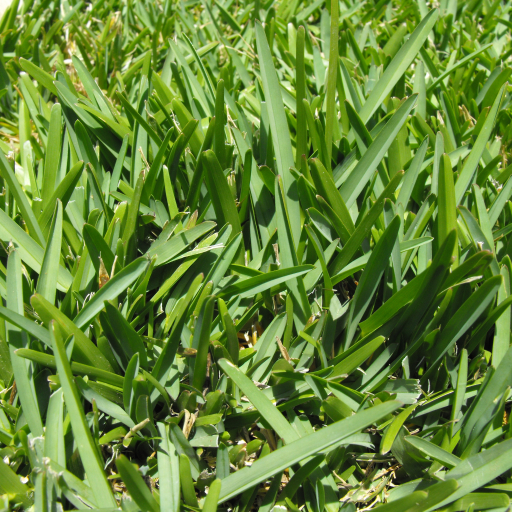
Plant Overview
Commonly known as St. Augustine Grass or "Charleston Grass," this robust perennial is the undisputed king of coastal lawns. Originating from the sandy shores of the Gulf of Mexico and the Mediterranean, it is famous for creating a thick, carpet-like turf that feels like a plush outdoor rug. While other grasses struggle in the shade or salty air, St. Augustine thrives, making it the go-to choice for beachside bungalows and tropical estates alike.
🔍 How to Identify
- 🍃 Blade Shape: The leaves are notably broad, coarse, and have a distinctively blunt, rounded tip rather than a sharp point.
- 🌱 Growth Habit: It spreads via thick, creeping runners called "stolons" that crawl across the surface of the soil, rather than growing from deep underground rhizomes.
- 🎨 Color & Texture: It maintains a deep, vibrant blue-green hue and feels slightly "spongy" underfoot due to the density of its mat-like structure.
🏡 In Your Garden
- 🌳 The Shade Specialist: Unlike most warm-season grasses that crave 24/7 sun, St. Augustine is exceptionally shade-tolerant. It is perfect for those tricky spots under large oak or maple trees where other turf species often wither away.
- 🌊 Salt & Thirst: This plant has a high "thirst" and requires regular watering during dry spells. However, its evolutionary history on the coast means it can handle salt spray better than almost any other backyard grass, making it a coastal favorite.
⚠️ Safety & Toxicity
- ✅ Pet & Child Friendly: St. Augustine Grass is considered non-toxic to humans, dogs, cats, and horses. It is a safe surface for play and lounging.
- 🌾 Skin Sensitivity: While not poisonous, the coarse texture of the blades and the "hairs" on the stolons can occasionally cause mild, itchy skin irritation for sensitive individuals or pets after rolling in the grass.
✨ Fun Fact
Because St. Augustine grass produces very few "fertile" seeds, you almost never see it sold in bags of seed. Instead, it is grown and sold as "sod" or "plugs"—essentially transplanting live pieces of a parent plant to start a new lawn!

Detailed Care Instructions
| Lighting | Full Sun |
| Hardiness Zones | 7B - 11 |
To grow Stenotaphrum secundatum, commonly known as St. Augustine grass or buffalo grass, you can follow these steps:
- Choose the right location: Stenotaphrum secundatum thrives in warm climates and grows best in full sun or partial shade. Ensure the soil is well-drained, as the plant does not tolerate excessive moisture or standing water.
- Prepare the soil: Before planting the grass, prepare the soil by removing any weeds, rocks, or debris. Loosen the soil with a garden tiller or a rake to a depth of 4-6 inches.
- Soil amendment: If the soil is poor in nutrients, you may need to amend it with organic matter like compost or well-rotted manure to provide the grass with essential nutrients and improve soil structure.
- Planting: Stenotaphrum secundatum can be established either from seeds or sod. Sodding is the most common method. Place the sod pieces on the soil surface and ensure they are firmly pressed against the soil. For seeds, sprinkle them evenly over the prepared soil.
- Watering: After planting, water the grass thoroughly to help the roots establish. Keep the soil consistently moist but not overly saturated. During the establishment period, water deeply but infrequently to encourage deep root growth.
- Fertilization: Apply a slow-release, nitrogen-rich fertilizer recommended for St. Augustine grass according to the package instructions. Avoid fertilizing during the winter months.
- Mowing: Stenotaphrum secundatum should be mowed at a height of about 2.5-4 inches. Regular mowing helps to promote healthy growth and discourage weed competition.
- Weed control: To keep weeds at bay, apply an appropriate herbicide, specifically labeled for use on St. Augustine grass, as necessary.
- Maintenance: St. Augustine grass requires routine maintenance, including regular watering, fertilizing, mowing, and pest control. Also, ensure proper aeration and dethatching when required.
- Overwintering: In areas with cool winters, Stenotaphrum secundatum may turn brown or go dormant during the winter months. Applying a winterizing fertilizer in the fall can help the grass prepare for winter and promote healthy growth once spring arrives.
Remember to consult with a local gardening expert or extension service for specific recommendations tailored to your region's climate and soil conditions.

Place in a bright room that is sun drenched almost all day. Or directly in a south-facing window.

Stenotaphrum Secundatum plant is best watered by pouring water over the soil in its container or the ground around it. It is important to ensure that the water reaches the roots of the plant and does not just stay on the surface of the soil. The plant should be watered when the top inch of the soil feels dry to the touch. However, care should be taken not to overwater the plant as this can lead to root rot. It is recommended to use a watering can or a hose with a gentle spray nozzle to water the plant. The frequency of watering will depend on various factors such as humidity, temperature, and the size and location of the plant.
- First, ensure that the soil is fertile, well-draining, and has a pH between 6.0 and 7.5.
- Apply a slow-release, balanced fertilizer with all essential nutrients in the recommended ratio for grasses.
- Apply the fertilizer evenly over the soil surface, using a spreader if necessary to ensure even distribution.
- Water the area immediately with enough water to help the fertilizer soak into the soil.
- Repeat fertilization every 6-8 weeks during the growing season (or as recommended on the fertilizer packaging), adjusting the amount as needed based on the growth and appearance of the plant.
Stenotaphrum Secundatum, commonly known as "buffalo grass," requires a well-draining soil with a slightly acidic to neutral pH level between 6.0 and 7.5. It prefers a soil that is rich in organic matter with good moisture retention. It can tolerate a wide range of soil types, but it grows best in sandy or loamy soils with good fertility. It is important to avoid using heavy soils or ones that are prone to waterlogging. The soil should be prepared by incorporating organic matter, such as compost or well-rotted manure, to a depth of at least 15cm to improve drainage and nutrient availability. Add a slow-release fertilizer to the soil during planting to promote growth and establishment.
One way to propagate this plant is by dividing its clump. This can be done by digging up the clump and carefully separating individual sections, making sure each section has roots and stems. These sections can then be replanted in their own separate pots or directly in the ground.
Another way to propagate this plant is by taking stem cuttings. Choose a stem that is healthy and has several leaves on it, and cut it at an angle just below a leaf node. Remove the lower leaves from the stem cutting, leaving only a few leaves at the top. Dip the end of the cutting in rooting hormone, and then plant it in a pot filled with moist soil. Keep the cutting in a warm and humid environment until it forms roots, and then it can be transplanted into a larger pot or directly in the ground.
A third way to propagate this plant is by seed. To collect seeds from the plant, wait until the flowers have bloomed and dried up. The seeds will be contained within the dried flower heads. Gently remove the seeds and plant them in a pot filled with moist soil. Keep the pot in a warm and humid environment until the seeds germinate and sprout. Then, they can be transplanted into a larger pot or directly in the ground.
Common pests of the st. augustine grass include Thrips. Make a habit of checking your st. augustine grass frequently for pests so that any infestations can be caught and managed early.








