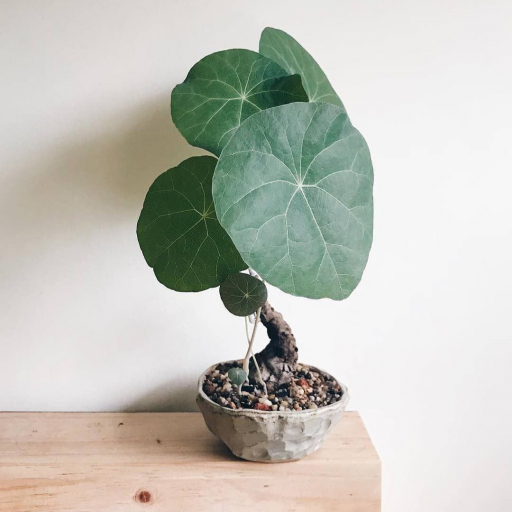
Plant Overview
Often referred to by its nickname "Stephania Nova," this rare and mesmerizing specimen is the crown jewel of the Thai forest. It grows from a rugged, corky base that looks like an ancient stone, eventually sprouting delicate vines topped with massive, shield-like leaves. Its dramatic contrast between the prehistoric "potato" base and the velvet-textured foliage makes it a favorite for minimalist interior design and serious plant collectors alike.
🔍 How to Identify
- 🥔 The Caudex: A large, woody, and often dark brown bulbous base that sits above the soil. Its texture is rough and fissured, resembling cracked earth or old bark.
- 🍃 The Foliage: Perfectly circular (peltate) leaves that can grow significantly larger than those of its cousin, Stephania erecta. The leaves feature a deep emerald-green color with a matte, velvety finish.
- 🕸️ Venation: Striking, pale-green or silvery veins radiate from the center of the leaf where the stem attaches, creating a starburst pattern that catches the light.
🏡 In Your Garden
- 💤 The Dormancy Dance: This plant is famous for its "nap time." If it suddenly drops all its leaves in the winter, do not toss it out! It is simply entering dormancy. During this time, it requires almost zero water; overwatering a dormant caudex is the fastest way to cause rot.
- ☁️ Humidity is Key: While the woody base looks tough, the leaves are quite delicate. They thrive in higher humidity levels. If the air is too dry, the edges of those beautiful circular leaves may turn crispy and brown.
- 🧗 Climbing Habit: Unlike many succulents, this is a vining plant. Providing a thin circular trellis or a bamboo stake allows the plant to show off its natural climbing instinct, creating a "floating leaf" effect.
⚠️ Safety & Toxicity
- 🚫 Status: Generally considered toxic if ingested.
- 🐾 Details: Like many members of the Menispermaceae family, it contains various alkaloids. Keep the plant on high shelves away from curious cats, dogs, or toddlers who might be tempted to nibble on the leaves or the "potato" base.
✨ Fun Fact
For years, this plant was sold under the placeholder name "Stephania sp. Nova" because it was so new to the botanical world. It wasn't until recently that it was officially described and named Stephania kaweesakii in honor of Thai botanist Kaweesak Keeratikiat.

Detailed Care Instructions
To grow Stephania Kaweesakii plant, you can follow these steps:
- Choose a healthy plant or obtain seeds: You can either obtain a young plant from a nursery or purchase seeds from a reputable supplier.
- Prepare a suitable growing medium: Choose a well-draining soil mix that is rich in organic matter. A mix of potting soil, sand, and perlite or vermiculite works well.
- Germinate the seeds (if applicable): If you are starting from seeds, soak them overnight in water to soften the outer shell and enhance germination. Sow the seeds in small pots or seed trays, covering them lightly with the soil mix. Maintain adequate moisture and warmth to encourage germination.
- Provide the right growing conditions: Stephania Kaweesakii prefers a warm and humid environment. Place the plant in a location with bright, indirect sunlight. Avoid direct sunlight as it may scorch the leaves. Maintain a temperature between 70-80°F (21-27°C).
- Water the plant appropriately: Keep the soil consistently moist, but not waterlogged. Allow the top inch of soil to dry out slightly between watering. Avoid overwatering as it can cause root rot.
- Provide adequate humidity: These plants thrive in high humidity. You can increase the humidity by placing the pot on a tray filled with water and pebbles or misting the plant regularly.
- Fertilize regularly: Feed the plant with a balanced liquid fertilizer once per month during the growing season (spring and summer). Follow the manufacturer's instructions for the correct dosage.
- Prune and support the plant: As the plant grows, consider staking or providing a trellis for support. Prune any dead or damaged leaves to maintain its appearance.
- Repot when necessary: When the plant outgrows its pot, move it to a slightly larger container with fresh soil mix. This is usually done every 1-2 years.
- Watch out for pests and diseases: Keep an eye out for common pests like aphids, mealybugs, or spider mites. If infested, treat with insecticidal soap or neem oil. Monitor the plant for any signs of disease, such as leaf spots or rot, and take appropriate action if necessary.
Remember to research and be familiar with any specific requirements or care instructions for Stephania Kaweesakii, as different plants may have slight variations in their growing conditions.

Place in a bright room that is sun drenched almost all day. Or directly in a south-facing window.

Stephania Kaweesakii is a plant that originates from Southeast Asia and is a member of the Menispermaceae family. To water this plant, first, ensure that it is planted in well-draining soil, as it does not tolerate standing water or overly wet roots.
When watering, it is important to avoid getting water directly on the plant's leaves or stem, as this can lead to rot and other diseases. Instead, water the plant at the soil level, aiming to moisten the soil evenly without overwatering.
The frequency of watering will depend on several factors such as the size of the plant, the humidity and temperature of the environment, and the amount of light it receives. As a general guideline, water the plant deeply every 7-10 days, allowing the soil to dry out slightly between watering.
It is also important to avoid letting the plant sit in standing water or allowing water to accumulate in the saucer beneath the pot. Empty any excess water after watering to prevent the roots from getting waterlogged.
- Choose a well-draining pot with lots of holes to allow excess water to drain away from the roots.
- Mix a balanced fertilizer, such as a 10-10-10 or 20-20-20, into the potting soil before planting.
- Water the plant deeply, allowing the excess to drain out of the pot's holes.
- Fertilize monthly during the growing season, which is typically spring and summer.
- Use a granular slow-release fertilizer, or a liquid fertilizer, following the manufacturer's instructions.
- Be cautious not to overfertilize, as this can burn and damage the plant.
- Aim to keep the soil moist but not soggy, and ensure that the plant gets enough light and warmth.
The ideal soil for the plant should be well-draining and nutrient-rich. A mixture of peat moss, perlite, and sand is recommended to provide adequate drainage and aeration for the roots. The pH level of the soil should be slightly acidic, around 6.0-6.5. It is important to avoid using heavy clay soils or soils that are prone to waterlogging as this can lead to root rot and other issues. A layer of organic mulch can be added to the surface of the soil to help retain moisture and provide additional nutrients as it breaks down over time.
To propagate this plant, obtain a healthy and mature stem cutting from the parent plant. Make sure the cutting is at least 6 inches long and has several nodes. Remove any leaves from the bottom half of the stem. Plant the cutting in a well-draining soil mix and water it thoroughly. Cover the cutting with a plastic bag or humidity dome to create a moist environment. Place it in a bright, indirect light until roots develop, which can take several weeks to a couple of months. Once the cutting has rooted, gradually acclimate it to its new environment by removing the covering and increasing the amount of light and ventilation.
Common pests of the stephania kaweesakii include Mealybugs, spider mites, aphids, thrips. Make a habit of checking your stephania kaweesakii frequently for pests so that any infestations can be caught and managed early.








