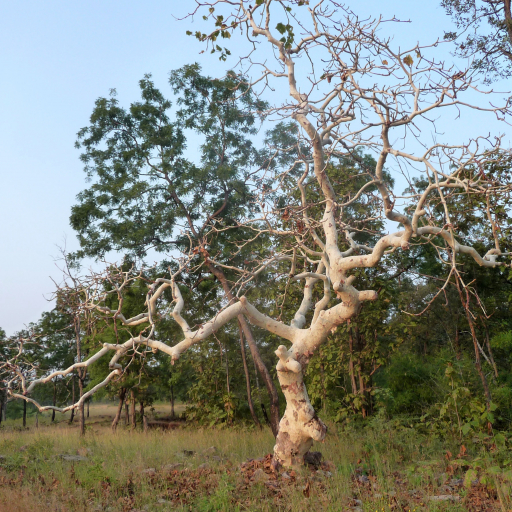
Plant Overview
Commonly known as the Ghost Tree or Gum Karaya, this striking deciduous tree looks like it belongs in a myth or a desert landscape painting. Its most famous feature is its smooth, shimmering bark that glows a ghostly white or pale pink in the moonlight, making it easy to spot in the dry, rocky forests of India. Beyond its eerie beauty, it is a vital industrial plant, producing a natural gum used in everything from dentures to ice cream.
🔍 How to Identify
- ⚪ The Bark: The most distinct feature; the bark is paper-thin, smooth, and peels off in large flakes to reveal a white, pinkish, or greenish under-layer.
- 🖐️ The Leaves: Large, hand-shaped (palmately lobed) leaves with five distinct points, usually clustered at the very ends of the thick, succulent branches.
- ⭐ The Seed Pods: Produces woody, star-shaped fruit pods that are covered in a dense, velvety layer of reddish-brown stinging hairs.
🏡 In Your Garden
- 🏜️ A Desert Survivor: This tree is a "caudiciform" lover’s dream; it thrives in poor, rocky, or gravelly soils where other plants might wither. It has evolved to survive extreme drought by storing moisture in its soft, pulpy wood.
- 🍂 Seasonal Change: Be prepared for its "naked" phase. The Ghost Tree is deciduous and will drop all its leaves during the dry season, leaving behind a beautiful, twisted white skeleton that acts as a dramatic focal point in a landscape.
⚠️ Safety & Toxicity
- 🌵 Physical Irritant: While the tree is not chemically poisonous, the seed pods are "stinging." They are covered in tiny, brittle hairs that can lodge in the skin or eyes, causing intense itching and irritation.
- 🐾 Pet Safety: Generally non-toxic if nibbled, but the fuzzy seed pods should be kept away from curious pets to avoid throat or skin irritation from the prickly hairs.
✨ Fun Fact
The bark of the Sterculia urens is so reflective that it was historically used by travelers in India as a natural "milestone" or beacon to navigate through the dark forest at night!

Detailed Care Instructions

Place in a bright room that is sun drenched almost all day. Or directly in a south-facing window.

Some plants require more regular watering than others, which should be done every few days. It's critical to maintain the soil moist all of the time. The water requirements of the same plant placed in pots with varying sizes will differ. Because the water in the smaller pot evaporates faster than the water in the larger pot, it will require more watering. Regardless of pot size, the surface should constantly be maintained moist.








