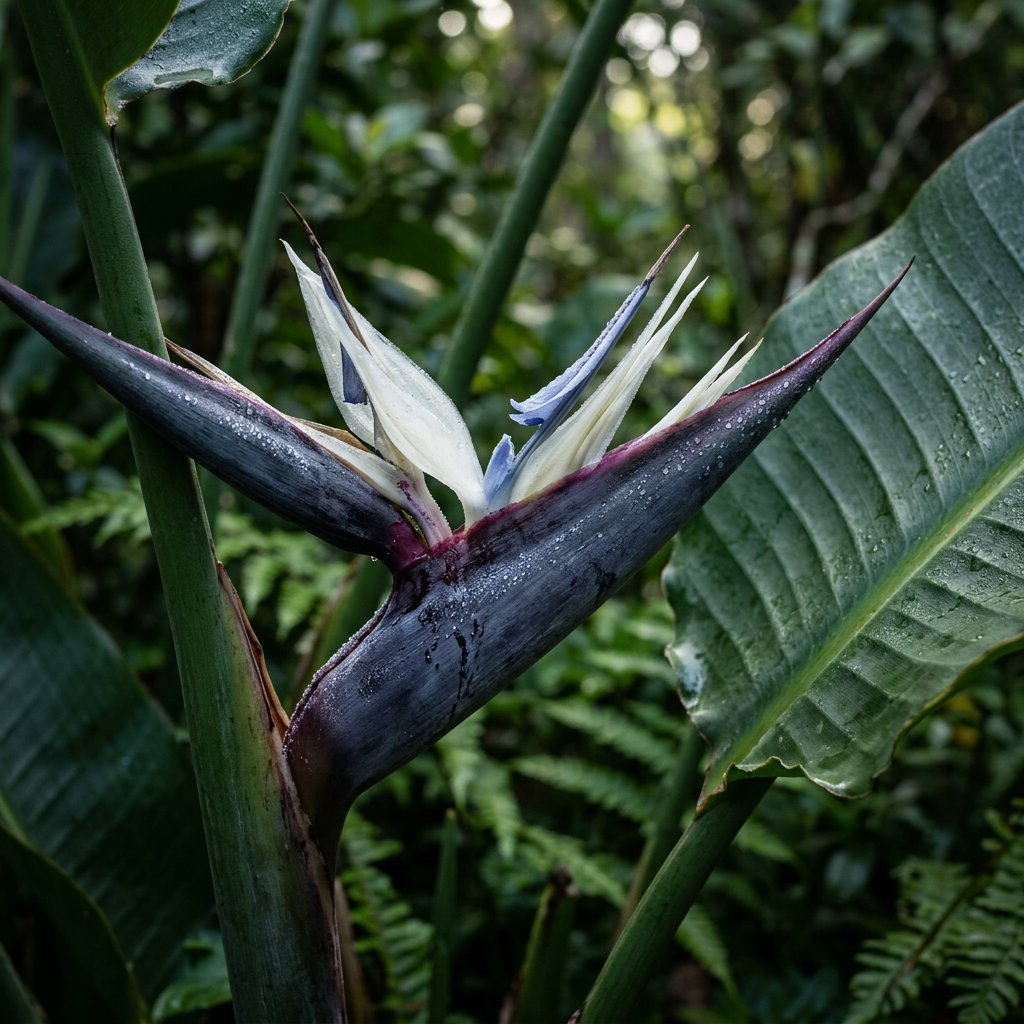
Plant Overview
Often referred to as the "Giant White Bird of Paradise" or "Wild Banana," Strelitzia nicolai is the architectural superstar of the indoor plant world. Native to the subtropical coastal forests of South Africa, it brings an immediate "urban jungle" vibe to any space with its massive, fan-like foliage. While it looks like a banana tree, it is actually a distant relative that trades edible fruit for stunning, bird-like blossoms.
🔍 How to Identify
- 🌿 The Foliage: Massive, paddle-shaped leaves that can reach up to 6 feet long. They are arranged in a distinct, vertical fan shape atop thick, woody stems.
- 🕊️ The Bloom: Unlike the common orange Bird of Paradise, this variety produces enormous, crane-like flowers with white sepals and midnight-blue "tongues" cradled in a dark purple-grey bract.
- 📏 Growth Habit: It is a vertical giant. Indoors, it can easily reach 10 feet tall, while in its native habitat, it can tower at 30 feet, eventually developing a tree-like trunk.
🏡 In Your Garden & Home
- ☀️ Light Requirements: This plant is a sun-worshipper. It needs bright, filtered light to maintain its structural integrity; without enough light, the stems may become "leggy" and lean dangerously toward the nearest window.
- 💨 The "Shabby Chic" Leaf: Don't panic if the leaves split! In the wild, these slits allow wind to pass through the leaves without catching them like a sail and snapping the trunk. Indoors, avoid high-traffic areas where brushing against the leaves might accelerate this natural tearing.
- 💧 Thirsty but Picky: While it loves humidity and regular watering during the summer, it hates "wet feet." Ensuring well-draining soil is vital because its thick, fleshy roots are prone to rot if kept in standing water.
⚠️ Safety & Toxicity
- 🚫 Status: Toxic to pets and humans.
- 🐶 Details: The plant contains tannins and substances that can cause mild to moderate digestive upset. If ingested by cats, dogs, or curious children, it may lead to nausea, vomiting, and drowsiness. The seeds are considered the most toxic part.
✨ Fun Fact
The species was named nicolai in honor of Grand Duke Nikolai Nikolaevich of Russia (the elder), who was a patron of the botanical gardens in St. Petersburg during the mid-19th century!

Detailed Care Instructions
| Humidity | High |
| Lighting | Full Sun |
| Toxicity | Poisonous |
| Difficulty | Medium |
| Hibernation | Cold Period |
| Temperature | 18°C - 22°C |
| Hardiness Zones | 10 - 11 |
To grow a Strelitzia Nicolai plant, also known as the giant white bird of paradise or wild banana, you can follow these steps:
- Choose a suitable location: Strelitzia Nicolai plants need lots of sunlight, so choose a spot that receives full or partial sun for at least 6 hours a day. The plant also requires ample space as it can grow quite large, so make sure you have enough room for it to spread out.
- Prepare the soil: Strelitzia Nicolai plants prefer well-draining soil. Mix organic matter, like compost or peat moss, into the soil to improve its drainage and fertility. This plant can tolerate a wide range of soil pH levels but does best in slightly acidic to neutral soil.
- Plant the seeds or division: Strelitzia Nicolai plants can be grown from seeds or by dividing an existing plant. If using seeds, soak them in warm water for a day before planting. Plant them about 1 inch deep in the soil and keep them consistently moist until they germinate.
If using division, carefully separate a portion of the plant that has its own roots from the parent plant. Plant the division in a large container or directly in the ground.
- Watering: Keep the soil evenly moist but not waterlogged. During the growing season, water your Strelitzia Nicolai plant regularly, allowing the top inch of soil to dry out between watering. Reduce watering during the dormant period to prevent root rot.
- Fertilize: Apply a slow-release, balanced fertilizer every two to three months during the growing season to provide essential nutrients. Avoid over-fertilizing, as it can damage the plant.
- Pruning: Prune any damaged or dead leaves to maintain the plant's appearance. You can also prune back overgrown stems to control its size. However, pruning is not necessary for the plant's health.
- Protection from cold: Strelitzia Nicolai plants are sensitive to cold temperatures and frost. If you live in a colder climate, consider growing it in a large container so you can move it indoors during winter or protect it with frost cloth or a cold frame.
By following these steps and providing proper care, your Strelitzia Nicolai plant should thrive and grow into a beautiful, tropical accent in your garden or home.

Place in a bright room that is sun drenched almost all day. Or directly in a south-facing window.

Watering the plant requires a consistent regimen. One thing to always keep in mind is to monitor the soil moisture level around the plant. Checking the soil every other day, or once a week, is a good place to start. This plant thrives in moderately moist soil, so make sure the soil dries out between waterings.
When you water the plant, watering deep is ideal to get the water to reach the roots. To do this, use a watering can or a hose to direct water toward the soil at the base of the plant and slowly soak the surrounding soil. Be sure to avoid getting too much water on the leaves, as it may cause fungal disease.
It’s a good idea to avoid using cold water to water the plant, as this can shock the plant and cause root damage.
Lastly, make sure there is a drainage hole in the pot or container. This allows excess water to drain out so that the plant doesn't sit in standing water, which can lead to root rot.
To fertilize this plant, use a balanced fertilizer with equal parts nitrogen, phosphorus, and potassium. Apply the fertilizer once a month during the growing season, which is typically spring and summer. Use a dilute solution of fertilizer and water the plant thoroughly, making sure the soil is moist but not waterlogged. Avoid over-fertilizing as it may cause burns and damage to the plant. Additionally, it is recommended to stop fertilizing during the winter months when the plant is dormant.
Strelitzia Nicolai plant requires a well-draining soil mix that contains a blend of organic matter such as peat moss, compost, and sand. The soil mix should retain moisture without becoming waterlogged. It is important to avoid using heavy soils that do not allow for adequate drainage. A slightly acidic soil with a pH range between 6.0 to 6.5 is ideal for this plant. It is recommended to add perlite or vermiculite to the soil mix to increase drainage and aeration. Additionally, it is important to repot the plant every few years to allow it to continue to grow and thrive.
To propagate this plant, you will need to obtain a healthy specimen with several mature leaves. Cut a section of stem approximately 4-6 inches in length, ensuring that it has at least one node (where a leaf or branch emerges). Remove any leaves from the bottom 2 inches of the stem to expose the node.
Next, prepare a pot with well-draining soil mix and moisten it slightly. Dip the cut end of the stem into rooting hormone powder, ensuring it is evenly coated. Then, insert the stem into the soil mix, burying it up to the first node.
Place the pot in a warm and bright location, but out of direct sunlight. Water the soil lightly as needed to keep it consistently moist but not waterlogged.
After a few weeks, you should see signs of root growth from the buried node. At this point, you can start tapering back on watering and allow the soil to dry slightly before watering again. When the plant has established a good root system and new foliage growth, you can transplant it into a larger pot or garden bed according to your preference.
Common pests of the white bird-of-paradise tree include Scale insect, mealybugs, spider mites. Make a habit of checking your white bird-of-paradise tree frequently for pests so that any infestations can be caught and managed early.








