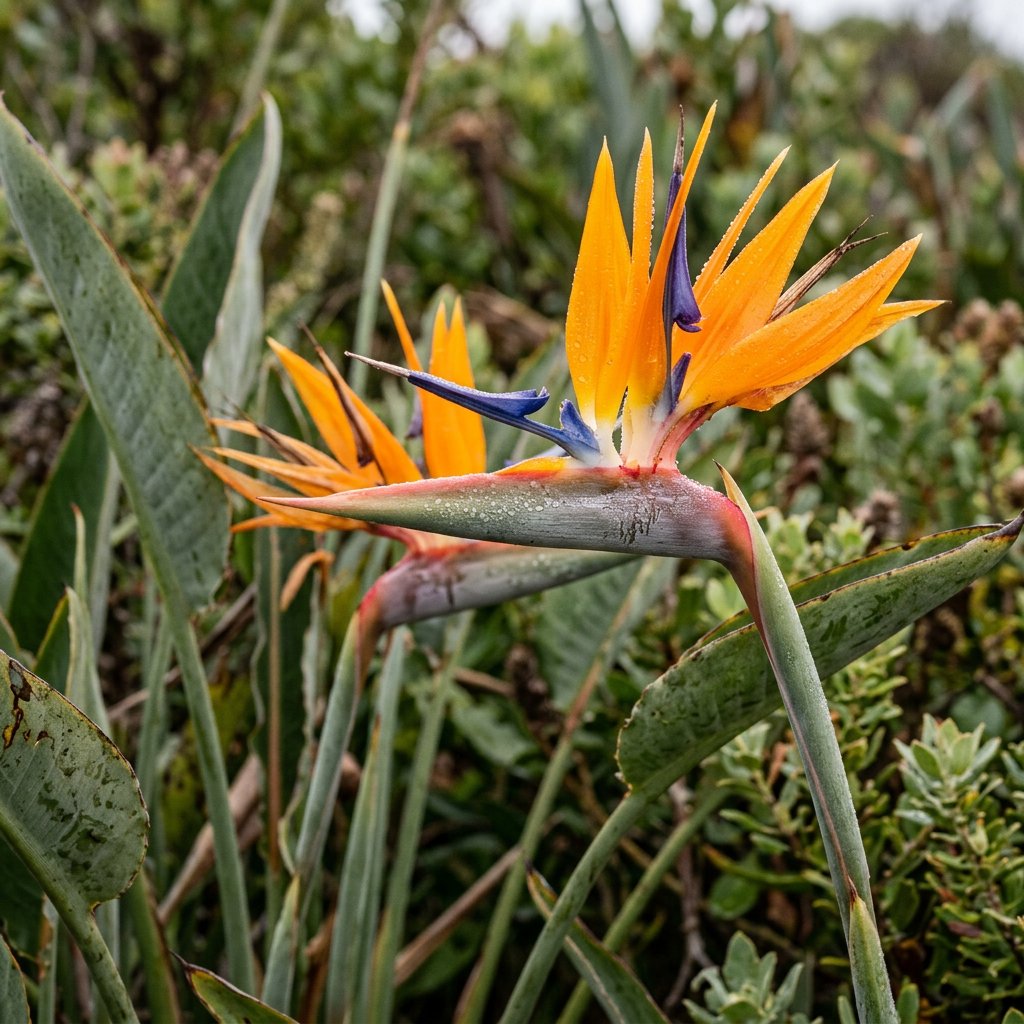
Plant Overview
Often called the "Bird of Paradise" or "Crane Flower," the Strelitzia is the undisputed royalty of the tropical garden. Named in honor of Queen Charlotte of Mecklenburg-Strelitz, this South African native doesn't just grow leaves; it puts on a theatrical performance. Its spectacular blooms look exactly like the head of an exotic bird poised for flight, making it one of the most recognizable plants in the world.
🔍 How to Identify
- 🌿 Paddle Leaves: Large, leathery, evergreen leaves that resemble banana foliage but are much tougher and arranged in a distinct fan-like spray.
- 🧡 The "Crest": Striking orange sepals and deep blue petals that emerge from a stiff, beak-like green bract called a "spathe."
- 🏗️ Architectural Form: A clumping growth habit that creates a dense, upright structure, making it a favorite for "jungle-vibe" interior design and landscaping.
🏡 In Your Garden
- ☀️ Sun Worshiper: While it tolerates partial shade, you won't see those iconic "birds" unless it gets plenty of bright, direct sunlight. Indoors, it needs a spot right next to a south-facing window.
- 🪴 Patient Roots: This plant actually prefers to be slightly root-bound to encourage blooming. It hates being moved, so avoid frequent repotting, as its thick, fleshy roots are surprisingly sensitive to disturbance.
- 💧 Humidity & Air: It loves a humid environment but needs good air circulation. If the air is too stagnant or dry, you might notice the leaf edges turning brown or "splitting" (which is actually a natural adaptation to wind in the wild).
⚠️ Safety & Toxicity
- 🐾 Toxic to Pets: Strelitzia is considered mildly toxic to cats, dogs, and horses. Ingestion can lead to nausea, vomiting, and drowsiness.
- 👶 Human Caution: While beautiful, the seeds and leaves can cause stomach upset in children if eaten. It is best kept as a "look but don't touch" centerpiece.
✨ Fun Fact
🐦 A Living Landing Pad: In its native South Africa, the flower is specifically engineered for bird pollination. The blue petals act as a sturdy perch for Sunbirds. When a bird lands to drink nectar, the petals open under its weight, dusting the bird’s feet with pollen to be carried to the next flower!

Detailed Care Instructions
To grow Strelitzia plants (also known as Bird of Paradise), follow these steps:
- Choose a suitable location: Strelitzia plants require a sunny spot with indirect sunlight. The plant should be protected from strong winds. If you are growing them indoors, place them near a window that receives bright, indirect light.
- Soil and potting: Strelitzia plants thrive in well-draining soil. Use a mixture of potting soil, sand, and perlite for good drainage. When potting, make sure to choose a pot with drainage holes.
- Watering: Water the plant thoroughly but allow the top inch of soil to dry out between waterings. Avoid overwatering, as it can lead to root rot. During the winter, reduce watering frequency.
- Fertilizer: Feed Strelitzia plants with a balanced, water-soluble fertilizer once a month during the growing season (spring and summer). Follow the instructions on the fertilizer package for correct dosage.
- Pruning: Remove any dead, damaged, or yellowing leaves regularly to maintain the plant's appearance. You can also prune old flower stems after they finish blooming.
- Propagation: Strelitzia plants can be propagated by division or from seeds. Division is the most common method. Carefully divide the plant during the spring, ensuring that each division has a healthy rhizome with roots. Plant the divisions in separate pots.
- Temperature and humidity: Strelitzia plants prefer warm temperatures between 65-80°F (18-27°C). They tolerate average room humidity, but appreciate higher humidity levels. Mist the leaves with water occasionally to increase humidity, especially if the air is dry.
- Pests and diseases: Strelitzia plants are generally resistant to pests and diseases. However, watch out for mealybugs, aphids, and scale insects. Treat any infestations with insecticidal soap or neem oil.
- Support: As the Strelitzia plant grows, it may require staking or support for the larger leaves to prevent them from drooping.
- Repotting: Strelitzia plants prefer slightly crowded conditions, and they don't need frequent repotting. However, if the roots start to circle the pot or if the plant becomes too large for its current container, it may be time to repot into a slightly larger pot.
By following these steps, you should be able to successfully grow Strelitzia plants and enjoy their beautiful, tropical foliage and vibrant flowers.

Place in a bright room that is sun drenched almost all day. Or directly in a south-facing window.

To water this tropical plant, it is important to ensure that the soil is well-drained. This can be achieved by using a potting mix that contains a good proportion of perlite or sand. Watering should be done when the top inch of soil feels dry to the touch. It is important not to over-water the plant as this can lead to root rot. Watering should be done thoroughly, allowing the water to soak into the soil and drain out of the bottom of the pot. It is also important to avoid getting water on the leaves as this can lead to fungal disease.
- Begin by selecting a balanced fertilizer suitable for indoor plants.
- Dilute the fertilizer according to the instructions on the package.
- Apply the fertilizer to the soil, ensuring that it does not come into contact with the leaves or stem of the plant.
- Water the plant thoroughly after fertilizing.
- Repeat fertilization every 4-6 weeks during the growing season (spring and summer).
- In the fall and winter, reduce fertilization to once a month.
- Watch for signs of over-fertilization, such as burned or yellowing leaves, and adjust the frequency and amount of fertilizer as necessary.
Strelitzia plants prefer well-draining soil with good water retention capacity. The soil should be slightly acidic with a pH ranging from 5.5 to 6.5. A mixture of garden soil, sand, peat moss, and perlite or vermiculite can be used to provide the right texture and drainage. The soil should be rich in organic matter and should not contain too much clay or sand. It is important to ensure that the soil is well-aerated to prevent waterlogging and root rot. Adding compost or aged manure to the soil can provide additional nutrients to the plant. It is recommended to repot the plant every 2-3 years with fresh soil to prevent nutrient depletion and maintain good health.
There are a few methods to propagate this plant.
One way is through seed propagation. To do this, harvest seeds from mature plants and soak them in warm water for a day or two. Then, plant them in well-draining soil and keep them moist. Germination can take anywhere from a few weeks to a few months.
Another method is through division. Carefully remove the plant from its pot and gently separate the roots into smaller clumps. Plant these clumps in their own pots or directly into the ground.
The third method is through stem cuttings. Take a stem cutting from the main plant, making sure it has at least one node (where a leaf attaches to the stem). Remove any leaves that are on the lower half of the stem, and dip the cut end into rooting hormone. Plant the cutting into well-draining soil and keep moist. In a few weeks, roots should begin to form and a new plant will grow.







