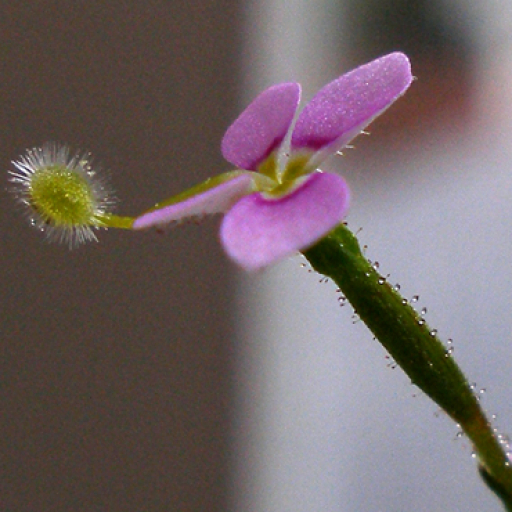
Plant Overview
Often called the Frazer’s Triggerplant, this small Australian native hides a high-speed mechanical secret within its delicate blossoms. While it looks like a simple, charming wildflower, it is actually an active participant in its own pollination, using a spring-loaded "arm" to interact with insects. It is a favorite among collectors of unusual plants due to its dainty rosettes and "sentient" behavior.
🔍 How to Identify
- 🌸 The "Trigger": Look closely at the center of the pink flower. You will see a curved column (the trigger) tucked back like a loaded spring, ready to snap forward when touched.
- 🍃 Rosette Form: The plant grows as a low, flat rosette of spoon-shaped, bright green leaves that hug the ground.
- 📏 Flower Spikes: Delicate, wiry stems rise about 6–10 inches above the foliage, carrying clusters of four-petaled, mauve-to-pink flowers.
🏡 In Your Garden
- 💧 The Bog Life: In its natural habitat, it thrives in sandy, moist heaths. If growing at home, use a mix of peat moss and perlite, and keep the "feet" of the plant damp by sitting the pot in a small tray of distilled water.
- 🦟 Sticky Stems: You may notice tiny droplets on the flower stalks. These are glandular hairs that can trap small gnats. While not a "true" carnivore like a Venus Flytrap, it is considered protocarnivorous, as it may absorb nutrients from these trapped insects.
⚠️ Safety & Toxicity
- ✅ Safe for All: Stylidium debile is non-toxic to humans, cats, and dogs.
- 🤏 Handle with Care: The plant is physically fragile. While the "trigger" mechanism is fun to watch, triggering it manually too often can exhaust the plant's energy and reduce the lifespan of the individual flower.
✨ Fun Fact
The trigger mechanism is one of the fastest movements in the plant kingdom! When an insect lands to search for nectar, the column swings around in roughly 15 milliseconds—faster than the blink of a human eye—to "slap" the insect with a payload of pollen.

Detailed Care Instructions

Place in a window with dappled sun or a spot in the middle of a room. Or directly in a window facing west or east.

The presence of a dry surface layer of soil does not indicate that the plant requires water. Instead, stick your finger 1-2" (3-5 cm) deep in the soil to feel dampness or moisture content. If the soil seems dry, it's time to water your greens. If the soil is still moist, however, it is better not to water your plant and instead wait a day or two. Overwatering or waterlogging raises the risk of root rot. So if the soil takes longer than a week to dry, check the light conditions because it's likely that the plant isn't getting enough light. It's fine if the upper layer of soil is dry between waterings, but the deeper soil layer should always have some moisture.
These plants can thrive without taking help from any fertilizer. However, if the medium of growth is something other than soil for instance sand then you may need to add little fertilizer. The best way to know if your plants need fertilizer or not is to check for yellowing of leaves. If the leaves start to turn yellow it’s fertilizing time.
You may use Carnivore Fertilizer for your Frail Triggerplant








