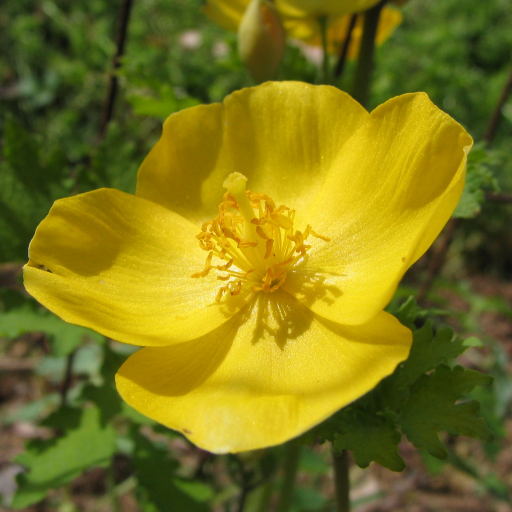
Plant Overview
Known affectionately as the Celandine Poppy or Wood Poppy, this native North American treasure is a burst of liquid sunshine for the shade garden. While most poppies demand the scorching sun, this woodland beauty thrives under the cool canopy of deciduous trees. It is a storyteller of the spring, signaling the end of winter with its brilliant golden petals and lush, lobed foliage.
🔍 How to Identify
- 🌼 Golden Blooms: It features large, four-petaled flowers of a deep, buttery yellow that can reach up to two inches across.
- 🍃 Lacy Foliage: The leaves are a soft blue-green, deeply lobed and divided, giving the plant a delicate, fern-like silhouette.
- ☁️ Fuzzy Seed Pods: After the flowers fade, they are replaced by nodding, oval-shaped seed capsules covered in distinct, soft silvery hairs.
- 🧪 Yellow Latex: If you break a stem or leaf, the plant bleeds a thick, bright yellow-to-orange sap, a key trait of the poppy family.
🏡 In Your Garden
- 🌳 The Shade Specialist: This is the perfect candidate for a "wild" or woodland-style garden. It prefers rich, moist, organic soil—think of the decaying leaf mold found on a forest floor.
- 💤 Summer Dormancy: Don't panic if your plant disappears in August! If the soil gets too dry or the heat too intense, the Celandine Poppy will often go dormant to protect itself, tucked away safely underground until next spring.
- 🌱 Friendly Spreader: It self-seeds quite readily. If you give it the right damp, shady conditions, it will naturally colonize an area, creating a stunning golden carpet over several seasons.
⚠️ Safety & Toxicity
- 🚫 Toxic if Ingested: The plant contains isoquinoline alkaloids. It is considered toxic to both humans and pets (cats, dogs, and horses) if eaten, usually causing digestive upset.
- 🧤 Skin Irritation: That vibrant yellow sap can be a skin irritant for some people. It’s a good idea to wear gloves if you are dividing the plant or clearing old foliage.
- 🦌 Deer Resistant: Because the sap is bitter and mildly toxic, deer and rabbits almost always leave this plant completely alone.
✨ Fun Fact
Native Americans historically used the potent, staining sap of the Celandine Poppy as a natural dye for baskets and clothing, and even as a colorful body paint for ceremonies!

Detailed Care Instructions
To grow Stylophorum diphyllum, also known as Celandine poppy, follow these steps:
- Choose a suitable location: Select a spot in your garden that receives partial shade to full shade. Celandine poppies prefer cool, moist conditions and cannot tolerate prolonged exposure to direct sunlight.
- Prepare the soil: The plant prefers fertile, well-draining soil. Amend the soil with organic matter like compost to provide nutrients and improve drainage.
- Planting: Dig a hole twice the size of the root ball of the plant. Place the Stylophorum diphyllum in the hole, making sure the plant is at the same level as it was in the pot. Backfill the hole with soil and gently firm it around the plant.
- Watering: Water the plant thoroughly after planting and maintain regular watering throughout the growing season. Celandine poppies need consistently moist soil, so monitor the moisture level and water as needed. However, avoid overwatering as it can lead to root rot.
- Mulching: Apply a layer of mulch around the base of the plant to help retain moisture and suppress weed growth. Use organic materials like bark chips or straw for mulching.
- Fertilizing: Celandine poppies do not require heavy feeding. However, you can apply a balanced, slow-release fertilizer in spring to provide a gentle nutrient boost.
- Pruning: Trim back the plant after it finishes flowering to remove spent blooms and maintain a tidy appearance. This will also encourage bushier growth.
- Propagation: Stylophorum diphyllum can be propagated through division or by sowing seeds in early spring. Divide clumps every few years to promote healthier growth.
- Pest and disease control: Celandine poppies are generally resistant to pests and diseases. However, keep an eye out for common garden pests like slugs or snails, and take appropriate measures to control them if necessary.
By following these guidelines, you can successfully grow Stylophorum diphyllum and enjoy its bright yellow flowers and attractive foliage in your garden.

Place in a window with dappled sun or a spot in the middle of a room. Or directly in a window facing west or east.

To water this plant, make sure the soil is slightly dry before watering. When watering, avoid getting water on the foliage and instead focus on watering the soil directly. Use a watering can or hose with a gentle spray nozzle to avoid disturbing the soil around the plant. Water slowly and evenly until the soil is moist but not waterlogged. Monitor the soil moisture regularly and adjust your watering schedule as needed. It is important not to over-water this plant.
To fertilize this plant, apply a balanced, slow-release fertilizer in early spring just before new growth emerges. Follow the manufacturer's instructions regarding application rates and frequency. Avoid over-fertilizing, as this can harm the plant and lead to excessive foliage growth at the expense of flowers. If the soil is already high in nutrients, skip fertilization until the following year.
Stylophorum Diphyllum grows best in well-draining soil that is rich in organic matter. The soil should be moist but not waterlogged, as this can lead to root rot. It prefers soil that is slightly acidic to neutral with a pH between 5.5 and 7.0. Adding compost or other organic matter to the soil can improve its texture and fertility. It is important to avoid compacted soil, as this can prevent the plant from receiving adequate oxygen and hinder its growth. A layer of mulch can help to maintain moisture levels and regulate soil temperature.
To propagate this plant, take stem cuttings in late spring or early summer. Choose a healthy stem that has several nodes, and cut it at a 45-degree angle, just below a node. Remove any leaves from the bottom half of the cutting.
Dip the cut end of the stem into rooting hormone and plant it in a well-draining soil mixture. Water the cutting well and cover it with a plastic bag or create a miniature greenhouse to help retain moisture. Place the pot in a bright but indirect light.
Within a few weeks, the cutting should begin to develop roots. Once the roots are well-established, transplant the new plant into its own pot or directly into the ground. Keep the soil consistently moist and provide occasional fertilizer to promote growth.








