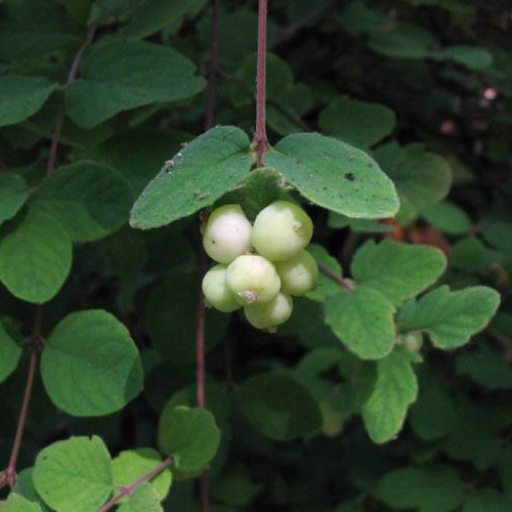
Plant Overview
Often called the Creeping Snowberry, this humble shrub is a master of the forest floor across Western North America. Unlike its upright cousins, Symphoricarpos mollis stays low to the ground, creating a soft, textural carpet that transforms throughout the seasons. It is most famous for its ghostly white "pop" berries that linger on bare winter branches like tiny ornaments left behind by woodland spirits.
🔍 How to Identify
- 🍃 The Foliage: The leaves are small, oval, and noticeably "fuzzy" or velvety to the touch—hence the name mollis, which is Latin for soft.
- 🌸 The Flowers: In late spring, look for tiny, bell-shaped blossoms that range from creamy white to a delicate shell-pink, usually hidden tucked among the leaves.
- ⚪ The Berries: Its most distinct feature is the cluster of white, waxy drupes that appear in late summer. These berries have a spongy, marshmallow-like texture when squeezed.
- 🌱 Growth Habit: This plant rarely exceeds 2 feet in height; instead, it spreads horizontally, trailing its thin, woody stems across the soil.
🏡 In Your Garden
- ⛰️ Erosion Expert: Because of its "creeping" nature and ability to root where branches touch the soil, it is a fantastic choice for stabilizing shady slopes or banks where grass refuses to grow.
- 🕊️ Wildlife Magnet: While humans shouldn't snack on them, the berries are a vital winter food source for birds like thrushes and towhees, while the flowers provide nectar for bees and butterflies.
- 💧 Shade Tolerant: It thrives in the "difficult" spots of a garden—dry shade under large trees. It is remarkably drought-tolerant once established because its native habitat involves surviving under the canopy of towering oaks and pines.
⚠️ Safety & Toxicity
- 🚫 Edibility: While the berries look like little treats, they are not for human consumption. They contain saponins, which give them a bitter taste and can cause stomach upset or vomiting if eaten in quantity.
- 🐾 Pets & Kids: The plant is generally considered low-toxicity, but it’s best to keep curious toddlers and pets from "sampling" the white berries, as they can cause mild digestive distress and nausea.
✨ Fun Fact
Native American tribes traditionally used the branches of the Snowberry to create fine-grained, sturdy brooms, and the crushed berries were sometimes used as a soothing topical wash for skin sores or "road rash."

Detailed Care Instructions
To grow Symphoricarpos mollis, also known as the creeping snowberry or creeping five-fingers, follow these steps:
- Choose a suitable location: The plant prefers full sun to partial shade, so select a spot in your garden that receives at least 6 hours of sunlight per day.
- Prepare the soil: Snowberry plants adapt to various soil types but prefer well-draining soil. Amend the soil with organic matter, such as compost, to improve drainage if necessary.
- Planting: Dig a hole that is slightly larger and deeper than the plant's root ball. Place the plant in the hole and fill it with soil, gently pressing it down to eliminate air pockets. Leave a slight depression around the plant to hold water.
- Watering: Water the plant thoroughly after planting to settle the soil. Afterwards, provide regular watering, especially during dry periods. Aim to keep the soil consistently moist but not saturated.
- Mulching: Apply a 2-3 inch layer of organic mulch, like wood chips or straw, around the snowberry plant. Mulch helps to conserve moisture, suppress weeds, and regulate soil temperature.
- Pruning: Prune the plant in late winter or early spring before new growth begins. You can remove any dead, damaged, or overgrown branches to promote a more compact and healthy growth habit.
- Fertilizing: Although not necessary, you can apply a slow-release balanced fertilizer in early spring to encourage new growth. Follow the instructions on the fertilizer package for application rates.
- Maintenance: Monitor the plant for pests and diseases like aphids or powdery mildew. Spray or treat the affected areas accordingly.
- Propagation: If desired, you can also propagate snowberry plants by collecting and planting the seeds or by taking stem cuttings during late spring or early summer.
By following these guidelines, you should be able to successfully grow Symphoricarpos mollis in your garden.

Place in a window with dappled sun or a spot in the middle of a room. Or directly in a window facing west or east.

To water this plant, it is important to ensure that the soil is moist but not waterlogged. One way to do this is by checking the soil with your finger; if it feels dry to the touch, it is time to water. When watering, it is best to use a watering can or hose and direct the water towards the base of the plant, avoiding the leaves and stems. It is advisable to water early in the day to allow the plant to soak up the moisture before any evaporation occurs. In dry weather conditions, the plant may require more frequent watering, but it is important not to overwater it, as this can lead to root rot.
To fertilize this plant, you should use a balanced fertilizer with a ratio of 10-10-10 or 12-12-12. Apply the fertilizer at the base of the plant, avoiding getting any on the leaves or stems. Water the plant after fertilizing to ensure the nutrients are absorbed by the roots. Fertilize the plant once in the spring and once in the summer, following the recommended dosage on the fertilizer package.
Symphoricarpos Mollis plants thrive in well-drained soil that is rich in organic matter. A soil mixture that is slightly acidic to neutral pH is ideal for these plants. It is recommended to use a loamy soil that is well-draining, as overly wet soil can lead to root rot and other issues. Adding compost or aged manure to the soil can help improve its structure and fertility, providing the necessary nutrients for healthy plant growth. Additionally, incorporating a slow-release fertilizer into the soil can help ensure that the plant receives a steady supply of nutrients throughout the growing season. Overall, choosing a high-quality soil that is well-drained and rich in organic matter is essential for the successful cultivation of Symphoricarpos Mollis plants.
For best results, you may also want to consider planting Symphoricarpos Mollis in a location that receives full to partial sun exposure and is protected from strong winds. Proper soil preparation is key to ensuring that the plant has the necessary nutrients, moisture, and drainage to thrive and produce beautiful blooms and foliage.
Propagation of this plant can be achieved by taking softwood or hardwood cuttings, which can be obtained by carefully removing portions of stem from the parent plant. The cuttings should be taken in the spring or fall, when the plant is actively growing, and should be between 4 and 6 inches long. The lower leaves should be removed, and the cuttings should be placed in a planting medium that is well-draining, such as sand or vermiculite. The cuttings should be kept moist and in a warm, humid environment, such as under a plastic dome or in a misting chamber. Once new growth appears, the cuttings can be transplanted into individual pots or directly into the garden. They should be watered regularly and protected from harsh weather conditions until they are established.








