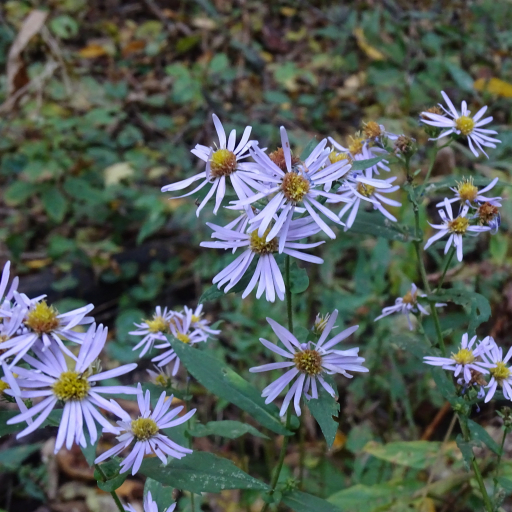
Plant Overview
Known affectionately as the Zigzag Aster, Symphyotrichum prenanthoides is a delightful woodland native that looks like it was designed by a playful architect. Often found dancing along stream banks or tucked into moist forest edges across Eastern North America, this aster is famous for its "crooked" stems and its ability to bring a soft, blue-violet haze to the late-summer garden just as other plants begin to fade.
🔍 How to Identify
- 〰️ The Zigzag Stem: Its most iconic trait; the smooth stem takes a sharp, noticeable turn at every leaf node, creating a distinct "staircase" or zigzag appearance.
- 🍃 Clasping Leaves: The long, lance-shaped leaves have a unique "waist"—they narrow near the base and then widen again to wrap almost entirely around the stem.
- 🌸 Pale Star-Flowers: Clusters of delicate blooms featuring 15–30 thin, pale violet or lavender rays surrounding a central disk that shifts from yellow to a deep reddish-purple as it matures.
🏡 In Your Garden
- 💧 Moisture Lover: This species is a "wet-feet" enthusiast. It thrives in damp, rich soils and is an excellent candidate for rain gardens or those tricky, low-lying spots in your yard that stay moist.
- 🌳 Shade Tolerance: Unlike many of its sun-loving aster cousins, the Zigzag Aster is perfectly happy in dappled sunlight or partial shade, making it a valuable tool for naturalizing woodland borders.
- 🏃 A Gentle Spreader: It moves through the garden via underground rhizomes. While it isn't "invasive," it will happily form a lush colony over time if left to its own devices.
⚠️ Safety & Toxicity
- ✅ Non-Toxic Status: The Zigzag Aster is generally considered safe and non-toxic for humans, dogs, and cats.
- 🦋 Pollinator Friendly: While safe for your pets, it is "dangerously" attractive to late-season pollinators. It serves as a vital nectar source for migrating Monarch butterflies and native bees preparing for winter.
✨ Fun Fact
The species name prenanthoides means "resembling Prenanthes" (Rattlesnake Root). Botanists gave it this name because its unique, clasping leaves look almost identical to that unrelated genus, even though their flowers are completely different!

Detailed Care Instructions

Place in a bright room that is sun drenched almost all day. Or directly in a south-facing window.

Some plants require more regular watering than others, which should be done every few days. It's critical to maintain the soil moist all of the time. The water requirements of the same plant placed in pots with varying sizes will differ. Because the water in the smaller pot evaporates faster than the water in the larger pot, it will require more watering. Regardless of pot size, the surface should constantly be maintained moist.








