Plant Overview
Known as the "Turpentine Tree," Syncarpia glomulifera is a towering icon of the Australian bush. Despite its name, it doesn’t actually produce commercial turpentine; the name comes from the resinous scent released when the leaves are crushed or the bark is cut. It is legendary among arborists and historians for its iron-like durability and its incredible ability to survive both fire and sea.
🔍 How to Identify
- 🪵 The Bark: The most striking feature is its thick, fibrous, and deeply furrowed bark. It feels slightly spongy to the touch and has a brown-to-greyish hue, looking almost like braided rope wrapped around the trunk.
- 🍃 The Foliage: Leaves are broad, elliptical, and usually grow in "pseudowhorls" (clusters of four). While the tops are a glossy dark green, the undersides are a contrasting pale grey and covered in fine, soft hairs.
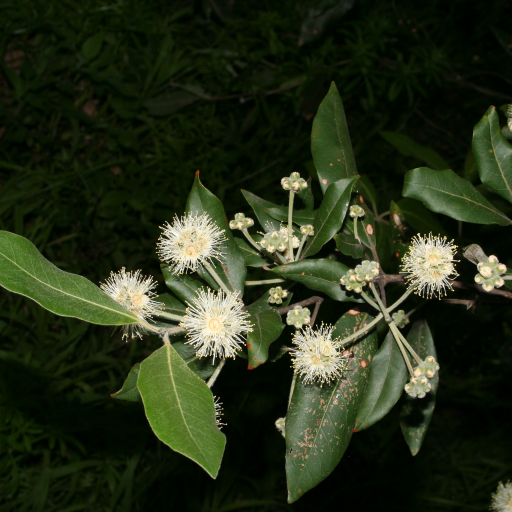
- 🌼 The Flowers: Unlike many trees with single blossoms, this species produces "glomules." These are creamy-white flower heads where seven individual flowers are fused at the base, creating a distinct, fuzzy globe shape.
🏡 In Your Garden
- 🌳 Space and Scale: This is not a plant for a small suburban yard. It is a slow-growing giant that can reach massive heights. It is best suited for large acreages or parklands where it can serve as a majestic shade tree or a robust windbreak.
- 🔥 Natural Shield: It is exceptionally fire-resistant. The thick, fibrous bark acts as an insulator, protecting the tree's inner life from the heat of bushfires. In many landscapes, it serves as a "green belt" that can help slow the spread of embers.
- ⚓ Environmental Resilience: It is one of the few large trees that can tolerate both coastal salt spray and heavy, poorly drained clay soils, provided the climate remains temperate to subtropical.
⚠️ Safety & Toxicity
- ✅ General Safety: Syncarpia glomulifera is not known to be toxic to humans, dogs, or cats. It is generally considered a "safe" tree for public spaces and large properties.
- 🖐️ Mild Irritant: Some people may find the fine, felty hairs on the underside of new leaves slightly irritating to the skin or eyes if they are doing heavy pruning without protection.
✨ Fun Fact
- 🚢 The Ship-Wrecker’s Foe: Because the wood contains high amounts of silica and natural oils, it is almost entirely immune to "shipworms" (marine borers). For this reason, Turpentine trunks were historically used as pilings for famous wharves around the world, including the London Docks and the Suez Canal!

Detailed Care Instructions
Syncarpia Glomulifera, also known as the Turpentine tree, is a native plant to Australia that is well-suited to growing in a variety of soil types and climates. Here are some tips on how to grow Syncarpia Glomulifera:
- Planting: Choose a sunny location with well-drained soil to plant your Syncarpia Glomulifera tree. The plant can tolerate a wide range of soil types, including sandy, loamy, and clay soils.
- Watering: In the first few months after planting, water your Syncarpia Glomulifera tree regularly to help establish its root system. Once established, the tree is drought-tolerant and only needs occasional watering during extended dry periods.
- Pruning: Trim any dead or damaged branches to promote the health and growth of your Syncarpia Glomulifera tree. Prune the tree in late winter or early spring before new growth begins.
- Fertilizing: Fertilize your Syncarpia Glomulifera tree with a balanced fertilizer in spring to provide it with essential nutrients for healthy growth.
- Mulching: Mulch around the base of the tree with organic materials, such as wood chips or bark, to help retain moisture, suppress weeds, and insulate the tree's roots.
- Pest and Disease Control: Keep an eye out for common pests and diseases that may affect Syncarpia Glomulifera, such as scale insects or powdery mildew. Treat any infestations promptly to protect the health of your tree.
By following these tips, you can successfully grow and care for Syncarpia Glomulifera plants in your garden or landscape.
To water Syncarpia Glomulifera, ensure that the soil around the plant is evenly moist but not waterlogged. Water deeply and less frequently, allowing the top few inches of soil to dry out between waterings. Avoid overhead watering to prevent foliage diseases. Use a soaker hose or drip irrigation system to deliver water directly to the root zone. Adjust watering frequency depending on the weather and season, watering more during hot, dry periods and less during cooler, wet seasons. Additionally, mulching around the base of the plant can help retain moisture and reduce the need for frequent watering.
To properly fertilize Syncarpia Glomulifera plants, it is recommended to use a balanced, slow-release fertilizer that is specifically formulated for native Australian plants. Follow the instructions on the fertilizer packaging for the appropriate amount to apply. Fertilize in early spring, just before new growth begins, and again in early summer to promote healthy growth and flowering. Be careful not to over-fertilize, as this can harm the plant. Water the plant thoroughly after fertilizing to help distribute the nutrients evenly throughout the soil.
The Syncarpia Glomulifera plant thrives in well-draining soil that is rich in organic matter. A soil mixture that is slightly acidic to neutral pH is the most suitable for this plant. It is important to avoid using soils that are heavy in clay, as they may retain too much water and lead to root rot. A sandy loam or sandy soil mixed with peat moss, perlite, or vermiculite is ideal for optimal growth and development of the Syncarpia Glomulifera plant. Mulching with organic materials such as bark chips or compost can also help to enhance soil structure and moisture retention, promoting overall health and vigor of the plant.
Syncarpia Glomulifera can be propagated using several methods, including seed propagation and cutting propagation.
To propagate Syncarpia Glomulifera from seeds, collect mature seeds from a healthy plant and store them in a cool, dry place until ready to sow. Sow the seeds in a well-draining potting mix and keep them moist but not waterlogged. Place the pot in a warm, brightly lit location and wait for the seeds to germinate, which can take several weeks to months.
Another method of propagating Syncarpia Glomulifera is through cutting propagation. Take stem cuttings from a healthy, mature plant, making sure they are at least a few inches long and have several nodes. Dip the cut ends in a rooting hormone to encourage root development, then plant the cuttings in a well-draining potting mix. Keep the cuttings moist and in a warm, brightly lit location until roots develop, which can take several weeks to months.
Both seed propagation and cutting propagation can be successful methods for propagating Syncarpia Glomulifera, allowing you to create new plants from existing ones.








