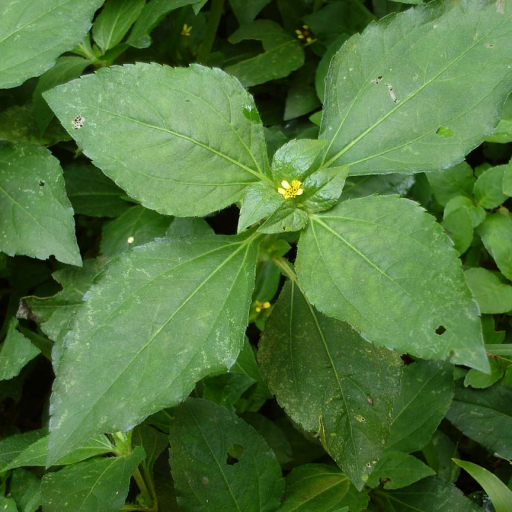
Plant Overview
Often called the Nodeweed or affectionately known as the Cinderella Weed, this resilient traveler originated in the tropical Americas but has since waltzed its way across the globe. It is a hardy member of the Aster family that thrives in disturbed soils, often tucking itself into sidewalk cracks, garden borders, and waste fields. While many gardeners view it as a persistent "weed," its tiny, button-like yellow flowers offer a subtle, wild beauty to neglected corners of the landscape.
🔍 How to Identify
- 🌿 The Foliage: Look for oval-shaped leaves with pointed tips and distinctively serrated (saw-toothed) edges. They grow in opposite pairs along the stem and usually feature three prominent veins starting from the base.
- 🌼 The "Nodding" Flowers: The tiny yellow flower heads are "sessile," meaning they lack a stalk. They sit tightly nestled in the axils—the little V-shaped space where the leaf meets the main stem.
- 🌱 The Stem Texture: The stems are typically cylindrical, covered in fine, stiff hairs, and can vary from green to a purplish-red hue near the ground.
🏡 In Your Garden
- 🧱 Urban Survivor: This plant is a "pioneer species," meaning it is often the first to colonize bare or poor-quality soil. It loves moisture but is incredibly drought-tolerant once established, making it nearly impossible to discourage once it finds a spot it likes.
- 📉 Growth Habit: It typically grows upright but can become prostrate (creeping) if it is frequently stepped on or mowed. In a garden bed, it can quickly out-compete smaller, delicate ornamentals, so it’s best managed by hand-pulling before it disperses its prolific seeds.
⚠️ Safety & Toxicity
- 🟢 Status: Generally considered non-toxic and safe for a general garden environment.
- 🐾 Pets & Kids: There are no widespread reports of toxicity to dogs, cats, or children. However, the fine hairs on the stems can occasionally cause mild skin irritation or "itchiness" for those with high sensitivity or allergies to plants in the Asteraceae (daisy) family.
✨ Fun Fact
The nickname "Cinderella Weed" isn't because it transforms at midnight; it is likely a linguistic play on its scientific name, Synedrella. In some parts of the world, it is actually used as a "famine food" or in traditional herbal poultices, though it's mostly famous today for its ability to grow where other plants give up!

Detailed Care Instructions
To grow Synedrella Nodiflora, also known as Singapore daisy or nodeweed, follow these steps:
- Choose the right location: Synedrella Nodiflora prefers full sun to partial shade. Make sure the area receives at least 6-8 hours of direct sunlight per day.
- Prepare the soil: Synedrella Nodiflora can adapt to most soil types but prefers well-draining soil. If the soil is heavy clay, consider adding organic matter such as compost to improve drainage.
- Planting: Dig a hole slightly larger than the plant's root ball. Place the plant in the hole and backfill with soil, gently firming it around the base of the plant. Make sure the plant sits at the same level as it was in the container.
- Watering: Water the newly planted Synedrella Nodiflora thoroughly and ensure the soil remains consistently moist, but not waterlogged. Water the plant deeply once a week or more during hot and dry periods.
- Mulching: Apply a layer of organic mulch around the base of the plant to help retain moisture, suppress weeds, and regulate soil temperature.
- Fertilization: Synedrella Nodiflora is generally low-maintenance and doesn't require much fertilization. However, you can apply a balanced, slow-release fertilizer in early spring to promote healthy growth.
- Pruning: Regularly prune Synedrella Nodiflora to maintain its shape and prevent it from becoming too leggy. Pruning also encourages bushier growth and more blooms.
- Protection: Protect the plant from extreme cold or frost by covering it with a frost cloth or bringing it indoors during harsh winter conditions, especially in zones where temperatures drop below freezing.
- Propagation: Synedrella Nodiflora can be propagated through stem cuttings or by dividing mature plants. Simply take a cutting from a healthy plant, remove the lower leaves, and plant it in moist potting soil or place it in water until roots develop.
By following these guidelines, you should be able to successfully grow Synedrella Nodiflora. Remember to provide regular care, including watering, pruning, and protecting it from extreme weather conditions.

Place in a bright room that is sun drenched almost all day. Or directly in a south-facing window.

To water this particular plant, it is important to first understand its watering needs. This can be determined by observing the plant for signs of drought stress, such as wilting or leaf curling. Once it is established that the plant needs water, it is important to water it thoroughly and evenly, making sure that the water is able to penetrate the soil deeply. It is generally recommended to water this plant once every 7-10 days, or more frequently in hot and dry weather conditions. When watering, it is important to avoid getting the leaves wet, as this can lead to disease and fungal issues. Instead, focus the watering on the root zone of the plant. Overall, proper watering is crucial for the health and growth of this plant, so it is important to pay attention to its needs and provide it with appropriate care.
To fertilize this plant, use a balanced fertilizer with an NPK ratio of 10-10-10. Apply the fertilizer every 4-6 weeks during the growing season, which is typically from spring to fall. Be sure to follow the recommended dosage on the fertilizer packaging and water the plant after fertilizing. Avoid fertilizing during the winter months when the plant is dormant.
The ideal soil for the plant should be well-draining and rich in organic matter to provide sufficient nutrients. It should have a pH level of around neutral or slightly acidic. The soil should not be overly compacted or heavy as this can cause poor drainage and lead to root rot. Additionally, the soil should retain moisture without becoming waterlogged. It is recommended to mix in some sand or perlite to improve drainage. Overall, a loose, crumbly soil with good aeration properties is ideal for the growth and development of the plant.
To propagate this plant, you will need to take stem cuttings. These cuttings should be around 4-6 inches long and ideally should have 2-3 leaf nodes on them. Once you have cut the stem, remove the lower leaves and dip the cut end into rooting hormone. Then, plant the cutting in a pot filled with moist soil. Place the pot in a well-lit area, but away from direct sunlight. Keep the soil moist by watering it regularly, but be careful not to overwater. The cutting should root in about 2-4 weeks. Once it has rooted, you can transplant it to a larger pot or directly into the soil outside, if the weather and growing conditions are suitable.








