Plant Overview
Known as the "Sea Apple," this majestic coastal giant is a staple of Southeast Asian shorelines. Its dense, evergreen canopy once served as a literal wall of defense against forest fires in early urban planning due to its high moisture content. With its thick, glossy foliage and "powder-puff" blooms, it brings a sense of ancient, seaside grandeur to any large landscape.
🔍 How to Identify
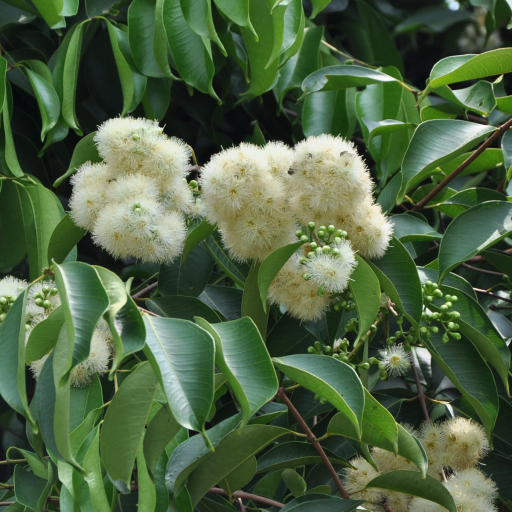
- 🍃 Large Leathery Leaves: The leaves are broad, elliptical, and possess a distinct "plastic-like" sheen that helps the tree shed salt spray and resist intense tropical sun.
- 🎆 Stamen-Heavy Blooms: The flowers appear as dense clusters of white, fluffy bursts that look like miniature fireworks; they release a sweet, heavy scent at night.
- 🍏 Pear-Shaped Fruit: It produces small, greenish-white fleshy fruits that resemble tiny, oblong apples, though they have a much drier, pithy texture than a typical apple.
🏡 In Your Garden
- 🌊 Salt & Wind Specialist: Because it originated on rocky beaches and mangroves, this tree is incredibly resilient against strong coastal winds and salty air, making it an ideal windbreak.
- 🌳 The Ultimate Shade-Maker: It grows rapidly and maintains a heavy, wide-spreading crown. In a garden setting, it requires significant space as its powerful root system can lift nearby pavement if planted too close to structures.
- 🦇 A Friend to Wildlife: The tree is a bustling hub for biodiversity; its nectar attracts sunbirds and honeybees, while its fruit is a primary food source for fruit bats and squirrels.
⚠️ Safety & Toxicity
- ✅ Safe Status: The Sea Apple is non-toxic to humans, dogs, and cats. It is a "friendly" giant often used in public parks and schoolyards.
- 🧹 Slip Hazard: While not poisonous, the fruit can be a safety concern in a different way; when the heavy fruits drop, they can make walkways very slippery and messy if not cleared regularly.
✨ Fun Fact
In the early 20th century, the Sea Apple was nicknamed the "Firebreak Tree." It was strategically planted in massive rows across Singapore and Malaysia to act as a living shield, as its succulent leaves are very difficult to ignite and could stop the spread of fires between village huts.

Detailed Care Instructions

Place in a bright room that is sun drenched almost all day. Or directly in a south-facing window.

When the top few inches of soil dry out, water your plants. If the top few inches of soil are still moist, do not water your plant. Wait a few days, then poke your finger into the soil to see if anything has changed. Overwatering poses a disease risk, such as the development of fungal diseases in the roots. These plants have adaptations in there leaves that allow them to survive in low water supply.








