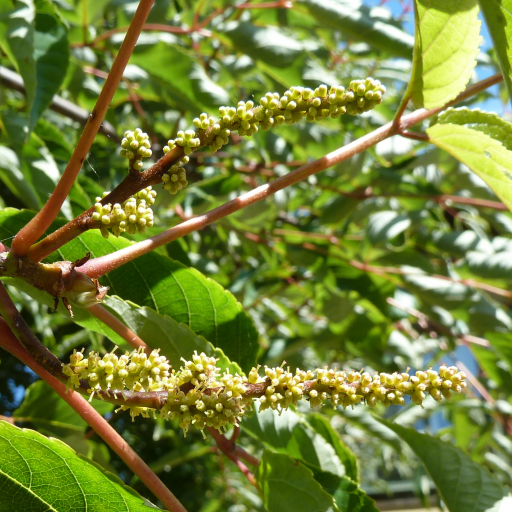
Plant Overview
Commonly known as the False Pistachio, Tapiscia sinensis is a rare and elegant deciduous tree hailing from the moist mountain forests of Central and Southern China. While its name suggests a relation to the nut we snack on, it actually belongs to its own unique evolutionary lineage. It is often sought after by botanical collectors for its lush, tropical-looking foliage and its status as a "living relic" of the plant world.
🔍 How to Identify
- 🍃 Lush Foliage: The leaves are "odd-pinnate," meaning they look like giant feathers with several pairs of leaflets and one single leaflet at the very tip. They can grow quite large, giving the tree a full, soft appearance.
- 🌼 Scented Blooms: In mid-summer, it produces large, airy clusters (panicles) of tiny, yellowish-green flowers. While the individual flowers are small, their sweet, honey-like fragrance can fill a garden.
- 🍇 Dark Fruit: After flowering, it develops small, egg-shaped fruits that turn a deep black or dark purple when ripe, looking somewhat like miniature olives.
🏡 In Your Garden
- 🌱 Drainage is Key: While this tree loves moisture, it is highly sensitive to "wet feet." It thrives best in rich, loamy soil that allows water to move through freely; heavy clay can lead to root issues.
- 🌤️ Sheltered Growth: Because of its large leaves, it prefers a spot sheltered from harsh, drying winds which can tatter its foliage. It’s an excellent choice for a woodland garden where it can enjoy dappled sunlight.
- ⏳ Patience Required: This is a slow-to-moderate grower. It doesn't like being moved once established due to its specific root structure, so choose its "forever home" carefully.
⚠️ Safety & Toxicity
- ✅ Safe Status: Tapiscia sinensis is generally considered non-toxic to humans, dogs, and cats. It does not possess the irritating oils found in some of its lookalikes.
- 🚫 Not for Consumption: While it is "safe," the fruits are not considered edible for humans and are best left for the birds, who find them quite tasty.
✨ Fun Fact
Tapiscia sinensis is an evolutionary loner! It is one of only two species in its entire genus and belongs to a very small family (Tapisciaceae). Because it is considered "vulnerable" in the wild due to habitat loss, growing one in a botanical collection or a private garden is actually a small act of conservation.

Detailed Care Instructions

Place in a bright room that is sun drenched almost all day. Or directly in a south-facing window.

When the top few inches of soil dry out, water your plants. If the top few inches of soil are still moist, do not water your plant. Wait a few days, then poke your finger into the soil to see if anything has changed. Overwatering poses a disease risk, such as the development of fungal diseases in the roots. These plants have adaptations in there leaves that allow them to survive in low water supply.








