Plant Overview
The Yew tree is a silent witness to history, often referred to as the "Tree of Immortality" due to its ability to live for over 2,000 years. Frequently found standing guard in ancient churchyards across Europe, it carries a shroud of mystery and folklore, symbolizing both death and eternal rebirth. While it looks like a typical evergreen, it is a unique conifer that defies many botanical norms.
🔍 How to Identify
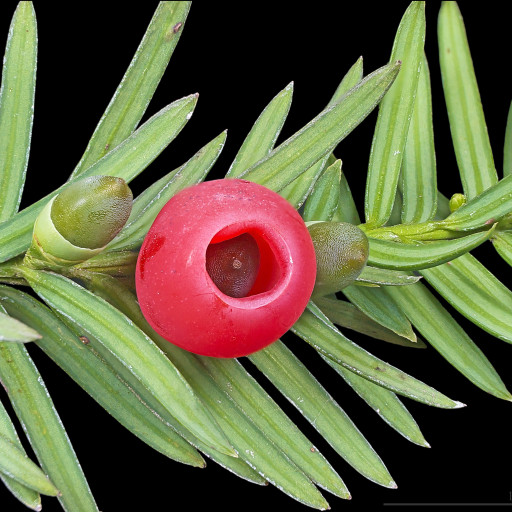
- 🌿 Needle Leaves: Flat, dark green needles arranged in two rows along the twig. They are soft to the touch, unlike the prickly needles of a spruce, and maintain their deep color year-round.
- 🔴 The Aril: Instead of a traditional woody cone, the Yew produces a striking, bright red, fleshy cup called an "aril." This structure protects a single seed and is often mistaken for a common berry.
- 🪵 Shaggy Bark: The trunk is covered in thin, scaly bark that ranges from reddish-brown to deep purple-grey, often peeling away in strips to reveal a smooth, colorful inner layer.
🏡 In Your Garden
- 🛡️ The King of Hedges: Taxus is legendary for its tolerance to heavy pruning. It is the primary choice for formal English gardens and topiary because it can be sheared into precise geometric shapes without losing its density.
- ☁️ Shadow Dweller: Unlike many evergreens that crave full sun, the Yew is remarkably shade-tolerant. It is one of the few structural plants that can thrive in the "dry shade" found beneath large deciduous trees.
- 💧 Drainage is Vital: While hardy, the Yew's one weakness is "wet feet." It requires well-draining soil; sitting in stagnant water will quickly lead to root rot, which is the most common cause of Yew failure in home landscapes.
⚠️ Safety & Toxicity
- 🚫 High Toxicity: Almost every part of the Yew—the needles, the bark, and especially the seeds—is highly toxic to humans, dogs, cats, and livestock.
- ❤️ Cardiac Risk: The plant contains taxine alkaloids which, if ingested, can cause severe respiratory distress, heart failure, or sudden death. Even though the red "aril" flesh is technically the only non-toxic part, it is unsafe to eat because the deadly seed is always inside. Keep away from curious pets and children.
✨ Fun Fact
The English Longbow, which changed the course of medieval warfare, was traditionally crafted from Yew wood. The wood is unique because it combines a flexible outer "sapwood" (to resist tension) with a dense inner "heartwood" (to resist compression), creating a natural, high-performance spring.

Detailed Care Instructions
Yew hedges and trees have incredibly long lives if properly maintained. Some European English yew trees have lived to an age of 1,500 to 3,000 years old. Yew trees and hedges have the ability to renew themselves, and their bending branches can even re-root. For this reason, yew has become a symbol of immortality.
Why do yew trees bleed?
Yew trees often bleed their blood-red sap if the tree has been injured by breakage or winter damage. This is usually not an issue of concern, as bleeding yew trees scar very easily. Ancient legends associate this bleeding to the tree's sympathy with Jesus after his death on the cross.
What is yew wood used for?
Handcrafted wooden bows are commonly built from a combination of sapwood and heartwood from mature yew trees. The sapwood (the white wood that is on the outside of the tree, just below the bark) forms the back of the bow and excels under tension, making it the perfect material for this hunting tool.
Growing a Taxus plant, commonly known as yew, requires attention to several key aspects: selecting the right location, preparing the soil appropriately, ensuring proper planting techniques, and providing adequate care. Here’s a detailed guide to help you grow a healthy Taxus plant:
1. Choosing the Right Location
- Light: Taxus plants can tolerate full sun to partial shade. Ideally, they should get a few hours of direct sunlight, but they can also thrive in shaded areas.
- Space: Ensure enough space for the plant to grow. Taxus can range in size from small shrubs to large trees, so consider the mature size of the specific variety you are planting.
2. Soil Preparation
- Type: Taxus plants prefer well-drained soil. They can tolerate a range of soil types from sandy to clay, but they thrive best in loamy soil.
- pH: The soil should ideally be slightly acidic to neutral (pH 6.0-7.0).
- Drainage: Good drainage is crucial. Use organic matter like compost to improve soil structure and drainage if necessary.
3. Planting
- Timing: The best time to plant a Taxus is during the spring or fall when the weather is cooler.
- Digging the Hole: Dig a hole that is twice as wide and as deep as the root ball.
- Planting Depth: Place the plant in the hole so that the top of the root ball is level with or slightly above the ground surface.
- Backfilling: Fill the hole with the removed soil, gently firming it around the root ball.
4. Watering
- Initial Watering: Water the plant thoroughly after planting.
- Establishment Period: Keep the soil consistently moist during the first growing season. Water deeply but infrequently to encourage deep root growth.
- Long-Term Care: Once established, Taxus plants are fairly drought-tolerant. Water as needed, especially during dry periods.
5. Mulching
- Application: Apply a 2-3 inch layer of mulch around the base of the plant to retain moisture, regulate soil temperature, and suppress weeds.
- Spacing: Keep the mulch a few inches away from the trunk to prevent rot.
6. Fertilizing
- Timing: Fertilize in early spring before new growth begins.
- Type: Use a balanced, slow-release fertilizer. For organic options, well-rotted manure or compost can be beneficial.
- Application: Follow the manufacturer's instructions for the amount and frequency of application.
7. Pruning
- Time: Prune in late winter or early spring before new growth starts.
- Technique: Remove any dead, damaged, or diseased branches. Taxus plants can tolerate heavy pruning, so don’t be afraid to shape them as needed.
- Tools: Use sharp, clean pruning shears to make clean cuts.
8. Pests and Diseases
- Monitoring: Regularly check for common pests like aphids, scale insects, and spider mites.
- Treatment: Use appropriate pest control methods, such as insecticidal soap or horticultural oil, if infestations occur.
- Diseases: Be on the lookout for fungal diseases like root rot, especially in poorly drained soils.
9. Protection
- Winter Care: In areas with severe winters, consider protecting young plants with burlap screens to shield them from harsh winds and heavy snow loads.
- Animal Damage: Yew foliage is toxic, but it may still be browsed by deer. Use fencing or deer repellents if necessary.
10. Propagation
- Methods: Taxus can be propagated by seeds, cuttings, or layering.
- Cuttings: The most common method is to take semi-hardwood cuttings in late summer or early autumn, dip them in rooting hormone, and plant them in a mixture of sand and peat moss.
By following these guidelines, you can successfully grow and maintain a healthy Taxus plant in your garden or landscape.

Place in a bright room that is sun drenched almost all day. Or directly in a south-facing window.

To water this plant, you will need to ensure that you are providing enough moisture without overwatering. It is important to water deeply and thoroughly, allowing the water to penetrate the soil and reach the roots. This can be done by applying water slowly and evenly to the soil around the plant, making sure to avoid getting water on the foliage.
It is recommended to water this plant regularly, especially during periods of dry weather. However, it is important to avoid watering too frequently, as this can lead to waterlogging and root rot. To determine when to water, you can check the soil moisture level by inserting your finger into the soil up to the first knuckle. If the soil feels dry at this depth, it is time to water.
Additionally, this plant prefers moist, well-draining soil, so it is important to ensure that the soil is not overly compacted or heavy. If you notice that the soil is not draining well or is becoming compacted, you may need to amend it with organic matter or perlite to improve drainage.
Overall, providing consistent and appropriate watering is crucial for the health and vitality of this plant. With proper care, it can thrive and provide beauty and interest in your landscape.
Here's a detailed guide on fertilizing your Taxus plant:
When to Fertilize
- Early Spring: This is the ideal time to apply fertilizer as the plant begins its new growth cycle.
- Late Fall: A secondary, lighter application can be beneficial, but only if necessary.
Types of Fertilizers
- Balanced, Slow-Release Fertilizers: Preferably use a balanced fertilizer, such as a 10-10-10 or 14-14-14 formulation. Slow-release types are particularly effective as they provide nutrients over a longer period.
- Organic Options: Compost or well-rotted manure can be applied as alternative organic options.
Application Instructions
- Determine the Amount: Follow the manufacturer’s instructions on the packaging. Typically, this will be based on the size and age of the plant.
- Prepare the Soil:
- Remove any mulch or debris from the base of the plant.
- Loosen the top layer of soil gently without disturbing the roots.
- Remove any mulch or debris from the base of the plant.
- Even Distribution:
- Broadcast the fertilizer evenly around the base of the plant, extending slightly beyond the drip line (the outer edge of the plant's foliage).
- Broadcast the fertilizer evenly around the base of the plant, extending slightly beyond the drip line (the outer edge of the plant's foliage).
- Incorporate into Soil:
- Lightly rake the fertilizer into the top layer of soil to help with absorption.
- Lightly rake the fertilizer into the top layer of soil to help with absorption.
- Watering:
- Water thoroughly after fertilizing to help the nutrients reach the root zone.
Special Considerations
- Water thoroughly after fertilizing to help the nutrients reach the root zone.
- Avoid Over-Fertilizing: Too much fertilizer can harm the plant, leading to excessive growth that may be weak or attract pests.
- Test Soil First: If possible, test your soil to determine its nutrient needs. This will help you choose the most appropriate fertilizer.
- Mulching: After fertilizing, reapply mulch around the base to help retain moisture and regulate soil temperature.
By following these instructions, you can help ensure your Taxus plant receives the nutrients it needs for healthy growth.
The ideal type of soil for Taxus plants is one that is well-draining, but also retains some moisture. It should have a slightly acidic pH level, between 5.5 and 6.5. The soil should be nutrient-rich and have a good balance of organic matter. It should be free of any harmful chemicals or contaminants that could harm the plant. It is recommended to mix equal parts of peat moss, perlite, and high-quality garden soil to create the perfect soil mix for Taxus plants.
Propagating Taxus plants, which are members of the yew family, can be successfully achieved through both seed and cuttings. Here are the detailed steps for both methods:
Propagation by Cuttings:
- Timing: The best time to take cuttings is during late summer to early autumn.
- Selection: Choose healthy, semi-hardwood branches. Ideally, these branches should be roughly a year old and display a balance of flexibility and firmness.
- Cutting: Cut segments that are around 4-6 inches long. Ensure each cutting has several nodes.
- Preparation: Remove the lower leaves from the cutting, leaving the top few pairs of leaves intact.
- Hormone Treatment: Dip the cut end into rooting hormone powder to promote root development.
- Planting Medium: Prepare a mixture of sand and peat moss or perlite. This ensures good drainage while retaining moisture.
- Planting: Insert the cuttings into the medium up to the base of the leaves.
- Environment: Place the container in a location with indirect light. Maintain high humidity by covering the container with a clear plastic bag. Ensure good ventilation to prevent mold or rot.
- Watering: Keep the medium moist but not waterlogged.
- Root Development: Roots should start developing within 2-3 months. Once rooted, gradually acclimate the new plants to outdoor conditions before transplanting them.
Propagation by Seeds:
- Seed Collection: Collect seeds from mature cones during autumn.
- Cleaning: Clean the seeds to remove any fleshy parts to prevent mold.
- Stratification: Seeds require a period of cold stratification to break dormancy. Mix the seeds with a damp medium like sand or vermiculite and place them in a sealed bag.
- Chilling Period: Store the bag in a refrigerator for about 3-4 months. This simulates winter conditions and prepares the seeds for germination.
- Sowing: After stratification, sow the seeds in a well-draining soil mix.
- Environment: Place the pots in an area with indirect sunlight and maintain consistent moisture.
- Germination: Germination can be slow and may take one or more growing seasons.
- Care: Once seedlings emerge, continue to care for them in a controlled environment until they are large enough to transplant outdoors.
General Care Tips:
- Soil: Prefer well-drained soil with moderate fertility.
- Light: Thrive in both full sun and partial shade.
- Watering: Regular watering is crucial, especially during dry periods.
- Pruning: Prune to shape and remove any dead or damaged branches to encourage healthy growth.
By following these detailed steps, you can successfully propagate Taxus plants and enjoy their lush, evergreen foliage in your garden.







