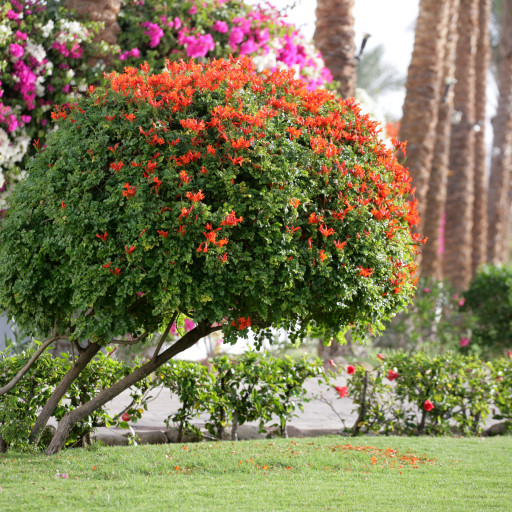
Plant Overview
Often called the Cape Honeysuckle, this South African native isn't actually a true honeysuckle, but it shares the same nectar-rich charm. Known for its "living fire" appearance, this versatile plant can be trained as a formal hedge, a scrambling vine, or a bushy shrub. It is a favorite for gardeners looking to add a splash of sunset-orange to their landscape while attracting a parade of local wildlife.
🔍 How to Identify
- 🎺 The Flowers: Large clusters of trumpet-shaped blooms, typically in a fiery orange, though yellow and salmon varieties exist. The stamens poke out prominently from the petals.
- 🍃 The Foliage: Shiny, dark green leaves that are "pinnate" (leaflets arranged like a feather). Each small leaflet has distinctly serrated or saw-toothed edges.
- 🎋 The Growth Habit: It features long, arching branches that "scramble." If left unsupported, it bows to the ground; if given a trellis, it will climb vigorously.
🏡 In Your Garden
- ✂️ Shape Shifter: Because it grows so aggressively, it requires regular pruning. Without a "haircut," it can become leggy or begin to swallow up neighboring plants, making it perfect for those who enjoy active gardening.
- 🕊️ Pollinator Magnet: In its native South Africa, it is a primary food source for Sunbirds. In other regions, it is a top-tier choice for attracting hummingbirds, who find the tubular shape perfectly suited for their beaks.
- ☀️ Drought Warrior: Once established, it is incredibly resilient to heat and dry spells. It prefers "tough love" over soggy soil, as sitting in water can lead to root rot.
⚠️ Safety & Toxicity
- ✅ Status: Generally considered non-toxic to humans and common household pets like cats and dogs.
- 🧤 Skin Sensitivity: While not poisonous, the sap can occasionally cause mild skin irritation for people with sensitive skin during heavy pruning. Wearing gloves is a good practice when shaping the plant.
✨ Fun Fact
In South Africa, the dried bark of the Cape Honeysuckle is traditionally used in folk medicine to create a soothing tea intended to relieve pain and induce sleep. However, most modern gardeners prefer to just enjoy the "dreamy" view of its vibrant orange blossoms!

Detailed Care Instructions
The shape of this plant depends entirely on how you let it grow,: as a shrub or vine. As a shrub, it can be anywhere from three to ten feet tall, depending on how consistently you prune it. In vine form it will travel a lot farther, reaching lengths of 25 to 30 feet or more. Usually, the cape honeysuckle is treated as a shrub and clipped into a box shape. However, this plant also likes to vine, so consider it for your trellis or pergola.
How do I train cape honeysuckle as a climber or groundcover?
To train it into a vine, guide it up a trellis or length of jute rope. To use as a ground cover, continuously trim off upward-growing stems and let it spread horizontally; it will reach a height of about two to three feet using this method.
Will deer eat cape honeysuckle?
Deer tend to avoid eating this plant as do rabbits, which makes it an excellent addition to gardens subject to these visitors.
| Color | Orange To Orange-Red |
| Soil Ph | 5.6 To 8.5 |
| Humidity | Normal |
| Lighting | Part Sun |
| Soil Type | Well Drained, |
| Bloom Time | Fall, Winter, Spring |
| Difficulty | Medium |
| Plant Type | Flowering Evergreen Shrub |
| Hibernation | Cold Period |
| Mature Size | 3 To 10 Feet Tall As A Shrub; 25 To 30 Feet Long As A Vine |
| Native Area | South Africa |
| Sun Exposure | Full Sun To Partial Shade |
| Hardiness Zones | 9 - 11 |
To grow Tecoma Capensis plants, also known as Cape Honeysuckle, you can follow these steps:
- Choose a suitable location: Tecoma Capensis prefers full sun to partial shade. Select a location that receives at least 6 hours of direct sunlight per day.
- Soil preparation: Ensure that the soil is well-draining and fertile. If your soil is heavy or poor quality, amend it with organic matter like compost or well-rotted manure to improve its texture and nutrient content.
- Planting: Dig a hole that is twice as wide and as deep as the root ball of the plant. Place the Tecoma Capensis plant in the hole, making sure that the soil level remains the same as the surrounding soil. Backfill the hole and gently tamp the soil around the roots, eliminating any air pockets.
- Watering: Water the newly planted Tecoma Capensis thoroughly, keeping the soil moist but not waterlogged. Once established, it is a drought-tolerant plant but still needs regular watering during dry periods.
- Fertilizing: Feed your Tecoma Capensis plant with a balanced fertilizer during the growing season. Follow the instructions on the package for application rates.
- Pruning: Prune your Tecoma Capensis plant in early spring to maintain its shape and promote bushiness. Remove dead or damaged branches and trim back long, straggly shoots.
- Mulching: Apply a layer of organic mulch around the base of the plant to suppress weeds, conserve moisture, and improve soil fertility.
- Propagation: Tecoma Capensis can be propagated from seed or through stem cuttings. Seeds can be collected from mature plants and sown in a well-draining seed-starting mix. Stem cuttings can be taken during the growing season, and they should be dipped in rooting hormone before being planted in a well-draining potting mix.
- Pests and diseases: Watch out for common garden pests such as aphids and spider mites, which can sometimes affect Tecoma Capensis. Regular inspection and treatment as necessary will help keep pests under control.
Remember to check the specific requirements for your particular region or climate, as Tecoma Capensis might have different needs depending on where it is grown.

Place in a bright room that is sun drenched almost all day. Or directly in a south-facing window.

To water this type of plant, you should first check the soil to make sure it is not completely dry. If it is dry, gradually add water to the soil until it is slightly damp but not waterlogged. It is important to avoid overwatering the plant, as this can lead to root rot. You should also avoid getting water on the leaves of the plant, as this can cause damage and disease. To water the plant, use a watering can or hose with a gentle, steady stream of water. It is recommended to water this plant once or twice a week, depending on the weather and humidity levels in your area.
To fertilize this plant, mix a balanced fertilizer with equal parts nitrogen, phosphorus, and potassium. Apply the fertilizer during the growing season, which is typically from spring to fall. Use a slow-release, granular fertilizer and sprinkle it around the base of the plant. Water the plant thoroughly after applying the fertilizer to help it absorb the nutrients. Avoid over-fertilizing, as too much can damage the roots and leaves.
Tecoma Capensis plants prefer well-draining soil that is rich in organic matter. Soil pH should be slightly acidic to neutral. Clay soils should be amended with sand and organic matter to improve drainage. In areas with heavy rainfall, raised beds may be necessary to prevent root rot. When planting Tecoma Capensis, add compost or a slow-release fertilizer to the soil to provide essential nutrients. Mulching around the base of the plant helps retain moisture in the soil and suppress weed growth. Regular watering is important but avoid overwatering as this can lead to root rot.
To propagate this plant, you need to take cuttings from a mature and healthy plant. Using a sharp, sterile pair of scissors or pruning shears, cut a 4-6 inch section of the stem at a 45-degree angle just below a leaf node.
Remove the lower leaves from the cutting, leaving just a few at the top. Dip the cut end of the stem into a rooting hormone powder to encourage root growth.
Plant the cutting in a pot filled with moist, well-draining soil, making sure the plant is stabilized in the soil. Cover the pot with clear plastic or a plastic bag to create a mini greenhouse that will help retain moisture.
Place the pot in a bright, warm location that receives indirect sunlight. Mist the cutting regularly to keep the soil moist and to maintain humidity within the plastic cover.
After several weeks, the cutting should have developed roots and new growth. Once the new plant has established itself, it can be transplanted into a larger pot or transferred to an outdoor location.
Common pests of the cape honeysuckle include Mealybugs, spider mites, aphids, whiteflies. Make a habit of checking your cape honeysuckle frequently for pests so that any infestations can be caught and managed early.








