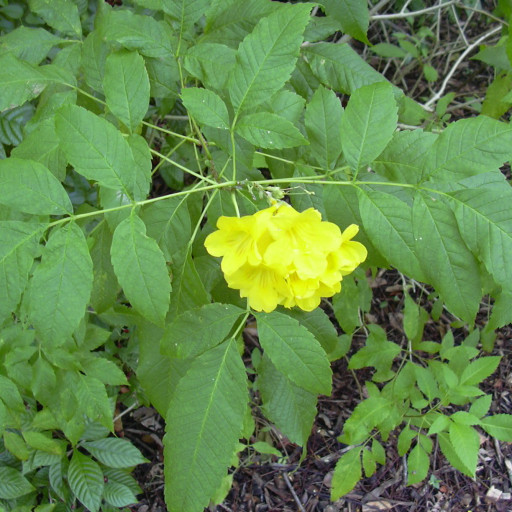
Plant Overview
Known as "Yellow Bells" or "Esperanza" (the Spanish word for "Hope"), this sun-loving shrub turns any garden into a tropical paradise. Native to the Americas, it is famous for its clusters of vibrant, sunshine-yellow flowers that seem to ring in the arrival of warm weather. It is a favorite for those wanting a low-maintenance splash of gold that can withstand intense summer heat.
🔍 How to Identify
- 🍃 Foliage: Features bright green, lance-shaped leaves with jagged (serrated) edges. The leaves are "pinnate," meaning they grow in opposing pairs along a central stem.
- 🎺 Flowers: Large, trumpet-shaped blossoms that grow in dense clusters at the ends of branches. If you look closely inside the "throat" of the flower, you’ll often see faint reddish lines designed to guide pollinators.
- 🌱 Growth Habit: A fast-growing woody shrub or small tree that can reach 10–20 feet tall. It has a naturally sprawling, multi-stemmed shape but can be pruned into a formal tree form.
🏡 In Your Garden
- ☀️ Sun Worshipper: This plant is a true desert native at heart; it thrives in intense heat and full sun. If it's planted in too much shade, it will become "leggy" and produce far fewer of its signature yellow bells.
- 💧 Drought Resilience: While it appreciates regular watering to keep the blooms coming, it possesses a deep root system that makes it incredibly drought-tolerant once established. It is an excellent choice for xeriscaping or water-wise landscapes.
- 🦋 Wildlife Magnet: It acts as a natural buffet for hummingbirds, butterflies, and bees. Don't be surprised if you see carpenter bees "robbing" the nectar by piercing the base of the flower tube!
⚠️ Safety & Toxicity
- 🐾 Pet Safety: Tecoma stans is generally considered non-toxic to dogs, cats, and horses, making it a safer alternative to the more toxic Oleander.
- 🧒 Human Caution: While not considered poisonous, some sensitive individuals may experience mild skin irritation (dermatitis) when handling the foliage or sap. It is not edible and should be kept away from curious toddlers who might try to eat the flowers.
✨ Fun Fact
In the past, the sturdy but flexible wood of the Tecoma stans was highly prized by indigenous people in the Americas for crafting powerful hunting bows and specialized tool handles.

Detailed Care Instructions
| Humidity | Normal |
| Lighting | Full Sun |
| Toxicity | Poisonous |
| Bloom Time | From Late Spring Through Early Fall |
| Difficulty | Medium |
| Plant Type | Evergreen Shrub |
| Hibernation | Cold Period |
| Mature Size | 12 Feet Tall |
| Native Area | Sonoran Desert |
| Temperature | 15°C - 30°C |
| Sun Exposure | Full Sun |
| Hardiness Zones | Min 8A |
To grow Tecoma Stans (also known as Yellow Bells or Esperanza), you can follow these steps:
- Obtain seeds or starter plants: You can find Tecoma Stans seeds or starter plants at nurseries or online garden stores. Decide whether you want to start from seeds or purchase plants.
- Choose a suitable location: Tecoma Stans prefers full sun and well-draining soil. Select a spot in your garden that receives at least 6-8 hours of sunlight per day.
- Prepare the soil: Tecoma Stans can tolerate a wide range of soil types, but it prefers slightly acidic to neutral soil. Add organic matter, such as compost, to enhance the soil's moisture-retention and nutrient content.
- Planting from seeds: If starting from seeds, sow them directly in the garden bed or in seed trays. Plant the seeds at a depth of about ½ inch (1.3 cm) and water lightly.
- Planting starter plants: If starting from starter plants, dig a hole in the prepared soil that is slightly larger than the plant's root ball. Place the plant in the hole, backfill with soil, and gently press it down. Water it thoroughly after planting.
- Watering: Tecoma Stans requires regular watering until established. Water deeply and evenly, keeping the soil moist but not waterlogged. Once established, it is drought-tolerant and requires less frequent watering.
- Fertilizing: Apply a balanced fertilizer during the growing season, following the manufacturer's instructions. Avoid over-fertilizing, as it can lead to excessive foliage growth with fewer flowers.
- Pruning: Tecoma Stans benefits from occasional pruning to maintain its shape and encourage new growth. Prune in late winter or early spring before new growth emerges. Remove dead or damaged branches, and trim back any overgrowth.
- Mulching: Apply a layer of organic mulch, such as wood chips or straw, around the base of the plant. This will help conserve moisture, suppress weeds, and regulate soil temperature.
- Pests and diseases: Tecoma Stans is generally resistant to pests and diseases. However, occasional issues like aphids or powdery mildew may occur. Monitor the plant regularly and address any infestations or diseases promptly with appropriate treatments.
By following these steps and providing proper care, your Tecoma Stans plant should thrive and produce beautiful yellow bell-shaped flowers.

Place in a bright room that is sun drenched almost all day. Or directly in a south-facing window.

To ensure that the plant remains healthy and well-hydrated, you should first identify its specific watering needs based on factors such as its size, the type of soil it's planted in, and the amount of sunlight it receives. In general, you should aim to water the plant deeply and thoroughly, but only when the soil is dry to the touch. Avoid overwatering, which can lead to root rot and other issues. Additionally, you may want to consider using a water-soluble fertilizer to help nourish the plant and encourage healthy growth.
To fertilize this plant, apply a balanced, slow-release fertilizer in the spring and again in the summer. Follow the recommended application rate on the fertilizer packaging, and water immediately after fertilizing. Avoid fertilizing in the fall or winter, as the plant may be in a dormant phase and not actively growing.
Tecoma Stans plants thrive in well-draining soil that is rich in nutrients. The ideal soil for this plant should have a slightly acidic to neutral pH level, ranging from 6.0 to 7.5. It should also have a good mix of organic matter, such as compost or peat moss, to help retain moisture and promote healthy root growth. This plant prefers soil that is sandy or loamy, with good drainage to ensure that excess water doesn't accumulate around the roots. It is essential to avoid compacted soil that doesn't allow air to circulate freely, as this can negatively impact the growth and health of the plant. A properly cared for Tecoma Stans plant can thrive in a range of soil textures, as long as it is well-draining and rich in essential nutrients.
To propagate this plant, you will need to take a cutting from a healthy parent plant that is at least 4-6 inches in length. Choose a stem that is healthy and without any disease or damage. Cut the stem at a 45-degree angle, just below a node. Remove the leaves from the bottom 2-3 inches of the stem and make a wound at the bottom of the stem by lightly scratching the bark in a few places with a sharp blade. Then, dip the cut end into rooting hormone powder.
Prepare a pot with well-draining soil and poke a hole in the soil with a pencil. Now, put the cutting in the hole and press the soil firmly around it to hold it in place. Water the cutting thoroughly but don't let the soil become waterlogged or overly dry. Place the pot in a humid place, away from direct sunlight. Cover the pot with a clear plastic bag or a plastic container that has holes in it for air circulation. This will create a moist environment which will help the cutting in developing roots.
Check the cutting regularly to see if it has developed roots. After 3-4 weeks, gently tug on the stem to see if it has taken root. If it resists being pulled out, it has developed roots and you can remove the plastic cover. Gradually expose the plant to more sunlight as it grows. When the plant has grown to a suitable size, it can be transplanted to its permanent location.
With proper care and attention, the propagated cutting will develop into a healthy and beautiful Tecoma Stans plant.
Common pests of the yellow-bells include Mealybugs, spider mites, aphids, whiteflies, larvae. Make a habit of checking your yellow-bells frequently for pests so that any infestations can be caught and managed early.








