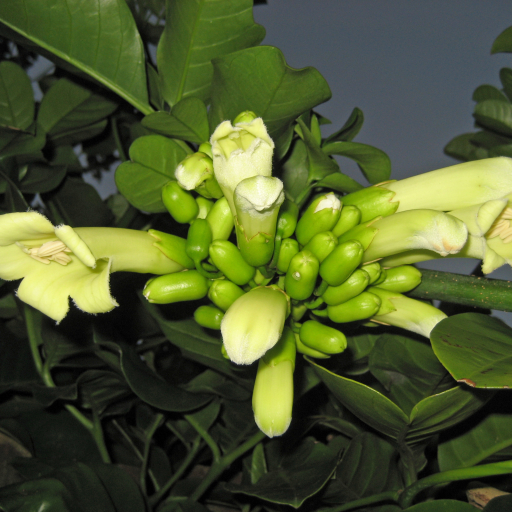
Plant Overview
Known as the Three Kings Vine, this plant holds the title of one of the rarest specimens on the planet. Discovered in 1945 on the remote Three Kings Islands off the coast of New Zealand, only a single plant was found surviving in the wild, narrowly escaping extinction from grazing goats. Today, thanks to dedicated conservation efforts, it has been brought back from the brink to grace gardens with its lush, tropical elegance.
🔍 How to Identify
- 🍃 Large, Glossy Foliage: It features massive, deep green, leathery leaves that look almost like they’ve been polished. They grow in a pinnate (feather-like) arrangement.
- 🌼 Tubular Blooms: The flowers are spectacular, bell-shaped, and creamy-white with a hint of pale green. They look like they belong in a prehistoric jungle.
- 🪵 Stem Flowering: Unlike many vines that bloom at the tips of new growth, this plant displays "cauliflory," meaning the flowers often erupt directly from the older, woody stems.
🏡 In Your Garden
- 🧗 A Vigorous Climber: This is a heavy-duty woody vine. It requires a very sturdy support system, like a pergola or a large tree, as its weight can easily collapse flimsy plastic trellises once it matures.
- 🏖️ Coastal Ancestry: Coming from an island environment, it thrives in high humidity and frost-free zones. While it loves bright light, the roots prefer to stay cool and shaded—mimicking the forest floor where it originated.
- 🥘 Rich Diet: It is a hungry plant that prefers deep, organic soil. It dislikes being moved once established because its root system is sensitive to disturbance, so pick its "forever home" carefully.
⚠️ Safety & Toxicity
- ✅ Safe Profile: The Three Kings Vine is generally considered non-toxic to humans and common household pets.
- 🐾 Pet Friendly: There are no recorded cases of severe toxicity for cats or dogs, making it a safe choice for a lush, pet-friendly backyard paradise. However, as with any ornamental plant, it is best to discourage curious pets from chewing on the tough leaves.
✨ Fun Fact
Every Tecomanthe speciosa in cultivation today is a descendant of that one single plant found on Great Island in 1945. It is essentially a global family of clones that saved an entire species from disappearing forever!

Detailed Care Instructions
To grow Tecomanthe speciosa, also known as the Three Kings Vine, you can follow these steps:
- Climate: Ensure that you live in a suitable climate for Tecomanthe speciosa, which is a subtropical or tropical region. It can be grown outdoors in USDA hardiness zones 9-11.
- Location: Choose a location that receives bright but indirect sunlight or partial shade. Tecomanthe speciosa prefers a sheltered spot away from strong winds.
- Soil: This plant prefers well-draining soil that is slightly acidic and rich in organic matter. It can tolerate a wide range of soil types but prefers moist soil. Improve the soil by adding compost or organic matter if needed.
- Planting: Plant Tecomanthe speciosa in spring or summer when the weather warms up. Dig a hole that is slightly larger than the root ball. Place the plant in the hole and backfill with soil, gently firming it around the roots. Water thoroughly after planting.
- Watering: Keep the soil consistently moist but not waterlogged. During dry periods, water deeply, ensuring the soil remains moist. Do not allow the soil to dry out completely.
- Pruning: Prune Tecomanthe speciosa regularly to control its growth and shape. You can train it to grow along a trellis, fence, or pergola. Prune selectively to maintain a desired shape and remove any dead or damaged branches.
- Fertilizer: Feed the plant with a balanced slow-release fertilizer in spring and summer to promote healthy growth and flowering. Follow the instructions on the fertilizer packaging for proper application.
- Mulching: Apply a layer of organic mulch around the base of the plant to help retain moisture, suppress weed growth, and regulate soil temperature.
- Propagation: Tecomanthe speciosa can be propagated from seeds or cuttings. Collect seeds from mature pods and plant them in a seed-starting mix. Cuttings can be taken from new growth and rooted in a well-draining rooting medium.
- Pests and diseases: Monitor the plant for common pests like aphids, spider mites, and whiteflies. Treat any infestations promptly with appropriate insecticides or insecticidal soaps. Additionally, ensure good air circulation to prevent fungal diseases.
By following these steps and providing proper care and maintenance, you can successfully grow Tecomanthe speciosa. It may take a few years for the plant to reach maturity and start flowering.

One way to water this plant without using its common name is to ensure that the soil is consistently moist, but not saturated. This can be achieved by watering the plant thoroughly once a week and monitoring the soil moisture throughout the week. If the top inch of soil feels dry, it is time to water again. It is important to avoid letting the plant sit in standing water as this can lead to root rot. During the growing season, fertilize the plant monthly with a balanced fertilizer to support growth. As the plant matures, it may require staking or a trellis for support.
- Choose a balanced fertilizer with equal amounts of nitrogen, phosphorus, and potassium (NPK).
- Dilute the fertilizer to half strength, according to package instructions.
- Apply the fertilizer to the soil surrounding the base of the plant, avoiding the leaves.
- Water thoroughly after fertilizing to ensure the nutrients reach the roots.
- Repeat every 4-6 weeks during the growing season (spring and summer) to promote healthy growth and blooming.
The ideal soil for Tecomanthe Speciosa is rich in nutrients and well-draining. It should be a well-balanced mix of organic matter and mineral components, with a pH range of 6.0 to 7.5. The soil should be able to retain moisture without becoming waterlogged and should not compact easily. A suitable mix could include compost, peat moss, vermiculite, perlite, and sand, mixed in equal parts. Adequate drainage is important as this plant is sensitive to root rot. The soil should be kept moist but not overly wet, as excessive water can lead to root rot. It is also recommended to fertilize the plant regularly with a balanced, slow-release fertilizer to promote healthy growth.
The propagation of Tecomanthe Speciosa involves taking stem cuttings from a mature and healthy parent plant. Firstly, select a portion of the stem that is thick and has a few nodes, ensuring that it is free from any diseases or pests. Cut the stem just below a node or leaf, making sure that the cutting is at least 10-15 cm in length.
Remove all of the leaves from the lower two-thirds of the cutting, leaving only two to three leaves at the topmost part. Dip the cut end of the stem into rooting hormone powder to encourage root growth, and then plant the cutting into a pot filled with moist, well-draining soil. Cover the pot with clear plastic and place it in a warm, bright area with filtered sunlight.
Water the cutting regularly, keeping the soil moist but not saturated, and provide adequate ventilation by removing the plastic cover for a few hours each day. After a few weeks, check for root growth by gently tugging on the stem. If resistance is felt, transfer the cutting to a larger pot with fresh soil and continue to care for it as it develops into a young plant.








