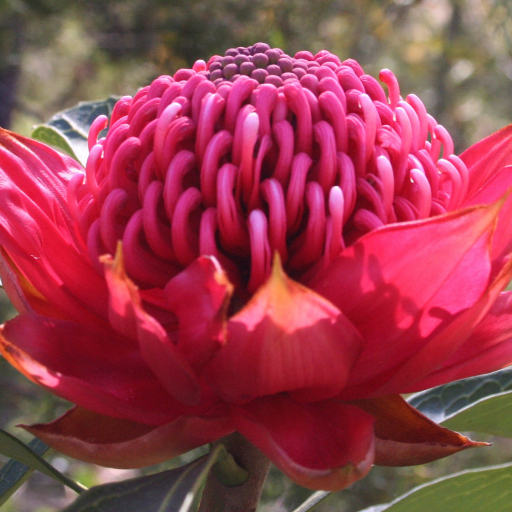
Plant Overview
The New South Wales Waratah, often called the "Red Jewel of the Bush," is one of Australia's most spectacular and recognizable native plants. In the Eora language, Waratah means "seen from afar," a fitting name for a bloom that acts as a crimson beacon in the forest. As the floral emblem of New South Wales, it carries a sense of regal strength and has been a central figure in Australian art and Indigenous storytelling for centuries.
🔍 How to Identify
- 🔥 The Flower Head: What looks like a single giant flower is actually a "conflorescence"—a dense cluster of up to 250 individual small flowers, cradled by a ring of bright red, petal-like bracts.
- 🍃 The Foliage: The leaves are long, dark green, and very leathery with distinctive "toothed" or serrated edges, designed to survive the harsh Australian sun.
- 🏗️ The Structure: It grows as a sturdy, woody shrub that can reach up to 4 meters high, often looking quite architectural and "stiff" rather than soft or drooping.
🏡 In Your Garden
- ⛰️ Drainage is Vital: The Waratah is famously finicky because it requires "perfect" drainage. It naturally grows on sandstone ridges, so it hates having "wet feet"; planting it on a mound or in a raised bed is the secret to keeping it alive.
- 🚫 Phosphorus Sensitivity: Like many Australian natives, it has specialized roots that are hyper-efficient at absorbing nutrients. Using standard garden fertilizer will actually poison the plant—always look for a specific "Low Phosphorus" native mix.
- ✂️ Pruning for Life: To prevent the plant from becoming "leggy" or sparse, it should be pruned back hard immediately after the flowers fade. This mimics the natural grazing or fire cycles of the bush and encourages a bushier, healthier shape.
⚠️ Safety & Toxicity
- ✅ General Safety: The New South Wales Waratah is considered non-toxic to humans and common household pets like cats and dogs.
- 🧤 Physical Hazards: While not poisonous, the leaves are very stiff and the serrated edges can be quite sharp. It is wise to wear gardening gloves when pruning to avoid scratches or skin irritation from the rough foliage.
✨ Fun Fact
In Indigenous Dreamtime legends, the Waratah was once white. It is said to have turned red when a female Wonga Pigeon, searching for her lost mate, was attacked by a hawk and her blood stained the white petals of the flower she landed upon.

Detailed Care Instructions
To grow Telopea speciosissima, also known as the New South Wales waratah, follow these steps:
- Climate: Telopea speciosissima grows best in a temperate climate with mild summers and cool winters. The plant is native to southeastern Australia, so it thrives in regions with similar weather conditions.
- Soil requirements: The waratah prefers well-draining soil with a pH level ranging from slightly acidic to neutral (pH 5.5-7). The soil should be rich in organic matter to enhance growth.
- Site selection: Choose a planting location that receives full sun or partial shade. Ensure the area has sufficient space for the plant to grow, as it can reach heights of up to six feet.
- Planting: Spring is the ideal time to plant Telopea speciosissima. Dig a hole that is slightly larger than the container the plant is in. Gently remove the plant from the container, being careful not to damage the roots. Place the plant in the hole, making sure it is at the same level as it was in the container. Backfill the hole with soil, and gently firm it down.
- Watering: The waratah requires regular watering, especially during dry periods. Ensure the soil remains consistently moist, but avoid overwatering, as excessive moisture can lead to root rot. Mulching around the plant can help retain moisture.
- Fertilization: Apply a slow-release fertilizer formulated for native plants in spring, following the instructions on the packaging. This will provide necessary nutrients for healthy growth.
- Pruning: Pruning is generally not required for Telopea speciosissima. However, dead or damaged branches can be removed, and shaping can be done after flowering to maintain a desired form.
- Propagation: Telopea speciosissima can be propagated through seeds or cuttings. Seeds need to be scarified (scratched or soaked in hot water) to break their hard coat before planting. Cuttings can be taken from the softwood tips of the plant in early summer, then treated with a rooting hormone and placed in a well-draining potting mix.
Remember, growing Telopea speciosissima can be challenging, so it's important to provide the right conditions and care for the plant to thrive.

Place in a bright room that is sun drenched almost all day. Or directly in a south-facing window.

Telopea Speciosissima is a plant that requires regular watering to thrive. The soil around the plant should be kept moist, but not soggy, and it is important to water deeply to encourage deep root growth. When watering, it is best to avoid getting water on the leaves and flowers of the plant, as this can lead to fungal diseases. It is also important to avoid overwatering, as this can lead to root rot and other problems. Therefore, it is recommended to water the plant every 7-14 days depending on the weather.
- Use a balanced fertilizer with equal amounts of nitrogen, phosphorus, and potassium.
- Apply the fertilizer in early spring before new growth appears.
- Water the plant thoroughly before fertilizing.
- Spread the fertilizer evenly around the base of the plant, avoiding contact with the foliage.
- Use a rate of 1 tablespoon of fertilizer per square foot of soil.
- Repeat the fertilization once a month during the growing season.
- Water the plant immediately after fertilizing to help the nutrients reach the roots.
- Monitor the plant for any signs of over-fertilization, such as yellowing leaves or stunted growth, and adjust the fertilization accordingly.
The Telopea Speciosissima plant prefers a slightly acidic soil with good drainage. A blend of sand, compost, and well-rotted leaves or bark can create the optimal growing medium for this plant. A pH level between 5.5 and 6.5 is ideal. It is also important to ensure that the soil is not compacted, as this can impede root growth and lead to poor plant health. Adding organic matter to the soil can help to improve its texture and boost nutrient availability, promoting healthy growth and abundant blooms.
To propagate this plant, you can take cuttings from the parent plant in late spring or early summer. Choose a healthy, new growth that has at least two leaf nodes. Cut the stem below the bottom node and remove any leaves from the bottom half of the stem.
Dip the end of the cutting in rooting hormone and plant it in a pot filled with a mixture of potting soil and perlite. Water the cutting well and cover the pot with a clear plastic bag to create a mini greenhouse. Keep the soil moist and place it in a bright spot without direct sunlight.
After 4-6 weeks, check for root development by gently tugging on the cutting. If you feel resistance, roots have formed. You can then remove the plastic bag and gradually acclimate the plant to normal conditions.
Continue to care for the Telopea Speciosissima by providing it with bright indirect light, regular watering, and occasional fertilizer. With time, it will grow into a beautiful and spectacular flowering shrub.








