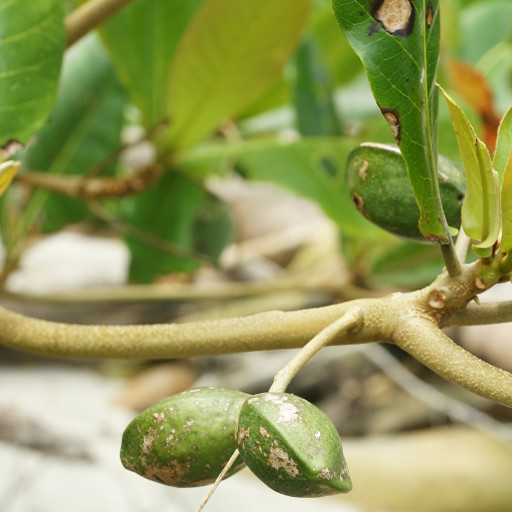
Plant Overview
Often called the Indian Almond or Sea Almond, this coastal giant is famous for its distinct horizontal branches that grow in tiers, giving it the look of a natural green pagoda. While it originates from the tropical shores of Asia and Australia, it has become a beloved shade provider in tropical gardens worldwide. Its most striking trick is its foliage; unlike many tropical trees, it puts on a "pseudo-autumn" show, turning its large leaves into brilliant shades of red and copper before shedding them.
🔍 How to Identify
- 🍃 The Pagoda Shape: The tree grows in a very organized, tiered fashion. Its branches extend horizontally from the trunk, creating a wide, flat canopy that provides excellent shade.
- 🍂 Giant Leathery Leaves: The leaves are large (up to 10 inches long), spoon-shaped, and glossy. They are dark green most of the year but turn a deep, vibrant crimson or golden yellow before they fall.
- 🥥 Almond-Shaped Fruit: It produces green, corky, egg-shaped fruits that eventually turn yellow or purple. Inside the fibrous husk is a small, edible nut that looks and tastes remarkably like a commercial almond.
🏡 In Your Garden
- 🏖️ The Coastal Warrior: This plant is incredibly salt-tolerant and thrives in sandy soil. It is the perfect choice for beachside properties where salty breezes might kill less hardy species.
- 🌳 The Taproot Rule: Because it develops a deep, strong taproot, it is notoriously difficult to transplant once it reaches a certain size. Choose its "forever home" carefully, ensuring it has plenty of space away from pipes or foundations.
- 🧹 A Bit of a Mess: Be prepared for some cleanup! Because it sheds its large leaves twice a year and drops heavy fruit, it isn’t the best choice to plant directly over a swimming pool or a pristine driveway.
⚠️ Safety & Toxicity
- ✅ Safe for Humans: The kernels inside the fruit are edible and widely consumed, though getting to them through the tough husk requires some effort.
- 🐾 Pet Caution: While not considered toxic, the hard, fibrous fruit pits can be a choking hazard or cause digestive blockages for curious dogs.
- 🐟 Aquarium Ally: The fallen leaves are actually "gold" for fish hobbyists. They release tannins that lower water pH and have natural antibacterial properties, making them a favorite for Betta fish breeders.
✨ Fun Fact
In many parts of the world, Terminalia catappa is known as the "Traveler’s Tree" (though not to be confused with the Ravenala). Its massive, broad leaves were historically used as emergency umbrellas during sudden tropical downpours!

Detailed Care Instructions
| Lighting | Full Sun |
| Hardiness Zones | Min 10A |
To grow Terminalia catappa, also known as Indian almond or tropical almond, you can follow these steps:
- Obtaining seeds: Purchase fresh seeds from a reputable supplier. Make sure the seeds are not damaged or too old.
- Germination: Soak the seeds in water overnight. This will help to soften the hard seed coat. Keep the water warm during soaking.
- Pot selection: Use a well-draining pot with drainage holes to avoid waterlogging. The pot should be at least 6-8 inches deep.
- Soil preparation: Use a well-draining soil mix that contains equal parts of garden soil, compost, and sand. This will provide good aeration and drainage.
- Planting: Plant the soaked seeds about an inch deep in the prepared potting mix. Cover them lightly with soil and gently pat it down.
- Watering: Keep the soil evenly moist but not waterlogged. Water the plant regularly, preferably in the morning, ensuring that excess water can drain out of the pot.
- Sunlight: Terminalia catappa prefers full sun to partial shade. Place the pot in a location that receives at least 6-8 hours of sunlight per day.
- Temperature and humidity: This plant thrives in a warm and humid climate. Keep it in a location with temperatures between 60°F to 85°F (15°C to 30°C) and provide some humidity if necessary.
- Fertilization: Feed the plant with a balanced liquid fertilizer once a month during the growing season. Follow the manufacturer's instructions for dosage.
- Pruning and care: Prune the plant regularly to maintain its shape and remove any dead or diseased branches. Protect it from strong winds and provide support if necessary.
- Transplantation: Once the plant outgrows its pot, transfer it to a larger one, gradually increasing the pot size as needed.
- Pests and diseases: Regularly inspect the plant for pests like mealybugs or scale insects. Treat any infestations promptly using appropriate insecticides or organic remedies.
Remember, Terminalia catappa can grow into a large tree, so it may eventually need to be planted outdoors if you have suitable conditions.

Place in a bright room that is sun drenched almost all day. Or directly in a south-facing window.

To properly water this particular plant, one should first assess the soil moisture level. Stick a finger or a moisture meter into the soil to determine if it is dry, moist, or wet. If the soil is dry to the touch, then it is time to water. When watering, be sure to saturate the soil evenly around the base of the plant, avoiding the leaves. Allow excess water to drain out of the drainage holes in the pot or planting area. It is important not to overwater as this plant does not tolerate waterlogged soil. In addition, this plant prefers to dry out slightly before being watered again, so be sure to monitor the soil moisture levels regularly.
To fertilize this plant, use a balanced fertilizer with equal parts nitrogen, phosphorus, and potassium. Apply the fertilizer every two weeks during the growing season, and reduce the frequency to once a month during the dormant season. Use a foliar spray fertilizer for faster absorption and better results. Be sure to follow the manufacturer's instructions when applying the fertilizer. Avoid over-fertilization, which can burn the roots and cause damage to the plant.
Terminalia Catappa plants are indigenous to tropical regions and grow best in free-draining, well-aerated soils that are rich in organic matter and nutrients. They prefer soils that are slightly acidic with a pH range of 5.5 - 6.5 and can tolerate a wide range of soil textures, from sandy to clay soils.
The ideal soil mix for Terminalia Catappa plants should be a blend of well-rotted compost, decomposed leaves, and coarse sand or perlite to ensure adequate drainage. It is crucial to avoid waterlogged soils as this can lead to root rot and damage the plant's health.
Additionally, Terminalia Catappa plants require regular fertilization with a balanced fertilizer to promote healthy growth and development. Fertilizer should be applied during the growing season, preferably every two to four weeks, depending on the plant's growth rate and environmental conditions.
Overall, providing the right soil mix and nutrients will ensure that Terminalia Catappa plants thrive and produce healthy foliage and attractive flowers.
Terminalia Catappa plant can be propagated through seeds or stem cuttings. For the seed method, one should collect the matured fruits and extract the seeds from them. The seeds should be soaked in water for 2-3 days to soften their outer shells before planting them in soil.
For the stem cutting method, one should take a healthy stem cutting of about 12-15 cm length from a mature plant. The leaves on the lower half of the stem should be removed, and the stem should be dipped in rooting hormone powder before planting it in soil.
In both methods, the planted seeds or stem cuttings should be kept in a shaded area and watered regularly. The seeds usually take 2-3 weeks to germinate, while stem cuttings take 4-6 weeks to root. Once the plant has established roots, it can be transplanted to a larger pot or into the ground.








