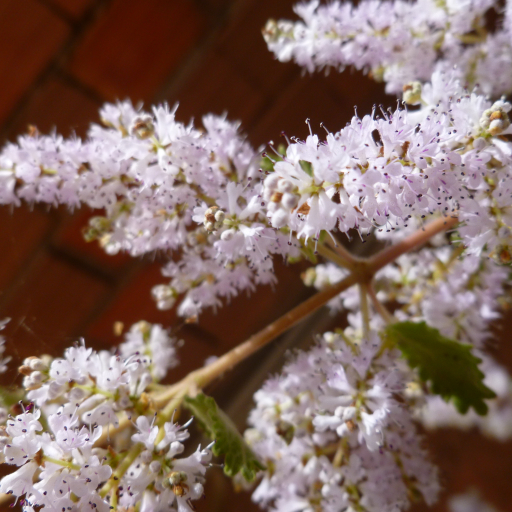
Plant Overview
Often called the "Ginger Bush" or "Misty Plume Bush," this South African native is a showstopper for the winter-weary gardener. It is beloved for its dramatic, cloud-like plumes of pale-lilac flowers that erupt just as most of the garden is still deep in its winter slumber. In its homeland, it is a staple of traditional medicine, known to the Zulu people as Iboza, a name that honors the plant's aromatic, ginger-scented foliage.
🔍 How to Identify
- 🍃 The Foliage: Large, heart-shaped leaves that are thick, velvety, and covered in fine, sticky hairs. When brushed or crushed, they release a potent, spicy scent reminiscent of ginger and nutmeg.
- 🌸 The Blooms: Thousands of tiny, tubular flowers—ranging from white to pale mauve—clustered in feathery, terminal plumes that give the shrub a "misty" appearance from a distance.
- 🌿 The Structure: A soft-wooded, succulent-like shrub with brittle, square stems. It can reach heights of up to 3 meters (10 feet) if left unpruned.
🏡 In Your Garden
- ✂️ Post-Bloom Pruning: This is a fast-growing, somewhat "leggy" species. To keep it looking lush and prevent it from becoming top-heavy, you should prune it back hard immediately after the flowers fade in early spring.
- ☀️ Frost Sensitivity: While it thrives in heat and can tolerate dry soil, it is very susceptible to frost. Because its stems are semi-succulent and hold a lot of water, a hard freeze can cause the plant to collapse; in cooler zones, it is best kept in a large pot and moved to a sheltered spot for winter.
⚠️ Safety & Toxicity
- ✅ Status: Generally considered non-toxic to humans, cats, and dogs.
- 👐 Contact Sensitivity: The leaves are rich in essential oils and covered in glandular hairs. While not poisonous, the sticky residue can occasionally cause mild skin irritation for people with very sensitive skin during heavy pruning.
✨ Fun Fact
The Ginger Bush is "dioecious," meaning male and female flowers grow on entirely separate plants. Gardeners almost exclusively seek out the male plants, as their flower plumes are significantly larger, fluffier, and more ornamental than the smaller, more discreet female blossoms!

Detailed Care Instructions
To grow Tetradenia Riparia, also known as the water mint plant, you can follow these steps:
- Obtaining a plant: You can start by acquiring a Tetradenia Riparia plant from a nursery or through online purchases from reputable sellers.
- Choosing a suitable location: Tetradenia Riparia thrives in full sun or partially shaded spots, so choose a location that receives several hours of sunlight a day. Ensure the soil is well-draining to prevent waterlogged roots.
- Planting: Dig a hole in the soil that is deep enough for the root ball of the plant. Place the plant in the hole and backfill with soil, gently pressing it around the base of the plant. Ensure the plant is adequately watered after planting.
- Watering: Tetradenia Riparia requires regular watering, but be mindful not to overwater, as it can lead to root rot. Water when the top inch of soil feels dry to the touch.
- Fertilizing: Feed the plant with a balanced, water-soluble fertilizer every 4-6 weeks during the growing season to promote healthy growth. Follow the instructions on the fertilizer packaging for the correct dilution and application rates.
- Pruning: Tetradenia Riparia benefits from regular pruning to maintain a compact shape and encourage bushy growth. Prune back any leggy or overgrown stems, making clean cuts just above a leaf node. This will not only promote new growth but also prevent the plant from becoming straggly.
- Pests and diseases: Tetradenia Riparia is generally resilient to pests and diseases. However, it can occasionally be susceptible to mealybugs or spider mites. Inspect your plant regularly and address any pest issues promptly using appropriate organic pest control methods or insecticidal soap.
- Propagation: If desired, you can propagate Tetradenia Riparia by taking stem cuttings. Snip a 4-6 inch stem just below a node, remove the lower leaves, and place the cutting in a glass of water or a well-draining potting mix. Keep the cutting in a warm, indirect light spot and lightly mist it to maintain humidity. After a few weeks, roots should develop, and you can transfer the cutting into a pot or garden bed.
Remember to research specific care requirements and adjust them based on your local climate and growing conditions.

Place in a window with dappled sun or a spot in the middle of a room. Or directly in a window facing west or east.

1. Determine the appropriate watering schedule for the plant based on its natural environment. Tetradenia Riparia typically grows in a semi-arid climate, so it may not require frequent watering.
2. Ensure that the soil is well-draining to prevent waterlogging and root rot.
3. Water the plant slowly and deeply to ensure that the water reaches the roots. Shallow watering can cause the roots to grow closer to the surface and become more vulnerable to drought.
4. Use room-temperature water to avoid shocking the plant's roots with cold water.
5. Avoid watering the leaves or stem of the plant, as this can promote fungal growth and disease.
6. Check the soil moisture level before watering to ensure that the plant actually needs water. The top inch of soil should be dry before watering.
7. Consider using a watering can or drip irrigation system to deliver water directly to the soil around the plant and avoid splashing water onto the foliage.
To properly fertilize this plant, you should apply a balanced fertilizer with an NPK ratio of 10-10-10. Fertilize every two weeks during the growing season, reducing to once a month during the winter. Be sure to follow the label instructions for application rates. Additionally, you may also want to consider using an organic fertilizer or compost to promote healthy soil and plant growth.
Tetradenia Riparia plant prefers a well-draining soil that is rich in organic matter. It requires soil with a pH level ranging from slightly acidic to neutral. The soil type should be loamy, with some sand and clay content. The plant grows well in soil that is moist but not waterlogged. It is recommended to mix some perlite or coarse sand to the soil mix to improve drainage. The plant does not tolerate heavy clay soils, so it is essential to avoid using soil that retains too much moisture. It is also suggested to fertilize the plant with a slow-release fertilizer that contains balanced nutrients to promote healthy growth.
To propagate this plant, first gather cuttings from the parent plant. Choose a healthy stem that is at least 4 inches long, and make a clean cut just below a node using a sharp, sterile knife or pruner.
Remove any leaves from the lower half of the stem, and dip the cut end in rooting hormone powder to promote root growth.
Prepare a pot with well-draining soil, and make a hole in the center with a pencil. Insert the cutting into the hole, firming the soil around it to ensure good contact. Water the soil until it is just moist, and cover the pot with a plastic bag or a plastic tent to create a greenhouse effect.
Place the pot in a warm, bright location out of direct sunlight, and mist the cutting daily to keep it moist. Check for roots after 2-4 weeks by pulling gently on the stem. If you feel resistance, roots have formed and the plant can be gradually acclimated to more light and less humidity.
Once the new plant is growing vigorously, it can be transplanted into a larger pot or directly into the garden.
Common pests of the iboza include Mealybugs, spider mites, thrips. Make a habit of checking your iboza frequently for pests so that any infestations can be caught and managed early.








