Plant Overview
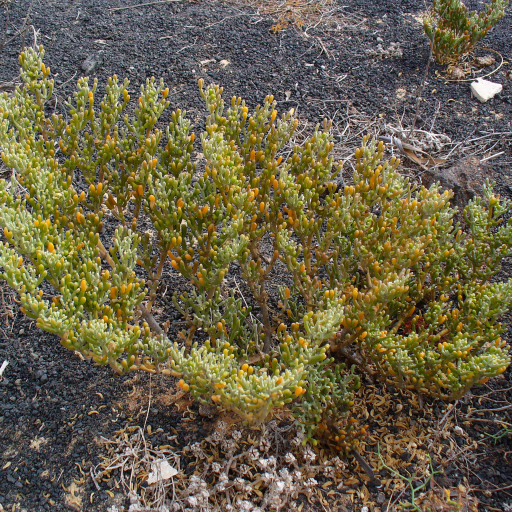
Known affectionately as the "Uva de Mar" (Sea Grape) or "Salgadinha" in its native regions, Tetraena fontanesii is a master of survival. This hardy succulent shrub is a specialist of the Macaronesian coasts, often found clinging to the wind-swept volcanic rocks of the Canary Islands and Cape Verde. It is a plant that thrives where others perish, turning harsh salt spray and intense sun into a vibrant display of fleshy, bead-like foliage.
🔍 How to Identify
- 🍇 The Foliage: The leaves are highly succulent, cylindrical, and shaped like tiny sausages or grapes. They grow in dense, opposite pairs along the stems.
- 🎨 Color Palette: While it starts as a bright yellowish-green, the plant often turns a striking orange, gold, or reddish-brown. This "stress coloring" is a natural sunscreen against the intense Atlantic UV rays.
- 🌸 The Flowers: It produces small, solitary flowers that are typically white or pale pink with four petals. They are subtle but charming when they peek out from between the fleshy leaves.
🏡 In Your Garden
- 🌊 Salt Specialist: This is a true halophyte, meaning it loves salt. If you live near the ocean, it is one of the few plants that will actively enjoy the salty mist that usually kills garden ornamentals.
- 🏜️ Drought Defiance: Because it stores so much water in its "beads," it can go long periods without a drop of rain. It requires extremely well-draining, sandy soil—if the roots sit in damp, heavy earth, the plant will quickly rot.
⚠️ Safety & Toxicity
- 🟢 Status: Generally non-toxic and safe to handle.
- 👅 Details: While not known to be poisonous to pets or humans, the plant accumulates high levels of salt from its environment. This makes it taste incredibly bitter and salty, which usually prevents curious pets or children from eating enough to cause a stomach upset.
✨ Fun Fact
The Tetraena fontanesii acts as a tiny coastal engineer; its low-growing, matted structure helps trap blowing sand, slowly building and stabilizing the very dunes it lives on. It is a vital player in preventing coastal erosion in fragile island ecosystems!

Detailed Care Instructions

Place in a bright room that is sun drenched almost all day. Or directly in a south-facing window.

Tetraena Fontanesii plant requires regular watering to maintain its health and growth. When watering this plant, it is important to use a watering can or hose that has a fine nozzle to avoid disturbing the soil or damaging the delicate roots. Water the plant thoroughly but avoid overwatering or leaving it in standing water, as it can cause root rot.
Before watering, check the soil to see if it needs watering – the top inch or so of soil should be dry to the touch. If it is still moist, wait a few more days before watering. When watering, pour the water around the base of the plant, making sure to wet the soil evenly. Avoid getting water on the foliage, as this can lead to disease or fungal growth.
In hot or dry weather, Tetraena Fontanesii may require more frequent watering to prevent the soil from drying out completely. It is also beneficial to add a layer of mulch around the base of the plant to help retain moisture and regulate soil temperature.
Overall, proper and consistent watering is essential to keep Tetraena Fontanesii plant healthy and thriving.
To ensure optimal growth and health of the Tetraena Fontanesii plant, it is recommended to use sandy, well-draining soil. The soil should have a pH level of around 6.5 to 7.5. It is important to avoid using heavy, compacted soil as it can lead to poor drainage and root rot. Adding a layer of gravel or sand at the bottom of the pot can help with drainage. Additionally, adding organic matter such as compost or peat moss can improve the soil's nutrient content. Over-fertilizing should be avoided as it can be harmful to the plant. Regular watering should be provided, but the soil should not be saturated.








