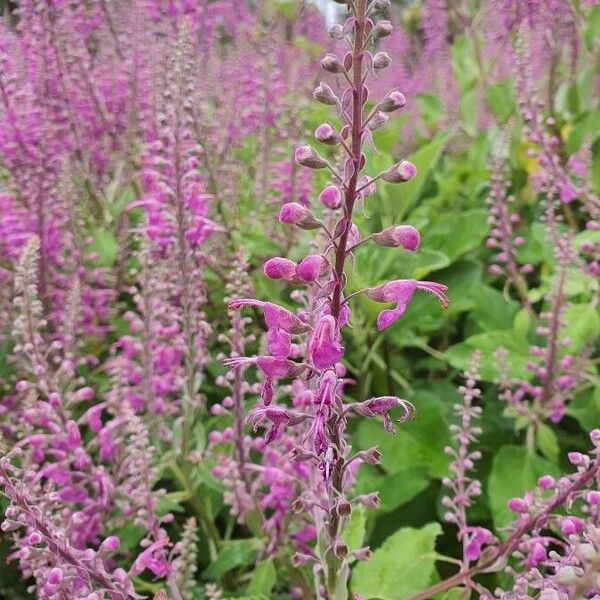
Plant Overview
Hailing from the misty cliffs and sun-drenched slopes of the Madeira archipelago, Teucrium betonicum—often called the Madeira Germander—is a resilient evergreen that brings a touch of Atlantic wildness to any garden. Known for its silvery, velvety foliage and towering spikes of amethyst blooms, it is a master of survival in rocky terrains. In historical herbology, germanders were often associated with medicinal gardens, though this specific variety is primarily prized today for its architectural beauty and "unbothered" attitude toward heat.
🔍 How to Identify
- 🌿 Foliage: The leaves are a soft grayish-green, lance-shaped, and feature distinctively scalloped (crenate) edges that mimic the "Betony" plant, which is how it earned its name.
- 🌸 Bloom Structure: In late spring and summer, it sends up dense, upright terminal spikes. These are crowded with small, lipped, tubular flowers in shades of lilac, rose, or deep purple.
- 🧤 Velvety Texture: The stems and the undersides of the leaves are covered in a fine, white "tomentum" (wooliness) that gives the plant a shimmering, silvery cast in the sunlight.
🏡 In Your Garden
- 🏜️ The Drainage Requirement: Because this plant evolved on volcanic island cliffs, it is highly sensitive to "wet feet." It prefers rocky or sandy soil where water can move quickly away from the roots, especially during the dormant winter months.
- ✂️ Pruning for Longevity: Without intervention, Madeira Germander can become "leggy" or woody at the base. Giving it a light haircut immediately after the flowers fade will encourage a bushier, more compact shape and better flower production next year.
⚠️ Safety & Toxicity
- 🛡️ General Status: This plant is generally considered non-toxic to touch and is not listed as a primary poisonous threat.
- 🐾 Pet Safety: While not specifically categorized as a deadly plant, many members of the Teucrium genus contain diterpenoids which, if consumed in very large quantities, can cause liver distress. It is best to discourage pets or children from chewing on the foliage.
✨ Fun Fact
Despite being a popular choice for Mediterranean-style gardens globally, in the wild, this plant is a true "island endemic." This means that in its natural state, it grows absolutely nowhere else on Earth except for the tiny islands of Madeira!

Detailed Care Instructions
To water this plant, ensure that the soil is dry to the touch before watering. Use room-temperature water and thoroughly saturate the soil until it drains through the bottom of the pot. Avoid allowing the plant to sit in standing water as it can lead to root rot. Water sparingly during the winter months when growth slows.
To ensure the optimal growth of Teucrium Betonicum, it is important to use soil that is well-draining and able to retain moisture. The soil should have a slightly acidic to neutral pH range, ideally between 6.0 to 7.5. It is recommended to use a mixture of both organic and inorganic matter, such as compost, perlite, and sand, to provide adequate nutrients and aeration to the plant's roots. Additionally, it is best to avoid soil that is too heavy, as it may lead to waterlogging and root rot.








