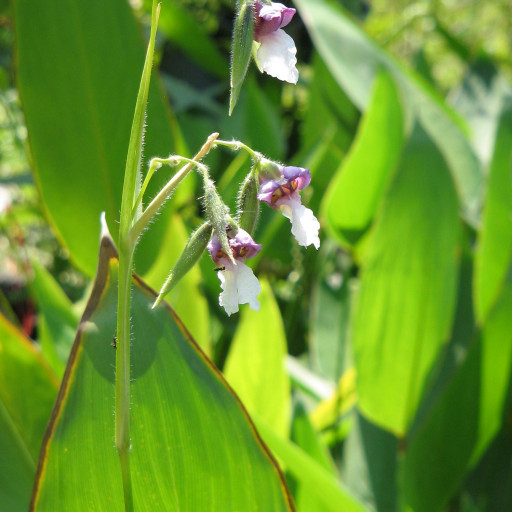
Plant Overview
Meet the Thalia geniculata, a swamp-dwelling giant often called the "Alligator Flag" or "Fire Flag." Native to the wetlands of the Americas and Africa, this plant is a favorite for water gardeners who want to add a touch of prehistoric, architectural drama to their landscapes. Its tall, dancing stems and massive leaves make it look like something straight out of a dinosaur-era marsh.
🔍 How to Identify
- 🍃 Large Foliage: The leaves are massive, paddle-shaped, and can reach up to 2 feet in length. They look very similar to Canna lily leaves but sit atop much longer, slender stalks.
- 📉 The "Bent" Stem: The species name geniculata means "jointed" or "bent like a knee." You’ll notice the flower stalks have a distinct, zig-zag pattern near the top.
- 💜 Purple Droplets: Small, delicate purple flowers hang in pairs from the tips of the wiry, zig-zagging stems, providing a soft contrast to the bold greenery.
🏡 In Your Garden
- 💧 Wet Feet Only: This is a "marginal" aquatic plant, meaning it thrives with its roots submerged in a few inches of water. It is the perfect choice for the shallow edges of a pond or a dedicated bog garden.
- ☀️ Sun Seekers: To keep those stems strong and the leaves vibrant, give it plenty of direct sunlight. In shaded areas, the plant may become "leggy" and the tall stems might flop over under their own weight.
- 🌱 Rhizome Power: It spreads via underground rhizomes. If you have a small pond, it’s best to keep it in a submerged pot to prevent it from taking over the entire water feature.
⚠️ Safety & Toxicity
- ✅ Non-Toxic Status: Thalia geniculata is generally considered safe and non-toxic to humans, cats, and dogs.
- ✋ Mechanical Irritation: While not chemically toxic, the large, fibrous leaves can be tough to digest if a pet nibbles on them, and the tall stalks can be a minor tripping hazard if they overhang garden paths.
✨ Fun Fact
The name "Alligator Flag" is literal! In the Florida Everglades, the movement of these tall leaves often acts as a signal; when an alligator swims through the underwater stems, the "flags" above the water shake, warning locals of the predator's presence nearby.

Detailed Care Instructions
| Humidity | Normal |
| Lighting | Part Sun |
| Difficulty | Medium |
| Temperature | 14°C - 30°C |
| Hardiness Zones | 6 - 10 |
To successfully grow Thalia Geniculata plant, follow these steps:
- Choose the right location: Thalia Geniculata plants prefer full sun to partial shade, so select a spot in your garden that receives at least 4-6 hours of direct sunlight. Ensure the soil is fertile, rich in organic matter, and well-draining.
- Prepare the soil: Thalia Geniculata plants thrive in moist soil. Before planting, amend the soil with compost or well-rotted manure to improve its fertility and water-holding capacity. Ensure the soil pH is slightly acidic to neutral (around 6.0-7.0).
- Planting: Dig a hole twice the size of the plant's root ball. Place the Thalia Geniculata plant in the hole, making sure it is level with the soil surface. Backfill the hole with soil, gently firming it around the roots to remove any air pockets.
- Watering: Thalia Geniculata plants require consistent watering to maintain moist soil. Water deeply and regularly, especially during periods of hot, dry weather. Avoid overwatering, as it can lead to root rot.
- Mulching: Apply a layer of organic mulch, such as wood chips or straw, around the base of the plant. This helps to conserve moisture, suppress weeds, and regulate soil temperature.
- Fertilization: Thalia Geniculata plants benefit from regular fertilization. Apply a balanced, slow-release fertilizer in early spring and mid-summer, following the manufacturer's instructions. Alternatively, you can use organic fertilizers like compost or well-rotted manure.
- Pruning: Prune Thalia Geniculata plants in early spring to remove any dead or damaged foliage. This helps to promote healthy growth and maintain an attractive appearance.
- Propagation: Thalia Geniculata plants can be propagated through division. After a few years of growth, dig up the plant and separate it into smaller sections, ensuring each section has roots attached. Replant these divisions in separate pots or in the garden.
- Winter care: Thalia Geniculata plants are not frost-tolerant and may require protection during winter. In colder climates, cut back the plant's foliage, mulch the base with a thick layer of straw or leaves, and cover with a frost blanket or burlap for extra insulation.
By following these steps, you can successfully grow Thalia Geniculata plant and enjoy its beautiful flowers and lush foliage.

Place in a bright room that is sun drenched almost all day. Or directly in a south-facing window.

The best method to water this plant is to first check the moisture level of the soil by pressing your finger about an inch deep into the soil. If the soil is dry, it is time to water the plant. Slowly pour water into the soil until it starts to seep out from the drainage holes at the bottom of the pot. Avoid overwatering, which can cause root rot and kill the plant. It is also essential to ensure that the soil has proper drainage to prevent standing water. The frequency of watering may vary depending on factors such as temperature, humidity, and light conditions, but generally, it is recommended to water the plant once a week.
To fertilize Thalia Geniculata plant, use a balanced fertilizer with a 3-1-2 NPK ratio. Apply the fertilizer every month during the growing season, and reduce the frequency to once every two months during the colder months. Dilute the fertilizer in water and apply around the base of the plant, making sure not to get it on the leaves or stems. Water the plant thoroughly after fertilizing. Avoid over-fertilizing, as this can cause damage to the plant.
Thalia geniculata is a water-loving plant and requires a soil that is rich in organic matter with good drainage. It is recommended to use a soil that is loamy and has a pH between 6.0 and 7.5. A mixture of peat moss, sand, and compost is a good option for planting Thalia geniculata. The soil should be kept consistently moist, but not waterlogged, as the plant thrives in wet conditions but cannot tolerate being completely submerged in water. Fertilization is important for optimal growth and flowering, and a balanced fertilizer with equal parts nitrogen, phosphorus, and potassium can be applied every six weeks during the growing season. Over-fertilization should be avoided as it can lead to excessive growth with weak stems.
To propagate this plant, you will need to first obtain a healthy parent plant. Then, you can take cuttings from the parent plant's stem or rhizome. Make sure to use a clean, sharp pair of garden shears to avoid damaging the plant.
For stem cuttings, choose a healthy stem that is at least 6 inches long and contains several leaves. Cut the stem at a 45-degree angle, making sure to include at least one node (the area where leaves attach to the stem). Remove the bottom set of leaves from the stem and dip the cut end into rooting hormone powder. Place the cutting into a pot filled with moist potting soil and cover the pot with a plastic bag to create a humid environment.
For rhizome cuttings, use a clean pair of garden shears to cut a small section of the rhizome that contains at least one node and one growing tip. Dip the cut end into rooting hormone powder and plant it in a pot filled with suitable soil. Ensure that the soil is kept constantly moist for the best chance of successful propagation.
Place the pots in a warm, bright location that receives indirect sunlight. Mist the cuttings with water daily and keep the soil moist but not waterlogged. In about 4-6 weeks, new roots should start to form, and the plant will begin to grow new leaves. Once the plant has established a healthy root system, it can be transplanted into a larger pot or out in the garden.








