Plant Overview
Often called the Chinese Meadow Rue or "Lavender Mist," this plant is the ballerina of the perennial border. Native to the high-altitude forests and meadows of Western China, it is beloved for its ethereal, "see-through" quality. Despite its delicate, cloud-like appearance, it is surprisingly hardy and adds a sophisticated, airy texture to any shaded garden corner.
🔍 How to Identify
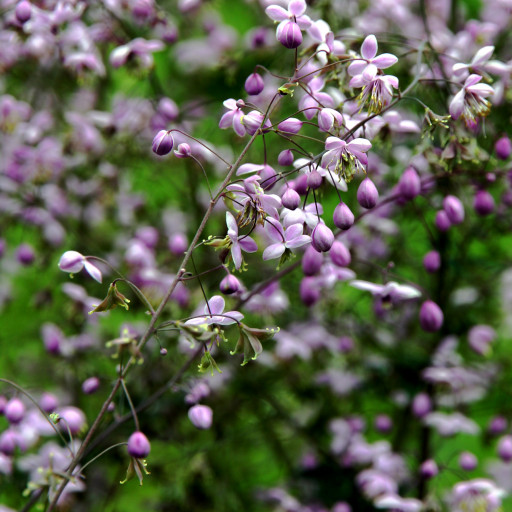
- 🌸 The Flowers: Massive, branching panicles of tiny, nodding lilac or soft purple bells. Each flower features a prominent cluster of creamy yellow anthers that hang down like little tassels.
- 🌿 The Foliage: Exquisite glaucous-green leaves that look remarkably like Aquilegia (Columbine) or Maidenhair Fern. The leaves are divided into many small, rounded leaflets.
- 🎋 The Stems: Tall, wiry, and often tinted with a deep purple or burgundy hue. They are remarkably strong for how thin they appear, though they may sway gracefully in a breeze.
🏡 In Your Garden
- 💧 Cool Feet, Airy Head: This plant thrives in "woodland" conditions. It loves rich, humic soil that stays consistently moist. It hates drying out during the summer, which can lead to the foliage crisping at the edges.
- 🌱 The Taproot Rule: Like many members of the Ranunculaceae family, it develops a deep root system and deeply resents being moved once established. Pick its "forever home" carefully to avoid transplant shock.
- 🛡️ Supportive Friends: While the stems are sturdy, the flower heads are so light and tall that they benefit from being planted among mid-sized shrubs or sturdier perennials that can provide a natural scaffolding.
⚠️ Safety & Toxicity
- 🐾 Mildly Toxic: Like most Meadow Rues, Thalictrum delavayi contains small amounts of ranunculin and alkaloids. It is generally avoided by deer and rabbits.
- 👶 Human Safety: If ingested in large quantities, it can cause stomach upset or nausea. The sap may also cause mild skin irritation or dermatitis in sensitive individuals, so wearing gloves while pruning is a smart precaution.
✨ Fun Fact
The variety 'Hewitt’s Double' is one of the most famous cultivars; it produces tiny, perfectly spherical double blooms that look like miniature purple pom-poms and last significantly longer than the single-flowered wild species.

Detailed Care Instructions
To grow Thalictrum Delavayi (also known as Chinese meadow rue), follow these steps:
- Choose a suitable location: Thalictrum Delavayi prefers partial shade to full sun, so select a spot in your garden that receives morning sun or dappled sunlight throughout the day.
- Soil preparation: The plant grows best in moist, well-draining soil. Amend the soil with organic matter, such as compost, to improve drainage and provide nutrients.
- Planting: Dig a hole that is slightly larger than the root ball of the plant. Place the plant in the hole, ensuring the crown (where the stems meet the roots) is level with the soil surface. Backfill the hole and gently firm the soil around the plant.
- Watering: Thalictrum Delavayi requires regular watering, especially during dry periods. Water thoroughly after planting and continue to water regularly, keeping the soil consistently moist but not waterlogged.
- Mulching: Apply a layer of organic mulch around the plant to conserve moisture, suppress weed growth, and regulate soil temperature.
- Provide support: Thalictrum Delavayi can grow quite tall and may require staking or support to prevent the stems from flopping over. Place stakes or a plant cage around the plant early in the growing season to provide support.
- Fertilization: Fertilize the plant in early spring with a balanced slow-release fertilizer to promote healthy growth. Follow the instructions on the fertilizer packaging for application rates.
- Maintenance: Remove any dead or faded flowers to prolong blooming and encourage additional flower production. Cut back the plant to the ground in late autumn or early winter, as it goes dormant.
- Division: Thalictrum Delavayi can be divided every few years to maintain vigor. Dig up the plant in early spring or late autumn and carefully separate the clumps into smaller sections. Replant the divided sections in prepared soil.
- Pests and diseases: Thalictrum Delavayi is generally resistant to pests and diseases, but it may occasionally be affected by aphids or slugs. Monitor the plant regularly and take appropriate measures, such as using organic insecticides or slug repellents, if necessary.
By following these steps, you can successfully grow Thalictrum Delavayi and enjoy its beautiful flowers in your garden.

Place in a window with dappled sun or a spot in the middle of a room. Or directly in a window facing west or east.

To properly water this plant, you should ensure that the soil is moist but not waterlogged. Take care not to let the soil dry out completely between watering, but also avoid overwatering which can cause poor growth and potentially root rot. A good rule of thumb is to water thoroughly once per week or more frequently in hot, dry weather. Avoid getting water on the foliage as this can increase the risk of disease development.
- Use a balanced fertilizer with equal amounts of nitrogen, phosphorus, and potassium.
- Apply the fertilizer in early spring before new growth appears.
- Water the plant thoroughly before fertilizing.
- Scatter the fertilizer evenly around the base of the plant.
- Avoid getting fertilizer on the foliage or flowers.
- Water the plant again after fertilizing to help the nutrients soak into the soil.
Thalictrum Delavayi prefers a well-draining soil that is slightly acidic with a pH ranging from 6.0 to 7.0. The ideal soil for this plant is rich in organic matter, such as compost or aged manure. It thrives in loamy soils that are moist but not waterlogged. This plant should not be planted in heavy clay soils that can retain too much moisture and cause root rot. A light, sandy soil that does not hold water for too long can also be used, but it should be amended with organic matter. Adequate soil preparation prior to planting is important to ensure the best growing conditions for Thalictrum Delavayi.
To propagate this plant, you will need to take cuttings from the stem or divide the plant at the root. For stem cuttings, select a healthy stem and cut it near the base. Remove all leaves except for the top two or three. Dip the cut end in rooting hormone and plant the cutting in a pot filled with a well-draining potting mix. Water the cutting and keep it in a bright area with indirect sunlight. Mist the cutting regularly to keep it moist.
To divide the plant, carefully dig up the root ball and separate the plant into smaller sections. Each section should have a healthy root system and stems with leaves. Replant the sections in pots or back into the garden, taking care to keep the soil moist until the plant has established itself.
Propagation success may vary depending on growing conditions and the individual plant.








