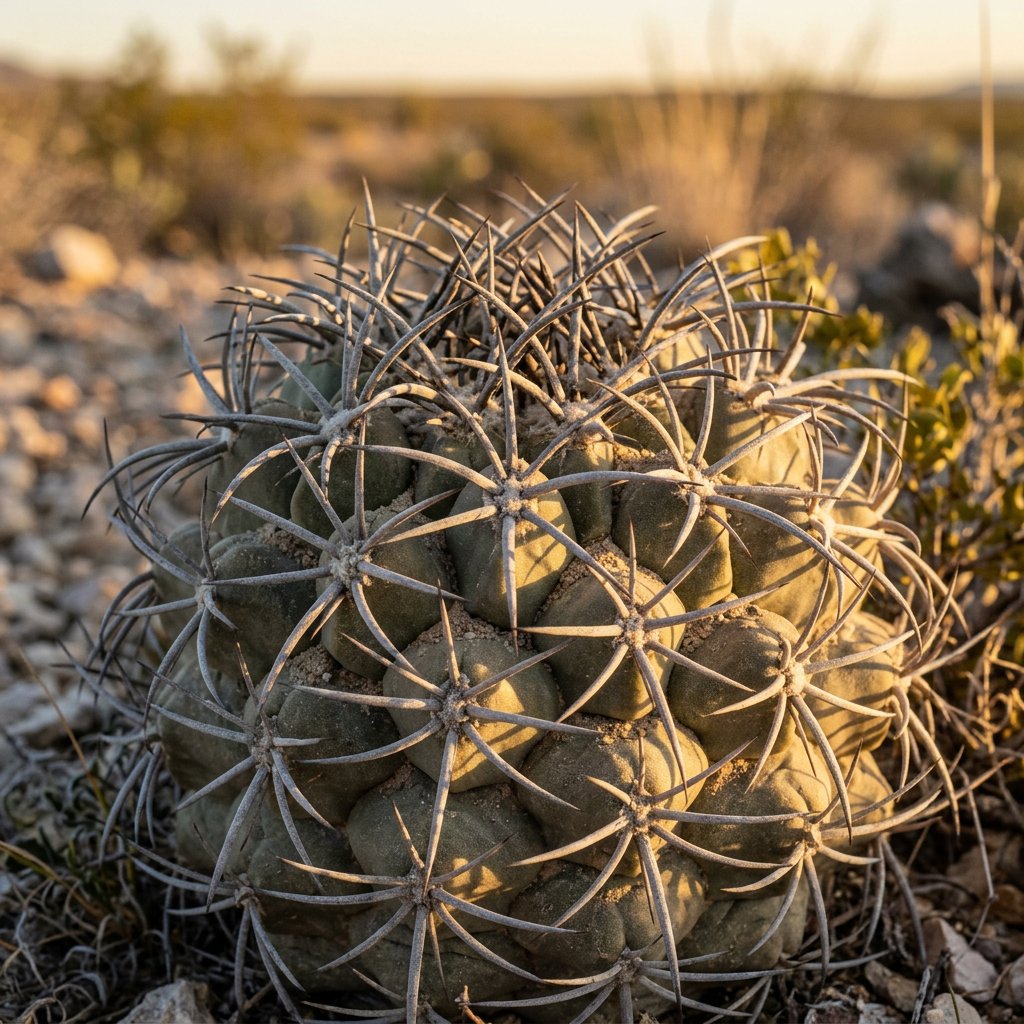
Plant Overview
Known as the "Six-angled Cactus," this Mexican desert dweller is a master of geometric symmetry. Its name, hexaedrophorus, literally means "bearing six-sided shapes," referring to the distinct, chunky tubercles that cover its surface like a suit of armor. In its native Chihuahuan Desert, it often grows tucked among limestone rocks, blending in perfectly until it erupts with massive, silky flowers in the spring.
🔍 How to Identify
- 🌵 The Body: A globular, slightly flattened stem that stays relatively small. Its skin is a matte, glaucous bluish-gray or olive green, divided into large, distinct hexagonal bumps (tubercles) rather than continuous ribs.
- 🪡 The Spines: Each tubercle is topped with a cluster of strong, needle-like spines. These range in color from chalky white to a deep, rustic reddish-brown, providing a beautiful contrast against the pale skin.
- 🌸 The Bloom: It produces surprisingly large, funnel-shaped flowers right at the crown. They are typically white or pale pearlescent pink, often featuring a darker stripe down the center of each petal and a bright yellow center.
🏡 In Your Garden
- 🪨 The Taproot Trap: This cactus develops a thick, fleshy taproot that acts as a water reservoir. Because of this, it is extremely sensitive to "wet feet." It requires a very gritty, mineral-heavy soil mix (mostly pumice or lava rock) to ensure the root never sits in moisture, which can cause it to rot rapidly.
- ☀️ Sun-Kissed Colors: While it thrives in bright, direct light, some growers notice that giving it a "hard" life with plenty of sun and slightly less water brings out a gorgeous purplish or bronze tint in the skin, a natural defense mechanism that makes the plant even more striking.
⚠️ Safety & Toxicity
- 🌵 Physical Hazard: The primary danger of the Six-angled Cactus is its spines. They are stiff, sharp, and capable of puncturing skin easily. Always use thick leather gloves or specialized tongs when repotting.
- 🐾 Non-Toxic: This species is generally considered non-toxic to cats, dogs, and humans. While it won't poison a curious pet, the spines are a significant deterrent and can cause mouth or paw injuries if a pet tries to play with it.
✨ Fun Fact
Unlike many other cacti that have straight vertical ribs to channel water, Thelocactus hexaedrophorus uses its hexagonal tubercles to expand and contract like an accordion. This allows it to soak up massive amounts of water quickly during rare desert rainstorms without splitting its skin!

Detailed Care Instructions
To grow Thelocactus hexaedrophorus plant, also known as the hedgehog cactus, you can follow these steps:
- Climate: Ensure that you live in a suitable climate for Thelocactus hexaedrophorus, which is warm and arid. These plants thrive in USDA hardiness zones 9-11.
- Lighting: Provide bright, indirect sunlight for at least 6-8 hours a day. Place the plant near a south-facing window or use artificial grow lights.
- Temperature: Maintain a temperature range between 60-85°F (15-29°C) during the day and around 50-65°F (10-18°C) at night. Avoid exposing the plant to extreme temperature fluctuations.
- Soil: Use a well-draining cactus potting mix or create a mix by combining regular potting soil with perlite or sand. Ensure that the container has drainage holes to prevent waterlogging.
- Watering: Thelocactus hexaedrophorus is drought-tolerant and prefers infrequent watering. Water the plant thoroughly when the top inch (2.5 cm) of soil feels dry and then allow it to dry out completely before watering again. Be cautious not to overwater as it can lead to root rot.
- Humidity: These plants thrive in low humidity environments, so there is no need to provide extra humidity.
- Fertilizer: Apply a balanced cactus fertilizer diluted to half the recommended strength once a month during the growing season (spring and summer). Avoid fertilizing during the dormant period in winter.
- Repotting: Repot the Thelocactus hexaedrophorus plant every 2-3 years or when it outgrows its current container. Choose a slightly larger pot, carefully remove the plant from the old pot, and plant it in the new one using fresh cactus potting mix.
- Pruning: Remove any dead, damaged, or overcrowded growth using sterilized pruning shears. The hedgehog cactus generally doesn't require extensive pruning.
- Pests and diseases: Monitor the plant regularly and watch out for common cactus pests like mealybugs, scale insects, and spider mites. Treat any infestations promptly using organic insecticidal soap or neem oil.
By following these steps, you can successfully grow Thelocactus hexaedrophorus and enjoy its unique beauty.

Place in a bright room that is sun drenched almost all day. Or directly in a south-facing window.

Thelocactus Hexaedrophorus plant requires regular watering during its growing season, which is typically in the spring and summer months. The frequency of watering depends on various factors like the climate, pot size, soil composition, and amount of sunlight it receives.
The soil should be kept slightly moist, but it should not be waterlogged, as this can cause root rot. Before watering, ensure that the soil is completely dry to the touch, and then add water until it starts to leak out of the drainage holes. Allow excess water to drain out completely and then place the plant back in its location.
In the winter months, the plant should be watered sparingly or not at all since it is generally dormant. Finally, it is always better to underwater than overwater the plant and always use room temperature or lukewarm water to avoid shocking the plant's root system.
To fertilize this plant, you should use a balanced fertilizer with equal parts nitrogen, phosphorus, and potassium. Apply the fertilizer twice a year, once in the spring and once in the fall. Water the plant thoroughly before applying the fertilizer and avoid getting the fertilizer on the plant's leaves or stem. Additionally, make sure to dilute the fertilizer according to the instructions on the packaging, as over-fertilizing can harm the plant.
Thelocactus Hexaedrophorus should be planted in a well-draining soil mix that provides good aeration. The soil should not be too dense or compacted as this can lead to waterlogging and root rot. Sand, perlite, and pumice can be added to improve drainage and prevent the soil from becoming waterlogged. It is important to avoid using heavy garden soils or potting mixes that contain large amounts of organic matter as these can hold too much moisture and cause problems for the plant. A soil mix that is low in nutrients is also recommended as the plant does not require high levels of fertilization.
To propagate this plant, you will need to start by carefully removing offsets (smaller plants growing off the main plant) from the base of the parent plant using a sharp, sterile knife.
Once you have the offsets, let them dry for a couple of days to ensure that the cut end has calloused over. After this, plant them in a well-draining soil mix in a small pot, keeping the soil lightly moist until you see new growth.
You can also propagate this plant from seeds, which should be sown in a well-draining soil mix and kept moist. It may take several weeks for the seeds to germinate, so be patient. Once the seedlings have grown large enough, they can be transplanted into their own pots.
Propagation of this plant can be done year-round, but it is best to avoid doing it during the dormant period in the winter months.
Common pests of the thelocactus hexaedrophorus include Scale insect, mealybugs, spider mites. Make a habit of checking your thelocactus hexaedrophorus frequently for pests so that any infestations can be caught and managed early.








