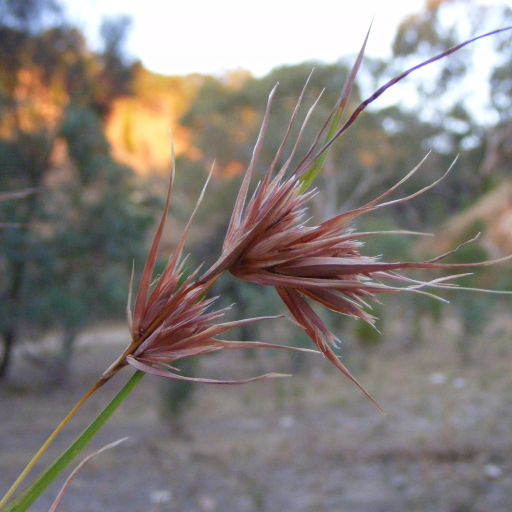
Plant Overview
Known as "Kangaroo Grass" in Australia and "Rooigras" in South Africa, this iconic perennial is a staple of the wild savanna and open woodlands. It’s more than just a background plant; it’s a living seasonal calendar, shifting its wardrobe from lush emerald greens to a deep, burnt orange as the weather cools. For thousands of years, it has been a vital resource, with its seeds even being ground into flour by Indigenous cultures.
🔍 How to Identify
- 🌾 Seed Heads: The most distinct feature is the large, drooping clusters of triangular spikelets. These look like dark, spiky beads with long, twisted "tails" called awns.
- 🎨 Seasonal Colors: During the growing season, the leaves are a soft blue-green, but they transition into striking shades of copper, rusty red, and purple-bronze in autumn and winter.
- 📏 Growth Habit: It forms dense, arching tufts (tussocks). While the foliage usually stays around knee-height, the flowering stems can shoot up to 1.5 meters tall.
🏡 In Your Garden
- ☀️ Drought Resilience: This grass is a master of survival. It thrives in nutrient-poor soils and requires very little water once established, making it the ultimate "set and forget" choice for a low-maintenance or rockery garden.
- 🔥 Fire Adaptation: In its natural habitat, Themeda triandra actually benefits from occasional fires. The heat clears away old, dead thatch and triggers a flush of vibrant, nutrient-rich new growth from the base.
- 🦋 Wildlife Haven: It acts as a bustling "insect hotel." It is a primary food source for the larvae of various brown butterfly species and provides essential nesting material and shelter for small birds and lizards.
⚠️ Safety & Toxicity
- ✅ Safe Status: This plant is non-toxic to humans, dogs, and cats. In fact, it is prized as a high-quality forage grass for both livestock and wild grazing animals like kangaroos and antelopes.
- 🌵 Seed Warning: While not poisonous, the seeds are very sharp. The long awns are designed to "drill" into the earth, but they can occasionally become lodged in a pet's fur, ears, or between their toes, causing minor irritation.
✨ Fun Fact
The seeds of Kangaroo Grass are "self-planting" engineers! The long, hair-like tails (awns) are hygroscopic, meaning they twist and untwist in response to humidity changes. This mechanical movement literally screws the seed into the soil, ensuring it reaches the perfect depth to germinate.

Detailed Care Instructions
To grow Themeda triandra, also known as kangaroo grass, you can follow these steps:
- Seed collection: Collect mature seeds from existing plants or purchase them from a reputable nursery or seed supplier.
- Seed preparation: Soak the seeds in water for 24 hours to enhance germination.
- Soil preparation: Choose a well-draining soil that is slightly acidic to neutral, with a pH range of 6.0-7.0. Remove any weeds or unwanted vegetation from the planting area.
- Planting: Plant the soaked seeds directly into the ground or in pots. Ensure the seeds are sown at a depth of 1-2 cm (0.4-0.8 inches) and spaced around 15-20 cm (6-8 inches) apart.
- Watering: Water the area thoroughly after planting to provide adequate moisture for germination. Monitor the soil moisture and keep it consistently moist during the germination period, which typically takes around 2-3 weeks.
- Sunlight: Themeda triandra thrives in full sun, so choose a location that receives at least six hours of direct sunlight each day.
- Fertilizer: Kangaroo grass usually grows well without additional fertilizers. However, if the soil is nutrient-poor, you can add a slow-release, low-nitrogen fertilizer during the growing season for better results.
- Maintenance: Once the plants are established, regular watering is generally not required. However, during extended periods of drought, it may benefit from occasional watering. Remove any weeds that compete with the plants for nutrients and sunlight.
- Harvesting: Themeda triandra can be left to grow and produce seeds naturally. Alternatively, you can harvest the seeds when they have ripened, typically after flowering. Check the plants regularly to prevent the seeds from dispersing naturally.
- Propagation: To propagate more Themeda triandra plants, collect the seeds and follow the previous steps for planting, or divide established clumps in early spring.
Remember to check if Themeda triandra is native to your region and if any permits or guidelines are required before cultivating it.

Place in a bright room that is sun drenched almost all day. Or directly in a south-facing window.

To properly water this particular plant, it is important to first understand its native environment and habitat. Themeda Triandra typically grows in grasslands and savannas with fluctuating rainfall patterns. As such, the plant is adapted to withstand periods of drought and respond quickly to rainfall.
When watering this plant, it is important to avoid overwatering as this can lead to root rot and other issues. Instead, water the plant sparingly but deeply, allowing the water to soak down to the roots. It is also important to water the plant during the early morning or late afternoon, when temperatures are cooler and the sun is not as intense, as this will reduce the risk of water evaporation.
One way to monitor the soil moisture level is to stick a finger into the soil and check for dryness or dampness. If the soil feels dry a few inches down, it is time to water the plant. It is also important to maintain good drainage, such as using soil that is well-draining or adding pebbles or sand to the soil.
Overall, the key to successfully watering Themeda Triandra is to find a balance between avoiding overwatering and ensuring that the plant receives enough moisture to thrive.
To fertilize this plant, you should apply a balanced fertilizer with an NPK ratio of 10-10-10. Apply the fertilizer once a month during the growing season, typically from late spring to early fall. Be sure to follow the instructions on the fertilizer package for the specific application rate and method. Avoid over-fertilizing as this can cause damage to the plant.
Themeda Triandra is a type of plant that prefers a well-draining soil that is rich in nutrients. It does well in soil that has a pH level of 6.5 to 7.5, with a loamy texture. The soil for this plant should be well-aerated, with good water retention, and a moderate level of organic matter. It is recommended to mix the soil with coarse sand, perlite, or vermiculite to improve drainage. The plant prefers soils that are not compacted and do not have a heavy clay content. Its root system is relatively shallow, which is why it requires good soil aeration. In general, the soil for Themeda Triandra should be fertile, moist, and well-draining to ensure healthy growth.
One way to propagate this plant is through seed collection. Wait until the seed heads turn brown and are dry, then collect the seeds. Store them in a dry and cool place until ready to plant. To plant, clear the area where you want to grow the plant, loosen the soil, and scatter the seeds. Cover with a thin layer of soil, tamp down gently, and water well. Keep the area moist until the seeds germinate, which should happen within 2-3 weeks.
Another way to propagate this plant is through root division. When the plant is mature, dig up the clump and separate the roots into smaller sections with sharp, clean tools. Each section should have some roots and leaves. Replant the divisions into prepared soil, water well, and keep the area moist until the divisions establish themselves.
Another method is through stem cuttings. Take a stem cutting from a healthy and mature plant, cut off the lower leaves to create a stem about 5-10cm long. Dip the cut end in rooting hormone and plant it in a pot filled with a well-draining soil mix. Water well and keep the soil moist until roots have formed. Transplant the new plant to the desired location once it has established a good root system.
Common pests of the red grass include Larvae. Make a habit of checking your red grass frequently for pests so that any infestations can be caught and managed early.








