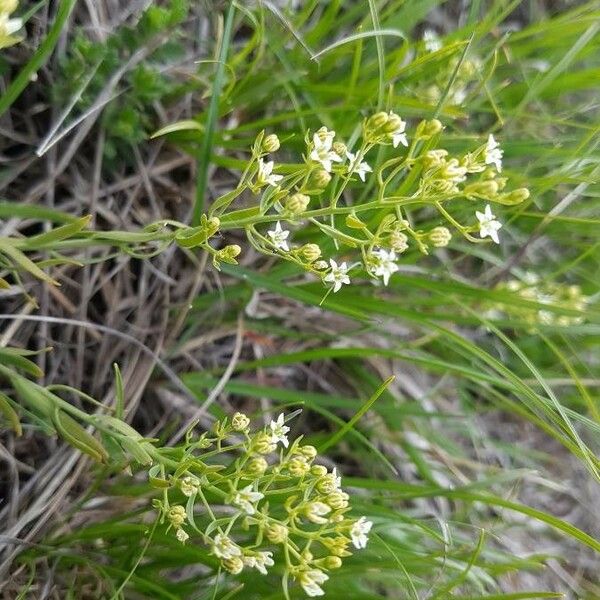
Plant Overview
Often called the Flax-leaved Toadflax, this delicate perennial is a bit of a "secret agent" in the botanical world. While it looks like a simple, grassy wildflower, it is actually a hemiparasite that secretly taps into the roots of neighboring plants to steal nutrients. Found across Central and Eastern Europe, it brings a subtle, star-studded elegance to dry, sunny hillsides.
🔍 How to Identify
- 🌿 Stems & Growth: It features slender, upright, and somewhat wiry stems that often grow in loose clumps, typically reaching about 15 to 30 cm in height.
- 🍃 The Leaves: The leaves are long, narrow, and lance-shaped—strikingly similar to the leaves of a flax plant (Linum), which is exactly how it earned its name linophyllon.
- 🌸 The Flowers: Look for tiny, star-like white blossoms with five pointed lobes. These aren't traditional petals but "tepals," and they appear in loose, airy clusters at the tips of the branches during the summer months.
🏡 In Your Garden
- 🤝 The Root Connection: This plant is rarely found in traditional garden centers because it is a "hemiparasite." While it can photosynthesize on its own, it survives best by using specialized root structures called haustoria to "borrow" water and minerals from the roots of nearby grasses.
- ⛰️ Specific Habitat: In the wild, it is a specialist of limestone and chalky grasslands. It thrives in poor, well-drained soils where the sun is bright and the drainage is impeccable, making it a rare sight in lush, fertilized garden beds.
⚠️ Safety & Toxicity
- 🛡️ General Status: Thesium linophyllon is generally considered non-toxic to humans, livestock, and household pets.
- 🚫 Usage: It has no known culinary or medicinal uses. Because it is often rare or protected in certain regions, it should never be foraged or disturbed in the wild.
✨ Fun Fact
🏛️ The genus name Thesium is believed to be linked to the legendary Greek hero Theseus, the slayer of the Minotaur. Ancient lore suggests he may have used a related plant to weave a victory garland, or that the plant was named in his honor to signify its hidden strength.

Detailed Care Instructions

Place in a bright room that is sun drenched almost all day. Or directly in a south-facing window.

Some plants require more regular watering than others, which should be done every few days. It's critical to maintain the soil moist all of the time. The water requirements of the same plant placed in pots with varying sizes will differ. Because the water in the smaller pot evaporates faster than the water in the larger pot, it will require more watering. Regardless of pot size, the surface should constantly be maintained moist.








