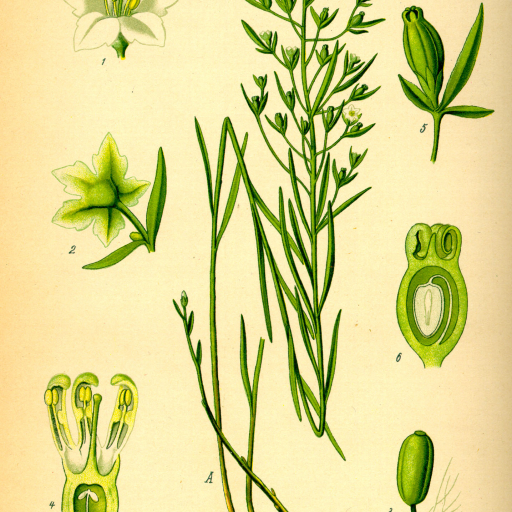
Plant Overview
Often overlooked in the high meadows and alpine pastures of Europe, Thesium pyrenaicum is a master of botanical disguise. Known commonly as the Meadow Bastard Toadflax, this delicate perennial lives a fascinating double life; while it appears to be a simple, independent wildflower, it is actually a "hemiparasite." It performs photosynthesis on its own but secretly siphons extra water and minerals from the roots of neighboring grasses.
🔍 How to Identify
- 🌿 The Foliage: Look for very narrow, linear leaves that are alternate and sit close to the stem, often blending in perfectly with the surrounding grass.
- ⭐ The Flowers: The blooms are tiny, white, and star-shaped, usually featuring five pointed lobes (tepals) that are greenish on the outside and bright white on the inside.
- 🌱 Growth Habit: It typically grows in a low, wiry clump, with stems that can reach up to 30cm but often sprawl or lean against sturdier plants for support.
🏡 In Your Garden
- 🔗 The Root Connection: This plant is rarely found in traditional gardens because it is a "vampire." It requires a host plant—usually a specific grass or clover—to thrive. If you try to transplant it alone, it will likely fail because it cannot survive without its underground host connection.
- 🏔️ Natural Habitat: In the wild, it loves "calcareous" (lime-rich) soils and sunny, open meadows. If you are lucky enough to have it on your property, it is a sign of a healthy, undisturbed ancient grassland ecosystem.
⚠️ Safety & Toxicity
- 🐾 Status: Generally non-toxic but not for consumption.
- ⚠️ Details: While there are no records of Thesium pyrenaicum being deadly, many hemiparasitic plants can absorb chemical compounds or alkaloids from their host plants. It is best to keep curious pets and children from nibbling on it, as it may cause minor stomach upset.
✨ Fun Fact
The "Bastard" in its common name isn't an insult! In historical botany, the term was frequently used to describe plants that looked very similar to a well-known genus (in this case, Linaria or Toadflax) but lacked the specific botanical structures to actually belong to that family.

Detailed Care Instructions

Thesium Pyrenaicum should be watered deeply and consistently to ensure that its roots have access to enough moisture to survive and thrive. When watering, it is important to make sure that the water is evenly distributed throughout the soil and that the plant is not over-watered, which can lead to root rot and other problems. This can be accomplished by using a watering can or hose with a gentle, even stream, and by allowing the water to soak into the soil slowly and thoroughly. It is also recommended that Thesium Pyrenaicum be watered in the morning or evening when temperatures are cooler, as this will reduce the chances of evaporation and help the plant to better retain moisture. Additionally, it is important to make sure that excess water is able to drain away from the roots, so be sure to provide proper drainage by using well-draining soil and adding a layer of gravel or other porous material to the bottom of the planting container.
For optimal growth and health, Thesium Pyrenaicum plant requires a well-draining soil that is rich in organic matter, nutrients, and minerals. A mixture of equal parts sandy loam, compost, and perlite is recommended to ensure good drainage while also providing ample nutrients and aeration for the roots. It is important to avoid using heavy, compacted soil that retains too much water, as this can lead to root rot and other issues. The ideal pH range for Thesium Pyrenaicum plant is between 6.0 and 7.0, so it is important to test the soil and adjust as needed with amendments like lime or sulfur. Additionally, the plant prefers a slightly alkaline environment, so adding some dolomitic limestone to the soil mixture may also be beneficial. Overall, providing well-draining, nutrient-rich soil with optimal pH levels is key to promoting healthy growth and long-term success with Thesium Pyrenaicum plant.








