Plant Overview
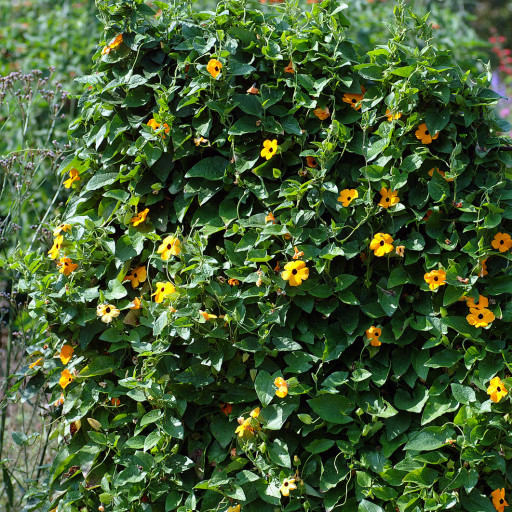
Often called the Black-eyed Susan Vine, this cheerful climber is a favorite for hanging baskets and garden trellises. Native to East Africa, it brings a burst of tropical sunshine to any landscape with its iconic dark-centered blooms that look like tiny, watchful eyes. It is a vigorous grower, capable of creating a lush, flowery screen in just a single growing season.
🔍 How to Identify
- 👁️ The "Eye": The most striking feature is the deep chocolate-purple or black center (the throat) surrounded by five flat, rounded petals in shades of bright orange, sunny yellow, or creamy white.
- 💚 Heart-Shaped Foliage: The leaves are soft, green, and distinctly heart-shaped (cordate) or slightly triangular with slightly jagged edges.
- 🌀 Twining Stems: Unlike plants that use sticky pads or tendrils, this vine climbs by "twining"—the entire stem spirals tightly around any available support like wire, string, or neighboring branches.
🏡 In Your Garden
- 🧗 Vertical Ambition: Because this vine grows upward so rapidly, it requires a trellis or netting early on. If left without support, it won't stop growing; it will simply scramble across the ground to form a thick, flowering groundcover.
- 💧 Thirsty Climber: Due to its fast growth and thin leaves, it loses moisture quickly. It prefers consistently moist soil and may "faint" or wilt visibly if the soil dries out completely, though it usually bounces back quickly once watered.
⚠️ Safety & Toxicity
- ✅ Non-Toxic: Good news for families—Thunbergia alata is generally considered non-toxic to humans, dogs, and cats.
- 👐 Mild Irritation: While not poisonous, the stems are covered in very fine hairs. Some gardeners with highly sensitive skin might feel a slight "itch" after pruning a large vine without gloves.
✨ Fun Fact
Despite its delicate appearance, the Black-eyed Susan Vine is so hardy and fast-growing that in certain tropical regions like Australia and Hawaii, it is actually classified as an invasive species because it can smother local vegetation!

Detailed Care Instructions
| Color | Orange, White, Yellow, Red, Pink |
| Soil Ph | 6.5 To 7.5 |
| Humidity | Normal |
| Lighting | Full Sun |
| Soil Type | Fertile, Well-Drained |
| Bloom Time | Summer (As An Annual) |
| Difficulty | Medium |
| Plant Type | Flowering Vine, Annual Or Perennial |
| Mature Size | 3 To 8 Feet Tall And 3 To 6 Feet Wide |
| Native Area | East Africa |
| Temperature | 5°C - 25°C |
| Sun Exposure | Full Sun To Part Shade |
| Hardiness Zones | 10 To 11 |
To grow Thunbergia Alata (commonly known as Black-eyed Susan vine or Clockvine), follow these steps:
- Planting: Start by selecting a suitable location for planting. Thunbergia Alata prefers full sun to partial shade, so choose an area with adequate sunlight. It can tolerate a range of soil types, but well-draining soil is recommended. Prepare the soil by loosening it with a garden rake and removing any weeds or rocks.
- Seeds or Transplants: You can either start with Thunbergia Alata seeds or purchase transplants from a local nursery. If using seeds, soak them overnight in warm water to improve germination rates before planting. If using transplants, dig a hole slightly larger than the root ball and gently place the plant in the hole, ensuring it is at the same level as the surrounding soil.
- Watering: Thunbergia Alata requires regular watering to establish its root system. Water the plant deeply at the time of planting and continue watering consistently until the roots are established. Afterward, water when the top inch of soil feels dry to the touch. Avoid over-watering, as it can cause root rot.
- Fertilizing: Apply a balanced, slow-release fertilizer when planting, following the manufacturer's instructions. Additionally, you can provide monthly feedings of a liquid fertilizer during the growing season to promote healthy growth and blooming.
- Support: Thunbergia Alata is a vine and needs support to climb. Install a trellis, arbor, or fence near the plant to provide a structure for it to cling to. Initially, you may need to gently secure the vines to the support until they start to climb on their own.
- Pruning: Thunbergia Alata can be pruned if it becomes unruly or to control its size. Pruning should be done in early spring before new growth emerges. Cut back any dead or damaged stems, as well as any excessively long or sprawling growth.
- Pests and diseases: Thunbergia Alata is generally resistant to pests and diseases. However, keep an eye out for aphids, spider mites, or whiteflies. If you notice any infestations, treat them promptly with an appropriate insecticide or by using natural methods like insecticidal soap.
- Winter care: Thunbergia Alata is typically grown as an annual in areas with frosty winters. However, in regions with mild winters, it can be treated as a perennial. Mulch around the base of the plant to protect the roots during colder months.
By following these steps, you can successfully grow and enjoy the vibrant flowers of Thunbergia Alata.

Place in a bright room that is sun drenched almost all day. Or directly in a south-facing window.

Thunbergia Alata is a type of plant that requires adequate watering to ensure healthy growth. To water this plant, you should first check the soil moisture level by sticking a finger into the soil. If the soil feels dry to the touch, it's time to water your plant.
When watering Thunbergia Alata, you should avoid overwatering, as too much water can lead to root rot and other types of fungal diseases. Instead, water the plant deeply and thoroughly, allowing the soil to absorb as much water as possible.
It's also essential to water this plant at the base and avoid getting the foliage wet, as this can lead to the development of fungus. You can use an irrigation system or watering can to deliver water directly to the base of the plant.
In addition to proper watering, Thunbergia Alata also requires good drainage to prevent water from pooling around its roots. You can improve drainage by adding organic matter to the soil or using a pot with drainage holes.
Remember to monitor your Thunbergia Alata regularly for signs of under or overwatering, such as drooping leaves or yellowing foliage, and adjust your watering technique accordingly. With proper care and attention, your Thunbergia Alata will thrive and produce beautiful, vibrant flowers.
To fertilize Thunbergia Alata, mix a balanced fertilizer (10-10-10) according to package instructions. Apply the fertilizer to the soil around the base of the plant every 6-8 weeks during the growing season (spring and summer). Water the plant well after applying the fertilizer. Avoid over-fertilizing as it may cause harm to the plant.
Thunbergia Alata plant prefers a well-draining and nutrient-rich soil that is pH-balanced. A mixture of loam, sand, and organic compost makes a perfect soil composition for this plant. The loam provides good aeration and drainage, while the sand improves the structure of the soil and prevents compaction. The organic compost enriches the soil with essential nutrients, which promotes healthy growth of the plant. Additionally, it is recommended to mulch the soil around the plant to retain moisture and suppress weed growth. Overall, the soil for Thunbergia Alata plant should be rich and well-draining, providing ample nutrition and moisture for optimal growth and blooming.
Thunbergia Alata is a flowering plant that can be propagated easily through stem cuttings. Start by selecting a healthy stem that is vigorous and disease-free. From this stem, cut a section about six inches long while making sure to avoid damaging the stem. Remove the leaves from the lower two inches of the stem, leaving only the topmost leaves intact.
Next, dip the cut end in rooting hormone powder and tap off any excess. Place the cutting in a container filled with damp potting soil, and cover it with a clear plastic bag or cover. This will help create a humid environment around the cutting.
Keep the soil moist but be careful not to overwater it. After a few weeks, new growth should appear. When the cutting is well-established, remove the plastic cover and transplant it into a larger container or directly into the ground.
Ensure that the plant is kept in a spot with indirect sunlight until it has fully acclimated to its new environment. With optimal conditions and careful attention, your propagated Thunbergia Alata plant will soon flourish and bloom with its beautiful, trumpet-shaped flowers.
Common pests of the blackeyed susan vine include Spider mites, aphids, whiteflies, larvae. Make a habit of checking your blackeyed susan vine frequently for pests so that any infestations can be caught and managed early.








