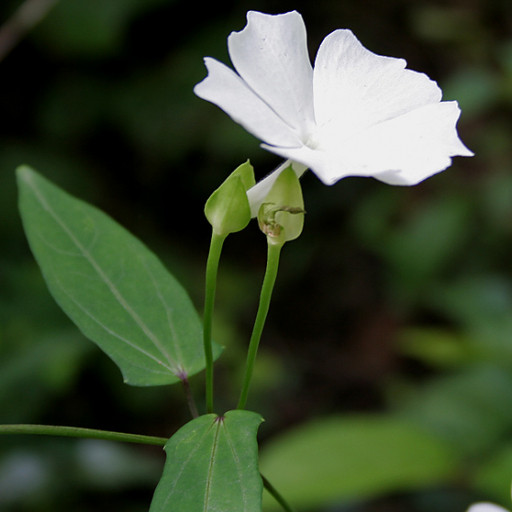
Plant Overview
Known as the Sweet Clock Vine or the White Lady, this delicate climber is the elegant, minimalist cousin of the common Black-eyed Susan vine. Native to India and Southeast Asia, it brings a touch of ethereal beauty to garden trellises with its pristine white blossoms that seem to glow in the twilight.
🔍 How to Identify
- 🌼 The Blooms: Pure, snow-white flowers with five spreading petals. Unlike its famous cousins, it lacks a dark "eye" in the center, giving it a clean, uniform look.
- 🍃 The Foliage: Soft, green leaves that are typically heart-shaped or shaped like an arrowhead with slightly wavy edges.
- 🎗️ Twining Stems: A slender vine that climbs by wrapping its stems around supports rather than using sticky tendrils or thorns.
🏡 In Your Garden
- 🧗 Vertical Support: Because it is a "twiner," it needs a thin trellis, mesh, or string to climb. It is excellent for "softening" the look of fences or creating a living privacy screen on a balcony.
- 🌞 Light & Moisture: It thrives in bright, filtered light. While it loves the sun, it appreciates some afternoon shade in very hot climates to prevent the delicate white petals from scorching.
- ✂️ Growth Management: It is a fast grower but less aggressive than other vines. Frequent "pinching" of the tips will encourage the plant to grow bushier rather than just straight up.
⚠️ Safety & Toxicity
- ✅ General Safety: Thunbergia fragrans is generally considered non-toxic to humans, cats, and dogs. It is a popular choice for "pet-safe" vertical gardening.
- 🧤 Skin Care: While not poisonous, the sap can occasionally cause minor skin irritation for individuals with high sensitivity. It’s always a good practice to wash your hands after pruning.
✨ Fun Fact
Despite the name fragrans (which means "fragrant"), many gardeners find that this plant has little to no scent! The name was originally given to a specific wild variety in India that possessed a heavy perfume, but most cultivated versions found in nurseries today have lost their scent over time.

Detailed Care Instructions
To grow Thunbergia Fragrans plant, also known as Sweet Clock Vine, follow these steps:
- Choose a suitable location: Thunbergia Fragrans prefers full sun to partial shade and well-draining soil. Select a spot in your garden that receives at least 6 hours of sunlight per day.
- Prepare the soil: Loosen the soil and add organic matter, such as compost, to improve drainage and nutrient content. Thunbergia Fragrans prefers slightly acidic to neutral soil with a pH between 6.0 and 7.0.
- Planting: Dig a hole in the prepared soil that is slightly larger than the nursery container. Carefully remove the plant from its container and gently loosen the roots. Place the plant in the hole and backfill with soil, ensuring it is level with the surrounding ground. Water thoroughly after planting.
- Watering: Thunbergia Fragrans requires regular watering, especially during hot and dry periods. Keep the soil consistently moist, but avoid overwatering which can lead to root rot. Water deeply when the top inch of soil feels dry.
- Fertilizing: Apply a balanced, slow-release fertilizer in spring and mid-summer to promote healthy growth. Follow the instructions on the fertilizer packaging for proper application.
- Training and support: As Thunbergia Fragrans is a vine, it will require support to climb. Provide a trellis, arbor, or any vertical structure for the plant to climb on. Regularly tie and train the vines to the support structure to ensure proper growth.
- Pruning: Thunbergia Fragrans can become leggy, so regular pruning is necessary to encourage bushier growth and maintain the plant's shape. Prune in early spring before new growth begins. Remove any dead, damaged, or crossing branches.
- Pests and diseases: Monitor the plant regularly for pests such as aphids, spider mites, or whiteflies. If necessary, treat them with organic insecticides or soapy water. Thunbergia Fragrans is generally resistant to most diseases, but it's important to maintain good air circulation around the plant to prevent fungal issues.
By following these steps and providing proper care, you can successfully grow Thunbergia Fragrans plant in your garden or outdoor space.

Place in a bright room that is sun drenched almost all day. Or directly in a south-facing window.

The Thunbergia Fragrans plant should be watered consistently to maintain moist but not wet soil. This can be achieved by watering the plant once a week, or when the soil dries out to a depth of about an inch. The water should be applied gently and evenly around the base of the plant, avoiding the foliage as much as possible. It is also important to avoid letting the plant sit in standing water, as this can lead to root rot. Additionally, the plant should be kept in an area with good drainage and airflow to prevent fungal growth.
To fertilize this plant, use a balanced fertilizer with equal amounts of nitrogen, phosphorus, and potassium. Apply the fertilizer once a month during the growing season, from early spring to late summer. Dilute the fertilizer with water as instructed on the package, and apply it to the soil around the base of the plant. Avoid getting the fertilizer on the leaves or flowers, as this can cause burning or damage. Water the plant thoroughly after fertilizing to ensure the nutrients are absorbed by the roots.
Thunbergia Fragrans plant requires well-draining soil that is rich in organic matter. The ideal soil pH range is between 6.0 to 7.5. The soil should be moist but not waterlogged, as waterlogging can lead to root rot. A good mix of soil should contain equal parts of sand, peat moss, and perlite. Additionally, adding some compost or aged manure to the soil will provide the plant with essential nutrients. It is important to ensure that the soil is loose and fluffy to allow for good aeration and water drainage. Avoid using clay soils or ones that have heavy clay content as they can retain too much water and lead to root rot.
Thunbergia fragrans is a deciduous climbing plant that is native to a particular region of the African continent. It is well-known for its beautiful and fragrant flowers that bloom during the mid to late part of the growing season.
To propagate this plant, there are several methods that can be used. The first is to take cuttings of the plant during the early part of the growing season. These cuttings should be about 6 to 8 inches in length and should be taken from healthy, mature plants.
After the cuttings are taken, they should be dipped in rooting hormone and then planted in a well-draining soil mix. The soil should be kept moist, but not overly wet, and the cuttings should be placed in a warm and sunny location.
Another method for propagating Thunbergia fragrans is by layering. This involves bending a low-hanging branch of the plant down to the ground and covering it with soil. The branch should remain attached to the parent plant, but roots will begin to grow from the buried section of the branch. Once the roots are established, the new plant can be separated from the parent plant and replanted.
Finally, Thunbergia fragrans can also be grown from seed. The seeds should be sown in a well-draining soil mix and should be kept moist until they germinate. Once the seedlings have grown to a sufficient size, they can be transplanted into their permanent location.








