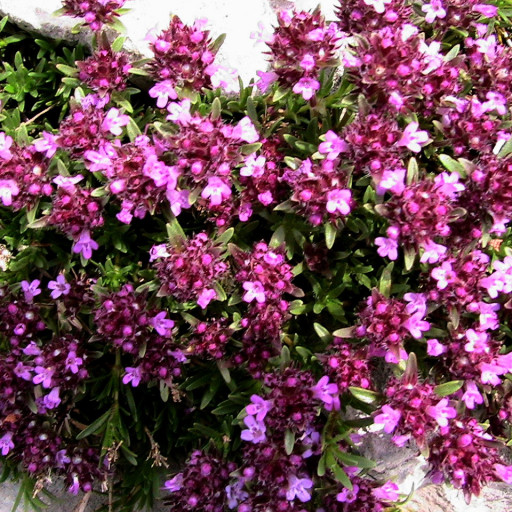
Plant Overview
Often called "Creeping Thyme" or "Mother of Thyme," this aromatic wonder is the ultimate living carpet for any sunny landscape. Native to the rocky hillsides of Europe and North Africa, it has been used for centuries as both a medicinal herb and a "steppable" groundcover. When you brush against its tiny leaves, it releases a refreshing, earthy perfume that transforms a simple garden walk into a sensory experience.
🔍 How to Identify
- 🌿 Growth Habit: It is a prostrate, mat-forming subshrub that hugs the ground tightly, rarely reaching more than 2 to 3 inches in height.
- 🍃 Foliage: The leaves are tiny, oval, and dark green, often appearing slightly hairy under a magnifying glass. They stay evergreen in milder climates.
- 🌸 Summer Blooms: During early to mid-summer, the green mat disappears under a sea of tiny, tubular flowers ranging from pale lavender to vibrant magenta.
🏡 In Your Garden
- 🌞 The "Why" of Care: This plant thrives on neglect and "poor" conditions. Because it evolved in rocky crevices, it has a deep taproot that hates being waterlogged; sharp drainage is much more important than rich soil.
- 👣 Pathways & Patios: It is one of the few plants that actually benefits from being stepped on occasionally. Light foot traffic bruises the leaves just enough to release their essential oils without damaging the plant's structure.
- 🐝 Pollinator Buffet: It is a primary nectar source for honeybees and small blue butterflies. If you are looking to create a "wildlife lawn," this is the gold standard for replacing thirsty grass.
⚠️ Safety & Toxicity
- ✅ Pet & Human Safe: Thymus serpyllum is generally considered non-toxic to dogs, cats, and horses.
- 🍵 Culinary Note: While it is edible and has a pleasant scent, it is much more pungent and "medicinal" than its cousin, the common Garden Thyme (Thymus vulgaris). It is mostly used for teas or landscaping rather than heavy cooking.
✨ Fun Fact
In medieval English folklore, patches of Wild Thyme were said to be the favorite playgrounds and beds for fairies. Gardeners would often plant it near their doors to invite good spirits and "fey" luck into the home.

Detailed Care Instructions
| Soil Ph | Neutral |
| Humidity | Dry |
| Lighting | Full Sun |
| Soil Type | Well-Drained, Loose, Rocky, Sandy |
| Bloom Time | Summer |
| Difficulty | Easy |
| Plant Type | Herbaceous Perennial |
| Native Area | Southern Europe |
| Temperature | 18°C - 21°C |
| Sun Exposure | Full Sun |
| Hardiness Zones | 4-9 |
To grow Thymus serpyllum, also known as creeping thyme, you can follow these steps:
- Choose a suitable location: Thyme thrives in well-drained soil and full sunlight. Select a spot in your garden or containers where it will receive at least 6-8 hours of direct sunlight each day.
- Prepare the soil: Thyme prefers slightly alkaline soil with a pH between 6.0 and 8.0. Ensure the soil is well-drained by adding compost or organic matter to improve its texture. Thyme can tolerate poor soil but will perform better in fertile soil.
- Sow the seeds or plant seedlings: Thyme can be propagated from either seeds or seedlings. If using seeds, plant them in early spring or fall, scattering them over the prepared soil and lightly covering them with a thin layer of soil. Water gently to keep the soil moist but not waterlogged until the seeds germinate.
- If using seedlings, dig small holes in the prepared soil, spacing them around 6-12 inches apart. Carefully remove the seedlings from their containers and place them in the holes, backfilling with soil and gently firming it around the roots.
- Watering: Thyme has low water requirements once established, so be careful not to overwater. Water deeply and infrequently, allowing the soil to partially dry out between watering sessions. Thyme is drought-tolerant and can survive dry periods without much harm.
- Weed control: Keep the area around your thyme plant free from weeds, as they can compete with the plant for nutrients and moisture. Regularly check for and remove any weeds to maintain healthy growth.
- Pruning: Thyme benefits from regular light pruning throughout the growing season to encourage bushy growth and prevent it from becoming leggy. Prune off any dead or wilting stems, and lightly trim the plant to maintain its shape and size.
- Fertilizing: Thyme generally doesn't require much fertilization, especially if the soil is nutrient-rich. However, you can apply a balanced, slow-release fertilizer once a year in early spring if desired.
By following these steps, you should be able to successfully grow Thymus serpyllum and enjoy its fragrant foliage and charming flowers.

Place in a bright room that is sun drenched almost all day. Or directly in a south-facing window.

Thymus Serpyllum is a small yet hardy perennial herb that requires careful watering to thrive. When watering this plant, it is important to use a gentle stream of water to avoid damaging the delicate leaves and stems. The soil should be kept evenly moist, but not waterlogged, as excessive moisture can lead to root rot and other types of fungal diseases. It is best to water this plant early in the morning or late in the day when the temperatures are cooler, as this can help to reduce moisture loss due to evaporation. Additionally, it is important to avoid getting water on the leaves of the plant, as this can make it more susceptible to disease and pest infestations. Overall, proper watering is essential for the health and vitality of Thymus Serpyllum, and with a little bit of care and attention, it can thrive in a wide range of environments.
To fertilize this plant, it is recommended to use a balanced fertilizer with equal parts nitrogen, phosphorus, and potassium. Apply the fertilizer in the spring and summer months, when the plant is actively growing. Be sure to follow the instructions on the fertilizer packaging for the proper application rate. Over-fertilizing can lead to excessive growth and reduced overall plant health.
Thymus serpyllum plant prefers well-draining soil that is rich in organic matter and has a slightly acidic to neutral pH. This plant is also tolerant of poor soil conditions, including rocky or sandy soils. It is important to avoid heavy, waterlogged soils to prevent root rot. A blend of peat moss, sand, and loamy soil can be used to create an optimal growing environment for Thymus serpyllum. Additionally, this plant can benefit from the addition of lime or sulfur to adjust the pH as needed.
Thymus Serpyllum plant can be propagated through cutting or stem division.
To propagate through cutting, select healthy stems and cut a 2-3 inch piece. Remove the lower leaves and dip the cut end in rooting hormone. Plant the cutting in a container with well-draining soil, water it and cover it with a plastic bag to create humidity. Place the container in a bright, warm area and mist the cutting daily. Once roots have formed, remove the plastic bag and transplant the new plant into a larger container.
To propagate through stem division, carefully dig up the plant and separate the stems into smaller sections. Ensure that each section has a good root system. Plant each section into a container or directly into the ground with well-draining soil and water it thoroughly.
Propagation is best done in the spring or early summer when the plant is actively growing.
Common pests of the wild thyme include Spider mites, fungus gnats, aphids, thrips, whiteflies. Make a habit of checking your wild thyme frequently for pests so that any infestations can be caught and managed early.








