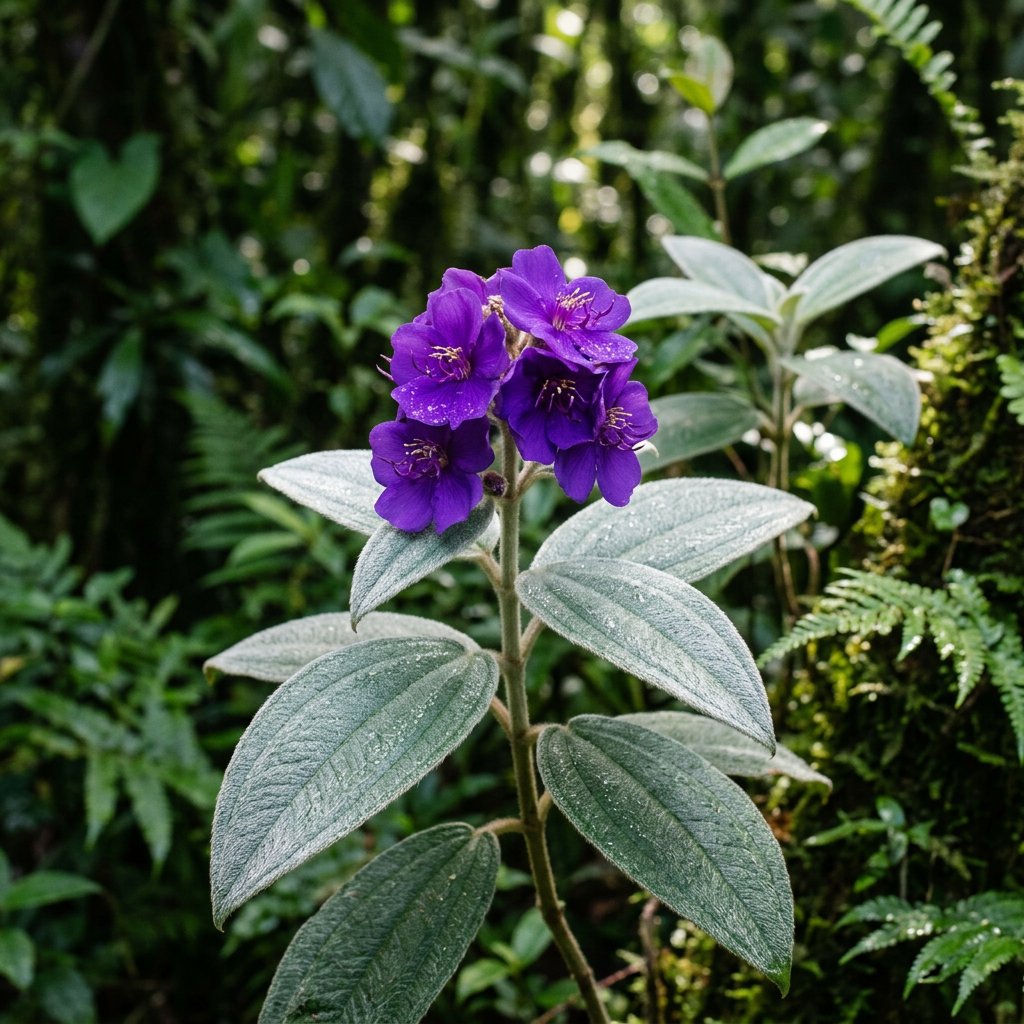
Plant Overview
Known as the Silver-Leaf Princess Flower, this Brazilian beauty is a true showstopper in any tropical or subtropical landscape. While its cousins are famous for their vibrant green leaves, Tibouchina heteromalla stands out with its shimmering, velvety silver foliage that looks like it was plucked from a fairy tale. When in bloom, the contrast between the royal purple flowers and the metallic leaves creates a regal display that earns its "Princess" title.
🔍 How to Identify
- 🌿 Velvety Foliage: The most striking feature is the large, heart-shaped leaves covered in fine, silky silver hairs that feel like soft flannel to the touch.
- 💜 Royal Blooms: It produces dense clusters of deep violet-purple flowers that sit atop the foliage, each featuring five petals and curved, hook-like stamens.
- 📏 Growth Habit: This is an upright, evergreen shrub that can reach heights of 4 to 6 feet, often forming a naturally rounded and lush shape.
🏡 In Your Garden
- ☀️ Light and Shelter: While it loves basking in the sun to maintain that silver sheen, its large, soft leaves are easily shredded by high winds. Plant it in a spot protected from heavy gusts to keep the foliage looking pristine.
- 💧 Thirst and Soil: This "Princess" is a heavy feeder and prefers acidic, well-draining soil rich in organic matter. It dislikes "wet feet," so ensure the water drains away quickly to prevent root rot, especially during humid summers.
- ❄️ Cold Sensitivity: Being a tropical native, it is quite sensitive to frost. If you live in a cooler climate, it thrives beautifully in large containers that can be moved indoors or to a greenhouse during the winter months.
⚠️ Safety & Toxicity
- ✅ Status: Generally considered non-toxic.
- 🐾 Details: This plant is safe for households with curious pets and children. However, the fine hairs on the leaves can occasionally cause very mild skin irritation for people with highly sensitive skin, so it’s best to handle it gently.
✨ Fun Fact
The leaves of the Silver-Leaf Princess Flower are so densely covered in hairs that they are remarkably water-repellent; raindrops will often bead up and roll right off the surface like silver mercury!

Detailed Care Instructions
| Humidity | High |
| Lighting | Part Sun |
| Difficulty | Medium |
| Hibernation | Cold Period |
| Temperature | Min 21°C |
| Hardiness Zones | 10 - 11 |
To grow Tibouchina Heteromalla, also known as silver leafed princess flower, you can follow these steps:
- Choose the right location: Tibouchina Heteromalla prefers full sun to partial shade. Select a spot that receives at least 6 hours of direct sunlight per day. The plant can tolerate a wide range of soil types but requires good drainage.
- Prepare the soil: Ensure the soil is well-draining by amending it with organic matter such as compost. This will help improve the soil's structure and water retention.
- Planting: Dig a hole that is slightly larger than the root ball of the plant. Place the plant in the hole, making sure the top of the root ball is level with or slightly above the soil surface. Backfill the hole with soil and gently firm it around the plant.
- Watering: Water the plant immediately after planting and for the first few weeks until it becomes established. Tibouchina Heteromalla prefers consistent moisture, so provide regular watering, particularly during dry periods. Avoid overwatering, as this can lead to root rot.
- Fertilization: Apply a balanced, slow-release fertilizer in early spring and mid-summer to promote healthy growth. Follow the instructions on the fertilizer packaging for the correct application rate.
- Pruning: Tibouchina Heteromalla can be pruned to maintain its shape and control its size. Prune in late winter or early spring before new growth appears. Remove any dead, damaged, or diseased branches and shape the plant as desired.
- Protecting from frost: If you live in an area with cold winters, provide protection for the plant during freezing temperatures. Cover it with a frost blanket or move it indoors if possible.
- Pests and diseases: Tibouchina Heteromalla is generally not prone to serious pest or disease problems. However, keep an eye out for common garden pests like aphids or mealybugs. Treat any infestations promptly using appropriate insecticides or insecticidal soaps.
- Propagation: Tibouchina Heteromalla can be propagated from seeds or stem cuttings. Propagation by seeds may be more challenging and time-consuming. Stem cuttings taken in spring or early summer have a higher success rate. Dip the cut end in rooting hormone and place it in a well-draining potting mix. Keep the soil moist and provide bottom heat to encourage rapid root development.
With proper care and maintenance, your Tibouchina Heteromalla plant should thrive and produce its beautiful purple flowers and distinctly silver leaves.

Place in a bright room that is sun drenched almost all day. Or directly in a south-facing window.

To water this plant, you should first check the moisture level in the soil by inserting your finger about an inch deep into the soil. If the soil feels dry, it is time to water the plant. Use a watering can or hose nozzle with a gentle flow to avoid damaging the plant or causing soil erosion. Water the soil around the base of the plant and avoid getting water on the leaves or flowers. Allow the soil to drain completely and avoid overwatering, which can cause root rot and other problems. The frequency of watering will depend on the climate and the plant's growth stage, so it is important to monitor the moisture level and adjust as needed.
To fertilize this plant, it is recommended to use a balanced, slow-release fertilizer with equal parts nitrogen, phosphorus, and potassium. Apply the fertilizer in the early spring, just before new growth appears, and again in mid-summer. Be careful not to over-fertilize, as this can damage the plant. Water thoroughly after fertilizing.
Tibouchina Heteromalla requires a well-draining soil that is rich in organic matter. The soil should be slightly acidic with a pH range of 5.5 to 6.5. A mixture of peat moss, coarse sand, and perlite can be used to create a suitable soil mixture. The plant prefers moist but well-drained soil, so it is essential to ensure that the soil does not become waterlogged. Additionally, it is crucial to avoid using heavy garden soil or clay soil, as this can suffocate the plant's roots and lead to poor growth. Overall, a light, aerated soil is optimal for the healthy growth of Tibouchina Heteromalla.
To propagate this plant, one should use stem cuttings. First, select a healthy stem that is at least 4-5 inches long and has a few leaves on it. Cut the stem with a sharp, sterile knife or pruning shears, making sure to cut just below a node (the point where a leaf attaches to the stem). Remove any leaves from the bottom half of the stem.
Next, dip the cut end of the stem in rooting hormone powder, which will encourage root growth. Then, plant the cutting in a pot filled with well-draining soil. Make a hole in the soil with a pencil or similar object, and gently insert the cutting into the hole. Firmly press the soil around the stem to hold it in place.
Water the cutting thoroughly and place it in a bright, indirect light location. Cover the pot with a plastic bag or dome to create a humid environment that will help the cutting root. Mist the cutting with water every few days to keep the soil moist.
After a few weeks, check the cutting for signs of root growth by gently tugging on the stem. If it resists being pulled out of the soil, roots have likely formed. At this point, remove the plastic cover and continue to care for the plant as you would a mature Tibouchina Heteromalla plant.
Common pests of the silverleafed princess flower include Scale insect, mealybugs. Make a habit of checking your silverleafed princess flower frequently for pests so that any infestations can be caught and managed early.








