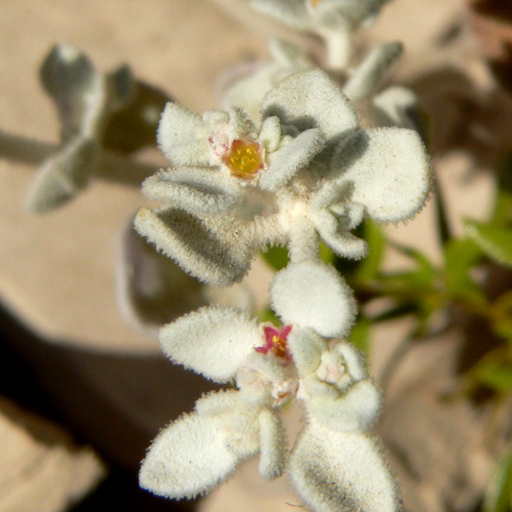
Plant Overview
Known affectionately as the Shrubby Honeysweet, this resilient desert dweller is a master of survival in the scorching landscapes of the American Southwest and Northern Mexico. Despite its name, it isn't related to the climbing honeysuckle vines you might find in a cottage garden; instead, it earns its title from the faint, sweet fragrance of its tiny, golden blooms. It is a true specialist, often flourishing in harsh, gypsum-rich soils where few other plants dare to grow.
🔍 How to Identify
- 🌿 Silvery Foliage: The leaves are small, oval, and covered in a dense coat of fine, star-shaped hairs. This gives the entire plant a distinctive "dusty" or silvery-gray appearance, which helps reflect intense desert sunlight.
- 🌼 Tucked-in Blooms: The flowers are minuscule, yellow, and lack traditional petals. They grow in tight clusters nestled in the leaf axils, appearing like tiny golden jewels hidden amongst the silver leaves.
- 🪵 Mounded Habit: It grows as a low, rounded sub-shrub with a woody base. The term suffruticosa literally means "somewhat woody," referring to how the plant stays low to the ground to avoid drying winds.
🏡 In Your Garden
- ☀️ Heat Seekers: This plant is an excellent candidate for "hellstrip" gardening or rock gardens. It thrives on intense heat and reflected light from stones, making it perfect for areas where other plants might wilt.
- 🏜️ Drainage is King: Because it is native to arid regions, it has a deep taproot and cannot tolerate "wet feet." It requires extremely well-draining, sandy, or gravelly soil. If planted in heavy clay, it will likely struggle with root rot during the rainy season.
⚠️ Safety & Toxicity
- ✅ Non-Toxic: Shrubby Honeysweet is generally considered non-toxic to humans, dogs, and cats. It is not known to contain the harmful alkaloids found in some other desert species.
- 🧤 Skin Sensitivity: While not poisonous, the dense, fuzzy hairs on the leaves can occasionally cause mild mechanical irritation (itchiness) for individuals with very sensitive skin. Wearing gloves during pruning is a simple precaution.
✨ Fun Fact
The Shrubby Honeysweet is a C4 plant, meaning it uses a highly specialized form of photosynthesis. This biological "turbo-charge" allows the plant to continue growing and creating energy even when temperatures are high enough to shut down the metabolism of most other garden plants!

Detailed Care Instructions
To grow Tidestromia suffruticosa (also known as honeysweet or kleinia), you can follow these steps:
- Climate and location: Tidestromia suffruticosa thrives in warm climates, such as USDA hardiness zones 9 to 11. It requires plenty of sunlight, so choose a location that receives direct sunlight for at least 6-8 hours a day.
- Soil: The plant prefers well-draining soil that is slightly acidic to neutral. Improve the soil by adding organic matter like compost or well-rotted manure, which will help with drainage and provide essential nutrients.
- Planting: You can start by sowing the seeds directly into the soil, as the plant does not typically tolerate transplanting well. If you do choose to transplant, ensure that the seedlings are handled with care to avoid root disturbance.
- Watering: While Tidestromia suffruticosa is drought-tolerant, it is important to keep the soil moist during the initial growth stages. Once established, the plant requires less frequent watering, as it can withstand dry conditions.
- Fertilization: Apply a balanced, slow-release fertilizer during the growing season to promote healthy growth. Follow the manufacturer's instructions regarding frequency and application rates.
- Pruning: Periodically trim back any dead or damaged branches to maintain the plant's shape and appearance. You can also prune lightly to encourage bushier growth.
- Pest and disease control: Tidestromia suffruticosa is relatively resistant to pests and diseases. However, you should still keep an eye out for common garden pests like aphids or spider mites. If necessary, use an appropriate insecticidal soap or organic pest control methods.
- Propagation: You can propagate Tidestromia suffruticosa through stem cuttings. Simply cut a healthy stem, remove the lower leaves, and plant it in a well-draining potting mix. Keep the soil moist and place the cutting in bright, indirect light until it roots.
Remember to consult local gardening resources or contact a horticulturist for specific advice based on your exact location and climate.

To water this plant, first check the soil to make sure it is dry to the touch. Fill a watering can with room temperature water. Slowly pour the water around the base of the plant, avoiding pouring directly on the leaves or stems. Make sure not to overwater the plant, as this can cause root rot. Watering once every week or two should suffice, depending on the climate. Be sure to adjust watering frequency as necessary based on the plant's needs.
To fertilize this plant, use a balanced fertilizer with a ratio of 10-10-10 or 20-20-20. Apply the fertilizer every two to three weeks during the growing season, which is typically from spring to fall. Do not over-fertilize as this can damage the plant and lead to excessive growth or weakened roots. Always follow the manufacturer's instructions for the appropriate amount of fertilizer to use. A light application of organic compost or well-rotted manure can also be beneficial for nutrition and soil health.
For the cultivation of Tidestromia Suffruticosa plant, it is recommended to use a well-draining soil mix that contains a combination of organic matter and granular sand. The soil should be slightly acidic or neutral with a pH level of around 6.0-7.0. It is important to ensure that the soil remains moist but not waterlogged as Tidestromia Suffruticosa prefers a moderate amount of moisture for optimal growth. Adding a slow-release fertilizer to the soil can provide the necessary nutrients for the plant to thrive. It is also advisable to mulch the soil to help retain moisture and to discourage weed growth. Proper soil preparation is crucial for the successful cultivation of Tidestromia Suffruticosa, as it can affect plant health, growth, and yield.
The propagation method of this plant involves taking stem cuttings from a mature plant. Choose a healthy stem of the plant and make a cut just below a node. Remove any leaves from the bottom half of the cutting. Dip the cut end of the stem in rooting hormone powder and plant it in a container filled with well-draining soil. Water the cutting and place it in a location with bright, indirect sunlight. Keep the soil consistently moist but not waterlogged. After a few weeks, roots should begin to form and new growth should appear on the stem. Once the new growth is strong enough, it can be transplanted into a larger container or directly into the ground.








