Plant Overview
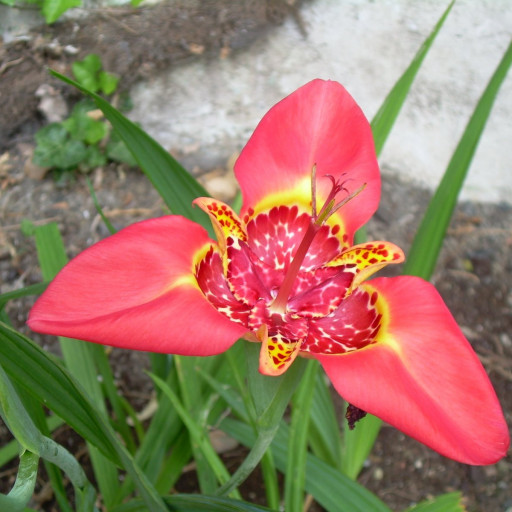
Known as the Mexican Shell Flower or Tiger Flower, Tigridia pavonia is a botanical masterpiece native to the highlands of Mexico and Central America. This exotic beauty is famous for its "one-day-only" performance, where each spectacular bloom opens at dawn and fades by dusk, resembling a vivid, spotted seashell or a flamboyant jockey's cap. Despite the short life of individual flowers, a single stalk will produce a relay of blooms to keep the show going for weeks.
🔍 How to Identify
- 🎨 The "Tiger" Center: The most striking feature is the central "cup" of the flower, which is heavily speckled with bold, contrasting spots, reminiscent of a jaguar or tiger’s coat.
- 📐 Triangular Symmetry: Each flower consists of three large, flared outer petals and three much smaller, inner petals, creating a distinct triangular or star-like silhouette.
- 🗡️ Sword-Shaped Foliage: The leaves are bright green, pleated, and fan-shaped, very similar to those of a Gladiolus, standing upright to frame the floral display.
🏡 In Your Garden
- ⏳ The 24-Hour Spectacle: Because each flower lasts only one day, this plant is best positioned where you walk daily (like a patio or entryway) so you don’t miss its fleeting beauty.
- 💧 Drainage is Vital: The plant grows from bulbs (corms) that are highly susceptible to rot. It thrives in "gritty" soil that allows water to pass through quickly while soaking up the full heat of the sun.
- ❄️ Winter Protection: In colder climates, these bulbs act like Dahlias. You must lift them from the ground after the first frost and store them in a dry, cool spot, or they will turn to mush in frozen soil.
⚠️ Safety & Toxicity
- ✅ Safe for Humans: Interestingly, the roasted bulbs were historically a food source for the Aztecs, said to taste like sweet potatoes or chestnuts.
- 🐾 Pet Caution: While not listed as a high-risk toxin like Lilies or Foxglove, the ingestion of any garden bulb can cause digestive upset (vomiting or drooling) in cats and dogs. It is best to keep curious diggers away from the planting site.
✨ Fun Fact
The Aztecs called this plant Cacomitl. While we admire it for its beauty today, it was once a staple "survival crop" in ancient Mexico, where the starchy bulbs were harvested and cooked to provide energy for long journeys.

Detailed Care Instructions
Grown in groups, tiger flowers will add interest to flower borders, and they look fantastic grown in containers on sunny patios. Because the foliage is rather sparse, it's best to plant them in the middle of the border, behind lower growing foreground plants, and in front of the towering back-of-the-border specimens.
Is tiger flower edible?
Native to Mexico, the cooked bulbs of these plants were a small but tasty food source that the Aztec people enjoyed. Raw bulbs can cause burning in the mouth, so they're usually roasted. The flavor is said to resemble both sweet potato and chestnut.
What is the difference between tiger flower and tiger lily?
Tiger flower is sometimes confused with tiger lily, but the plants belong to entirely different families. Tiger lily is a true lily from the Liliaceae family, while tiger flower is closely related to iris. Both are summer bloomers, but tiger lily is hardy as far north as zone 3, while tiger flower is a warm-weather perennial.Both plants have flowers with distinctive speckled throats, but the blossoms on tiger flower are fairly wide open and last for only a day, while the blooms on tiger lily have a distinctive trumpet shape and remain open for up to a week. Most importantly, tiger lily, as a true lily, is toxic to people and pets, while tiger flower is entirely harmless and even edible in some circumstances.
| Color | Pink, Red, Yellow, White |
| Soil Ph | Neutral, Alkaline |
| Lighting | Full Sun |
| Toxicity | Non-Toxic |
| Soil Type | Well-Drained |
| Bloom Time | Summer |
| Plant Type | Bulb, Corm |
| Mature Size | Up To 24 In. Tall |
| Native Area | Mexico |
| Sun Exposure | Full Sun, Partial Sun |
| Hardiness Zones | 8-10 |
To grow Tigridia Pavonia plants, also known as Mexican tiger flowers or peacock flowers, you can follow these steps:
- Start by choosing a suitable location for planting. Tigridia Pavonia plants prefer well-drained soil with full or partial sun exposure.
- Prepare the soil by loosening it with a garden fork or tiller. Remove any stones, weeds, or other debris. You can also mix in organic matter like compost or well-rotted manure to improve soil fertility.
- Plant the bulbs in late spring or early summer when the soil has warmed up. Dig holes about 4-6 inches deep and place each bulb with the pointed side up. Space the bulbs at least 6-8 inches apart.
- Cover the bulbs with soil and gently firm it down to ensure good contact. Water thoroughly after planting to settle the soil.
- Maintain consistent soil moisture throughout the growing season, but avoid overwatering, as it can lead to bulb rot. Water deeply when the top inch of soil feels dry to the touch.
- Apply a balanced fertilizer during the growing season to promote healthy growth and flowering. Follow the instructions on the fertilizer package for application rates and frequency.
- Provide support for the plants if necessary, as they can grow up to 2-3 feet tall and may need staking to prevent them from falling over.
- Remove any dead or yellowing leaves to maintain a tidy appearance and prevent diseases. However, don't remove any green leaves during the growing season, as they help the bulbs store energy for future growth.
- Tigridia Pavonia plants bloom from mid to late summer. Be patient, as they may take a year or two to flower after planting.
- After the blooming period, let the foliage die back naturally. This allows the bulbs to store energy for the next season. Do not remove the foliage until it has turned completely yellow and dried out.
- In colder climates, Tigridia Pavonia bulbs should be lifted in the fall before the first frost. Brush off excess soil and store them in a cool, dry place for winter. Replant them in spring when the danger of frost has passed.
By following these steps and providing proper care, you should be able to grow Tigridia Pavonia plants successfully.

Place in a window with dappled sun or a spot in the middle of a room. Or directly in a window facing west or east.

Tigridia Pavonia plants should be watered regularly but not excessively, as over-watering can lead to root rot. The soil should be moist but not waterlogged. Watering should be done deeply, making sure the water reaches the roots, and then allowed to drain. These plants should not be allowed to sit in standing water. During the growing season, it may be necessary to water more frequently if the weather is hot and dry. However, during the dormant season, watering should be reduced to avoid killing the bulbs. It is always better to water in the early morning or late afternoon to prevent evaporation and to allow the water to be absorbed efficiently.
To fertilize this particular plant, provide a balanced fertilizer that contains equal amounts of nitrogen, phosphorus, and potassium. Apply the fertilizer every two weeks during the growing season (spring and summer) at the base of the plant, avoiding contact with the foliage. Water the plant thoroughly after fertilizing. In the fall, cease fertilization as the plant enters dormancy.
Tigridia Pavonia plant prefers a well-draining soil mix that is rich in organic matter. The soil should be slightly acidic with a pH level of around 6.5 to 7.5. A mix of sand, peat moss, and perlite can be added to create a soil that is well-aerated and provides good drainage. The soil should also contain essential nutrients like nitrogen, phosphorus, and potassium for proper growth and flowering. It is important to avoid using heavy clay soils, as they can retain too much water and cause root rot. Additionally, the soil should be kept moist, but not excessively wet, to prevent waterlogging and promote healthy growth.
To propagate this plant, you will need to carefully remove the bulbs from the soil, making sure to avoid damaging any of the roots. Clean off any excess soil and separate the bulbs by gently pulling them apart. Each bulb should have a minimum of two leaves and a piece of stem attached.
Prepare a well-draining potting mix and plant each bulb in a small pot filled with the mix. Make sure to cover the bulb with enough soil so that only the tip of the leaves are exposed. Water the plants regularly and keep them in a warm, bright location.
Over time, new shoots will appear and the bulbs will grow into healthy plants. Once the plants have grown large enough, you can transplant them into larger pots or directly into your garden.
Propagation can also occur through the planting of fresh seeds. Seeds can be collected from the seed pods that form after the plant blooms. Once the pods have turned brown and dry, gently snap them off the stem and remove the seeds. Plant the seeds in trays filled with a well-draining potting mix and mist them regularly with water. The seeds should begin to germinate within a few weeks.








