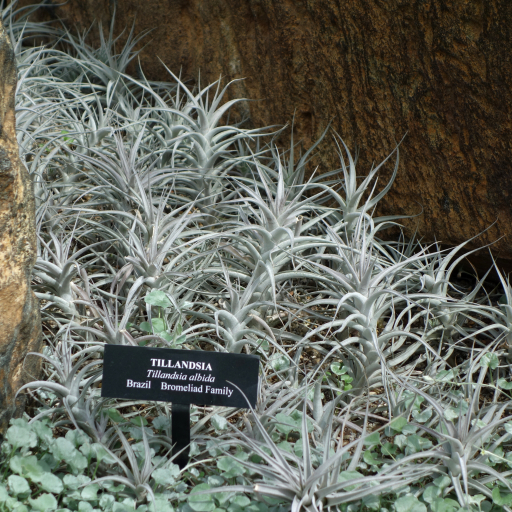
Plant Overview
Known as the "White Air Plant," Tillandsia albida looks like a botanical sculpture carved from moonlight. Hailing from the arid, rocky canyons of Mexico, this hardy survivor stands out with its shimmering, stiff foliage that forms an elegant, elongated spire. Unlike many of its green, tropical cousins, this plant is a "lithophyte," meaning it is naturally adapted to grow on cliffs and rocks under the blazing desert sun.
🔍 How to Identify
- ❄️ Silver Trichomes: The leaves are densely covered in tiny, silvery-white scales called trichomes. These act as a reflective "sunscreen" and a specialized system to trap moisture from the air.
- 📽️ Caulescent Growth: Unlike the typical "rosette" shape of many air plants, this species grows vertically along a distinct stem, often branching out to create impressive, cascading clusters over time.
- 🏮 Crimson Inflorescence: When it matures to bloom, it produces a tall, brilliant red spike that contrasts sharply with its white leaves, eventually sprouting delicate, cream-colored flowers.
🏡 In Your Garden
- ☀️ Light Lover: Because of its heavy coating of white scales, it thrives in much brighter light than most other air plants. It can handle some direct morning sun, which actually helps maintain its bright, "ghostly" appearance.
- 🌬️ Airflow is Key: In its native habitat, it clings to cliffs where breezes are constant. In a home environment, it requires excellent circulation to dry out quickly after misting or soaking; trapped water at the base of its stem is its greatest enemy.
- 🧗 Mounting Style: Since it grows on rocks in the wild, it looks spectacular when mounted on driftwood, cork bark, or even a decorative stone rather than being hung by a wire or kept in a glass globe.
⚠️ Safety & Toxicity
- ✅ Pet Friendly: Tillandsia albida is non-toxic to cats, dogs, and humans, making it a safe choice for households with curious furry friends.
- 🌵 Stiff Texture: While not poisonous, the leaves are quite rigid and pointed. It is best kept out of reach of small children or pets to avoid accidental pokes to the eyes or mouth.
✨ Fun Fact
Most Tillandsias produce vibrant purple or blue flowers to attract hummingbirds, but Tillandsia albida is a rare exception! It produces pale, yellowish-white blossoms, which are much less common in the air plant world.

Detailed Care Instructions
To grow Tillandsia Albida (also known as the Air Plant), follow these steps:
- Light: Place your Tillandsia Albida in bright, indirect sunlight. They thrive in bright light conditions, but avoid direct sunlight as it can scorch the leaves.
- Temperature: They prefer warm temperatures between 60-85°F (15-29°C). The plants can tolerate minimal temperature fluctuations, but avoid exposing them to freezing temperatures.
- Watering: Air Plants are epiphytes, which means they absorb moisture and nutrients through their leaves. Mist the plant 2-3 times a week with water or soak it in room temperature water for 20-30 minutes once a week. Shake off excess water and let it dry completely before placing it back in its spot.
- Humidity: These plants thrive in a humid environment. If you live in a dry climate, consider using a humidifier or placing a dish of water near the plant to increase humidity.
- Fertilizer: Use a bromeliad or air plant fertilizer once a month during the growing season (spring to fall). Dilute the fertilizer to half the recommended strength and apply it to the leaves. Avoid using fertilizer during the winter months when the plant is in its dormant phase.
- Air circulation: Good air circulation is essential for these plants. Avoid placing them in enclosed spaces and ensure there is adequate air movement around them.
- Display: Tillandsia Albida can be displayed in various ways. They can be mounted on a piece of driftwood, placed in a terrarium, or simply placed in a decorative dish or holder. Make sure the chosen display method allows the plant to receive enough air movement and light.
Remember to monitor the plant's foliage regularly for signs of underwatering or overwatering. Adjust the watering frequency accordingly to keep the plant healthy and thriving.

Place in a bright room that is sun drenched almost all day. Or directly in a south-facing window.

Tillandsia Albida is an air plant that belongs to the Bromeliaceae family. It is an epiphytic plant that does not require soil to grow. To water Tillandsia Albida, you should follow the below steps:
1. Remove the plant from its display. Hold it securely at the base, taking care not to damage the leaves.
2. Fill a bowl or sink with lukewarm water. The water should not be too cold as it can shock the plant.
3. Submerge the plant in the water, making sure that all parts of it are covered. You can hold the plant down with your hands or a weight if it floats.
4. Allow the plant to soak for at least 30 minutes. You can leave it longer if you want to thoroughly hydrate the plant.
5. Remove the plant from the water and gently shake off any excess water. Use a towel to blot it dry if necessary.
6. Allow the plant to air dry completely before returning it to its display.
7. Repeat this process once a week during the growing season (spring and summer) and every other week during the dormant season (fall and winter).
It is important not to overwater Tillandsia Albida as it can lead to rotting of the plant. Also, avoid using hard water or tap water containing chlorine, as it can damage the plant. Instead, use rainwater or distilled water for watering.
To fertilize Tillandsia Albida, you can follow these instructions:
- Prepare a diluted fertilizer solution by mixing a balanced water-soluble fertilizer with water. Use a fertilizer with a low nitrogen content (look for a balanced NPK ratio, such as 10-10-10).
- Fill a spray bottle with the diluted fertilizer solution. It is essential to use a spray bottle rather than soaking the plant as Tillandsia Albida absorbs nutrients through its leaves.
- Mist the plant's leaves evenly with the diluted fertilizer solution. Ensure that all parts of the plant, including the base and undersides of leaves, receive a light misting.
- Repeat this fertilizing process once every two to four weeks during the growing season, which typically runs from spring to early fall.
- Avoid over-fertilizing, as excessive nutrients can harm the plant. It is usually better to under-fertilize rather than overdo it.
- In addition to regular fertilizing, provide the Tillandsia Albida with adequate sunlight, water, and air circulation to promote its overall health and growth.
Remember to observe your plant for signs of nutrient deficiencies or excesses, such as yellowing or browning of leaves. Adjust the fertilizer application accordingly to ensure optimal health for your Tillandsia Albida.
Tillandsia Albida is an epiphytic plant, meaning it grows without soil and derives its nutrients from the air. However, it can be grown in a soil-like mixture to provide some stability. The ideal soil mixture for Tillandsia Albida should be well-draining and porous, allowing for air circulation and water absorption. A mixture of perlite, peat moss, and bark is commonly used as a soil substitute for this plant. It is important to avoid using heavy clay soils or standard potting mixtures, as they can cause water to stagnate and potentially damage the plant.
Propagating Tillandsia Albida plants can be done using the following detailed steps:
- Prepare the mother plant: Ensure that the mother plant is healthy and well-established before initiating propagation. Look for a mature plant with strong roots and a good overall condition.
- Identify the offshoots: Observe the base of the mother plant for any offshoots or offsets. These are smaller plants that have developed alongside the main plant. Offsets should be at least one-third the size of the mother plant and have their own set of roots.
- Separate the offshoots: Gently remove the offshoots from the mother plant. Be careful not to damage the roots or leaves during this process. Offsets can be easily pulled away from the main plant or carefully cut using sterile, sharp scissors or garden shears.
- Prepare the new container: Choose a suitable container for each offset. Small pots or containers with good drainage holes work well. Fill the containers with a well-draining growing medium, such as a mix of coarse sand, orchid bark, or a specially formulated epiphytic plant potting mix.
- Position the offshoots: Place each offset in its own container, ensuring that the roots are buried in the growing medium and the leaves are above it. Make sure the offset is firmly and securely positioned, minimizing any chances of it becoming dislodged or falling over.
- Provide optimal conditions: Tillandsia Albida plants require bright indirect light and good air circulation. Place the newly potted offsets in a location with plenty of natural or artificial light, away from direct sunlight. Maintain a consistent temperature range of 60-80°F (15-27°C).
- Watering routine: Mist the newly potted offsets with water using a spray bottle. Alternatively, you can set up a water bath by placing the container in a dish with water. Ensure that the water does not touch the leaves to prevent rot. Repeat this process 2-3 times a week, allowing the plant to dry out between waterings.
- Patience and monitoring: It may take several months for the offsets to grow and establish themselves as independent plants. Regularly monitor the plants for any signs of disease or dehydration. Maintain the optimal conditions and adjust care as needed.
By following these steps, one can successfully propagate Tillandsia Albida plants and enjoy their unique beauty and characteristics.
Common pests of the tillandsia albida include Mealybugs. Make a habit of checking your tillandsia albida frequently for pests so that any infestations can be caught and managed early.








