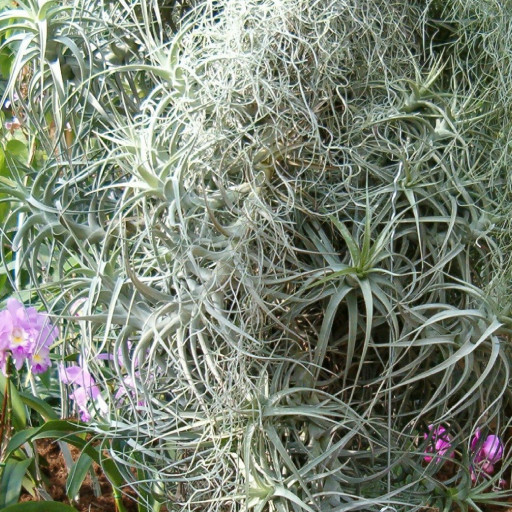
Plant Overview
Often called the "Clumping Air Plant" or "Madreselva," Tillandsia bergeri is a champion of the epiphytic world. Native to the rocky cliffs of Argentina, this hardy survivor is a favorite for beginners because of its incredible resilience and "never-say-die" attitude. Unlike many air plants that grow slowly and solitary, this species is a social climber that quickly forms impressive, spherical colonies.
🔍 How to Identify
- 🍃 Silvery Rosettes: The leaves are stiff, slender, and coated in a dense layer of silvery-grey "fuzz" known as trichomes, which the plant uses to "catch" moisture from the air.
- 🌀 Clumping Habit: It is a caulescent species, meaning it grows along a stem. It is famous for producing "pups" (offsets) rapidly, eventually creating a living ball of greenery.
- 🌸 Crinkled Blooms: In the spring, it produces a modest pink bract from which small, elegant flowers emerge. These petals are unique for their pale blue to lavender hue and slightly ruffled or "twisted" edges.
🏡 In Your Garden
- 💨 Airflow is Essential: Since this plant lacks traditional roots and "drinks" through its leaves, it requires excellent air circulation. It thrives when hanging in a breeze or placed near a window where air moves freely.
- 🧗 Mounting over Potting: Never put this plant in soil, as the base will rot almost instantly. Instead, use wire, waterproof glue, or simple gravity to tuck it into driftwood, cork bark, or even a decorative stone.
- ❄️ Cold Hardiness: Most air plants are strictly tropical, but T. bergeri is surprisingly tough. It can handle much cooler temperatures than its cousins and can even survive a very light, brief frost if it is kept dry.
⚠️ Safety & Toxicity
- ✅ Pet & Child Friendly: Tillandsia bergeri is non-toxic. It is a popular choice for terrariums and bird cages because it poses no chemical threat to animals or humans.
- 🌵 Physical Safety: While not sharp like a cactus, the leaves are quite stiff and pointed. Place it away from eye level in high-traffic areas to avoid accidental pokes.
✨ Fun Fact
Most Tillandsias follow a strict "bloom then die" life cycle (monocarpic), but Tillandsia bergeri is much more persistent. It is one of the fastest-growing air plants in the world, and a single small rosette can transform into a basketball-sized "clump" in just a few years if given enough light!

Detailed Care Instructions
| Lighting | Full Sun |
To grow Tillandsia Bergeri, also known as the featherleaf air plant, follow these steps:
- Light: Place the plant in bright, indirect sunlight. A south or east-facing window is ideal. Avoid direct sunlight as it can scorch the leaves.
- Watering: Tillandsia Bergeri is an epiphytic plant, meaning it grows without soil. It absorbs water and nutrients through its leaves. The best way to water it is by misting or soaking. Mist the plant 2-3 times a week, ensuring the leaves are thoroughly wet. Alternatively, you can soak the plant in a bowl of water for 20-30 minutes once every two weeks. After soaking or misting, shake off any excess water to prevent rot.
- Humidity: These plants prefer higher humidity levels. If your home is dry, you can increase humidity by using a humidifier, placing a tray of water near the plant, or grouping plants together to create a microclimate.
- Air circulation: Good air circulation is essential to prevent the plant from rotting. Ensure that the plant dries within a few hours after watering. Place it in an area with adequate airflow or use a fan to improve circulation.
- Temperature: Tillandsia Bergeri thrives in temperatures between 50-90°F (10-32°C). Protect it from extreme temperature fluctuations and keep it away from cold drafts or air-conditioning vents.
- Fertilizing: Tillandsia Bergeri does not require frequent fertilization. You can use a bromeliad or air plant fertilizer once a month during the growing season (spring to fall). Dilute the fertilizer to half strength and apply it by misting or soaking the plant.
- Repotting: Unlike most plants, air plants do not require repotting. They can be placed in various creative displays such as terrariums, driftwood, or suspended from strings or wires. Avoid using soil in their displays.
By following these care instructions, your Tillandsia Bergeri should thrive and grow beautifully.

Place in a window with dappled sun or a spot in the middle of a room. Or directly in a window facing west or east.

To water this plant, you should use room temperature water and submerge the plant in the water for 30 minutes once a week. After removing it from the water, you should shake it gently to remove any excess water and then let it dry completely before putting it back in its spot.
To fertilize this type of plant, mix a water-soluble fertilizer with water and mist the plant every two weeks during the growing season. Always follow the manufacturer's instructions for mixing and application. Avoid using fertilizer during the dormant season.
The ideal soil type to use with Tillandsia Bergeri plants is a well-draining and lightweight blend that promotes good air circulation around the roots. A combination of coarse sand, perlite, and a small amount of organic matter such as peat moss or coconut coir is recommended. This type of soil mixture helps prevent waterlogging and allows the plant to absorb moisture and nutrients efficiently. It is important to avoid compacted or heavy soils that can retain excess moisture and lead to root rot. Additionally, using a soil mix specifically designed for epiphytic plants like Tillandsia Bergeri can help ensure optimal growth and health.
To propagate this plant, first prepare a clean and sharp cutting tool, such as pruning shears or a knife. Then, identify the offsets that have grown at the base of the plant. These offsets are small, baby plants that have grown from the base of the parent plant. Carefully separate the offsets from the parent plant by gently pulling them off or using the cutting tool to make a clean cut.
After this, prepare a suitable pot or container with well-draining soil or a suitable substrate for Tillandsia Bergeri. Place the new offsets in the soil or substrate, making sure to leave enough space between them for growth. Water the newly planted offsets gently, being careful not to saturate them.
It's important to keep the newly propagated offsets in a warm and humid environment to help them root and grow. Place the pot or container in a bright, shaded area with plenty of indirect light. Keep the soil or substrate moist but not too wet.
Over time, the Tillandsia Bergeri offsets will begin to root and grow, eventually becoming mature plants themselves. With proper care and attention, these plants can become a beautiful and unique addition to any living space or garden.
Common pests of the spreading airplant include Mealybugs. Make a habit of checking your spreading airplant frequently for pests so that any infestations can be caught and managed early.








