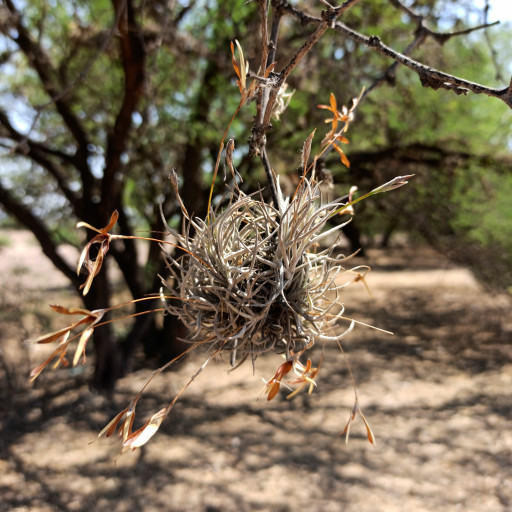
Plant Overview
Often mistaken for a stray bird’s nest or a clump of tumbleweed that lost its way, the Tillandsia recurvata, better known as Ball Moss, is a true master of the air. Despite its common name, it isn't a moss at all, but a flowering bromeliad related to the pineapple. It spends its entire life perched on tree branches or even telephone wires, living entirely off the moisture and nutrients it catches from the wind.
🔍 How to Identify
- 🌿 The "Ball" Shape: Unlike its cousin, Spanish Moss, which hangs in long curtains, this plant grows in tight, spherical clusters that can range from the size of a golf ball to a soccer ball.
- 🌫️ Silvery Foliage: The leaves are narrow, curved, and covered in tiny, specialized silver scales called "trichomes." these act like sponges to pull water directly from the humidity in the air.
- 🌸 Hidden Blooms: In the spring and summer, it produces tiny, inconspicuous flowers on long, thin stalks. These flowers are usually a pale blue or violet and eventually release "feathery" seeds.
🏡 In Your Garden
- 🌳 The Epiphytic Lifestyle: It is an epiphyte, meaning it uses trees only for physical support. It doesn't "suck the life" out of your oaks or elms, though a very dense population can sometimes shade out the inner leaves of a tree or cause small, weak branches to break under the weight of trapped rainwater.
- 💨 Air and Light Needs: If you find a clump that has fallen, you can "rescue" it by tucking it into the crook of a branch or a decorative basket. It thrives in bright, filtered light and needs excellent air circulation; it will quickly rot if kept in a soggy, stagnant corner of the yard.
⚠️ Safety & Toxicity
- 🛡️ Non-Toxic Status: Ball Moss is generally considered non-toxic to humans, dogs, and cats. It is a safe plant to have around curious pets who might find its "bouncy" shape tempting to bat around.
- 🕷️ Hidden Guests: While the plant itself is harmless, its dense, tangled center is a favorite hiding spot for small spiders and insects. If you bring a wild-harvested clump indoors, give it a gentle shake outside first!
✨ Fun Fact
💨 Aerial Paratroopers: The seeds of the Ball Moss are equipped with fine, silky hairs that act like parachutes. They can travel long distances on a breeze and are slightly sticky, allowing them to "glue" themselves to the rough bark of a new host tree the moment they land.

Detailed Care Instructions
| Humidity | Normal |
| Lighting | Full Sun |
| Difficulty | Medium |
| Temperature | 18°C - 32°C |
| Hardiness Zones | 8A - 11 |
To grow Tillandsia Recurvata, also known as Ball Moss or Spanish Moss, follow these steps:
- Choose a suitable location: Tillandsia Recurvata is an epiphytic plant and can be grown either in an outdoor garden or as an indoor houseplant. It requires bright but indirect light.
- Provide proper air circulation: The plant requires good air circulation to thrive. Make sure it is placed in an area with adequate airflow.
- Watering: Tillandsia Recurvata can survive with very minimal watering. Mist the plant with water once or twice a week or soak it in room temperature water for 10-15 minutes every 2-3 weeks. Be careful not to overwater as it can cause rotting.
- Humidity: This plant prefers a humid environment. If you live in a dry climate, misting the plant more frequently can help maintain the desired humidity level. You can also place it in a bathroom or use a humidifier nearby.
- Fertilization: Tillandsia Recurvata is a slow-growing plant that does not require regular fertilization. However, you can provide a weak, water-soluble fertilizer specifically formulated for air plants once a month during the growing season (spring to summer).
- Keep it clean: Remove any debris or dead leaves from the plant regularly to prevent mold or rot.
- Temperature: Tillandsia Recurvata can tolerate a wide range of temperatures, ideally between 50-90°F (10-32°C). Protect it from extreme cold or heat.
- Reproduction: Tillandsia Recurvata can reproduce by producing offsets called "pups." These pups can be separated from the parent plant once they are about one-third its size and start developing roots. Gently twist or cut the pup away and place it onto a suitable substrate to let it root.
By following these guidelines, you can successfully grow Tillandsia Recurvata as a unique and eye-catching addition to your plant collection.

Place in a window with dappled sun or a spot in the middle of a room. Or directly in a window facing west or east.

Tillandsia Recurvata is an epiphyte plant that belongs to the Bromeliaceae family. This plant is unique because it doesn't require soil to grow and can survive with very little water. To water this plant, you should mist it with a spray bottle or soak it in water for about 20-30 minutes once a week. If you live in a dry climate, you may need to water it more frequently. However, it's important not to overwater the plant as it can cause root rot and damage the plant. Additionally, make sure to shake off any excess water after watering to prevent water from pooling in the plant's leaves. Finally, it's recommended to use filtered or rainwater as the plant is sensitive to chemicals and minerals found in tap water.
To fertilize this plant, mix a low-concentration, water-soluble fertilizer with water and spray it on the leaves once a month during the growing season. Use a balanced fertilizer with equal amounts of nitrogen, phosphorous, and potassium. Avoid using high-nitrogen fertilizers, as they can burn the plant. Use distilled or rainwater instead of tap water, as the chlorine and other chemicals in tap water can damage the plant. Remove any excess fertilizer residue from the leaves with a gentle rinse of water.
Tillandsia Recurvata is a type of plant that does not require soil to grow. Instead, it obtains its nutrients and moisture from the air. However, if you choose to grow it in soil for aesthetic purposes, you can use a well-draining soil mix with a high content of organic matter. One suitable option is a mixture of peat moss, perlite, and pine bark. This will provide the plant with the support it needs while allowing excess water to drain away. It is important to avoid overwatering the plant as it can lead to root rot. Therefore, you should only water it once or twice a week, depending on humidity levels, and ensure that the soil is completely dry before watering again.
Propagation of this plant can be achieved through several methods. One can take the offsets or "pups" that emerge from the base of the mother plant and separate them using clean, sharp scissors. Care should be taken to ensure that the new pups have a sufficient root system before separating them. Alternatively, one can harvest the seeds from the plant and sow them in a well-draining potting mix. The seeds should be lightly covered with soil and kept moist but not waterlogged. In either case, the newly propagated Tillandsia Recurvata plant should be given bright but indirect light and kept at a moderate temperature until it has established itself and can be treated like a mature plant.
Common pests of the ball-moss include Mealybugs. Make a habit of checking your ball-moss frequently for pests so that any infestations can be caught and managed early.








