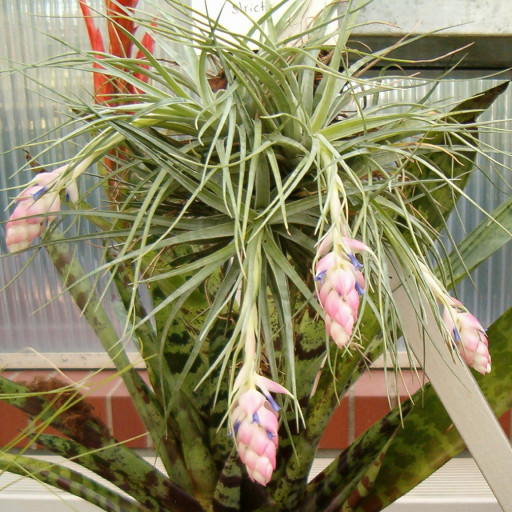
Plant Overview
Known affectionately as the "Upright Air Plant," Tillandsia stricta is a hardy South American native that looks like a miniature explosion of silver-green foliage. It is a favorite among beginners because it is incredibly forgiving and rewards its owners with a stunning, neon-pink flower spike that seems to defy the laws of nature. Whether perched on a piece of driftwood or tucked into a glass terrarium, it brings a touch of tropical elegance to any space.
🔍 How to Identify
- 🌿 The Rosette: It forms a dense, symmetrical rosette of narrow, tapering leaves that can grow in a stiff or soft upright fashion.
- 🎨 Foliage Color: Leaves range from bright lime green to a dusty, silvery-grey, covered in tiny "trichomes" that help the plant absorb water from the air.
- 🌸 The Bloom: A thick, vibrant pink floral bract emerges from the center, eventually producing delicate three-petaled flowers in shades of electric blue or violet.
🏡 In Your Garden
- 🌬️ Air is Life: As an epiphyte, this plant never wants to see a pot of soil. It "breathes" through its leaves, so high air circulation is its best friend to prevent moisture from trapped at the base.
- 💧 The Hydration Ritual: While it loves a weekly 20-minute soak, the stricta variety has thinner leaves than desert-dwelling air plants, meaning it appreciates frequent misting in dry, air-conditioned homes.
- ⚓ The "Roots": Any wiry roots you see are purely for anchoring onto branches or rocks. You can safely trim them or use them to glue the plant onto a decorative display.
⚠️ Safety & Toxicity
- 🐾 Pet Friendly: This plant is non-toxic to cats, dogs, and horses, making it a "worry-free" choice for pet owners.
- 👶 Safe for Humans: It is non-poisonous to children, though the pointed tips of the leaves can be a bit prickly if handled roughly.
✨ Fun Fact
In the wild, Tillandsia stricta is a master of adaptation, found growing everywhere from sea-level sandy beaches to the high-altitude forests of the Andes mountains!

Detailed Care Instructions
To grow Tillandsia stricta, also known as air plants, you can follow these steps:
- Lighting: Tillandsia stricta prefers bright, indirect light. Place them near a window where they can receive bright, filtered sunlight for at least 6 hours a day. Avoid direct sunlight, as it can scorch the plant.
- Temperature: These plants thrive in warm temperatures between 60-85°F (15-29°C). Ensure they are not exposed to frost or extreme temperature fluctuations.
- Watering: Air plants do not require soil to grow; they absorb moisture and nutrients from the air. Mist or soak your Tillandsia stricta once or twice a week. Submerge the plant in room temperature water for 10-15 minutes, then gently shake off the excess water. Let it dry completely before placing it back in its display.
- Air circulation: Good air circulation is vital for air plants to thrive. Provide proper ventilation by placing them in an area with a gentle breeze or use a small fan to keep the air moving around them.
- Fertilizing: Air plants can benefit from occasional fertilization to supplement their nutrient intake. Use a liquid fertilizer specifically formulated for air plants or bromeliads and dilute it to half the recommended strength. Apply the fertilizer by misting or adding it to the soaking water once a month.
- Display and care: Air plants are versatile and can be displayed in various ways. They can be mounted on driftwood, arranged in glass terrariums, or placed in decorative containers. Avoid placing them in airtight containers or covering their base with soil, as it can lead to rot. Remove any dead or yellowed leaves to maintain the plant's health and appearance.
With proper care, your Tillandsia stricta should grow, bloom, and produce new pups or offsets that can be separated to propagate new plants.

Place in a bright room that is sun drenched almost all day. Or directly in a south-facing window.

To water this plant, you should gently mist it or submerge it in room temperature water once a week for about 30 minutes. Afterward, shake off any excess water and allow it to air dry completely before placing it back in its container or hanger. Avoid using hard water or chlorinated water, as this can damage the plant's leaves. Instead, consider using rainwater or filtered water. Additionally, make sure the plant is situated in a location with good air circulation, as it relies on air flow to absorb moisture and nutrients.
- Use a water soluble fertilizer that is specifically formulated for air plants.
- Dilute the fertilizer in water according to the package instructions.
- Soak the plant in the fertilizer solution for 20-30 minutes.
- Remove the plant from the solution and allow it to dry completely.
- Repeat the fertilization process once a month during the growing season (spring and summer).
- Avoid fertilizing during the dormant season (fall and winter).
- Ensure that the plant has adequate sunlight, water, and air circulation to maximize the benefits of fertilization.
Tillandsia Stricta belongs to a group of plants that are commonly known as air plants. As air plants draw all their nutrients from the air, the type of soil is not very important for their growth. However, the soil should be porous and well-draining to avoid waterlogging, which can lead to rotting of the plant's roots. The ideal soil for Tillandsia Stricta is a well-draining mix that is made up of a combination of materials such as bark, peat moss, perlite, pumice, and sand. This type of soil will help to keep the air plant's roots dry while providing a stable base for the plant to grow on. When planting Tillandsia Stricta in soil, it is important to avoid burying its roots completely. Instead, the roots should be lightly covered with soil, leaving the plant's base visible above the soil line. This will allow the plant to absorb nutrients from the air while also giving its roots a chance to grow and spread out.
Tillandsia stricta is a type of plant that can be propagated through the separation of offsets. These offsets are smaller plants that grow from the base of the mother plant, and can be gently removed with a clean, sharp knife. Make sure the offset has a healthy root system before removing it from the mother plant.
Once you have removed the offset, soak it in water for a few hours to hydrate it and help it establish itself. Then, mount the offset onto a suitable surface such as a piece of wood, bark, or a decorative rock. You can use glue, wire or fishing line to attach the offset to the surface.
After mounting, mist the offset with water daily and avoid watering the base of the plant. The new plant should start to grow and produce roots within a few weeks. Eventually, it will form a clump and produce its own offsets, continuing the propagation process.
It is important to note that Tillandsia stricta is an epiphyte, which means it naturally grows on other surfaces rather than in soil. Therefore, it is best to mount the offsets onto a surface rather than planting them in soil.
Common pests of the airplant include Mealybugs. Make a habit of checking your airplant frequently for pests so that any infestations can be caught and managed early.








