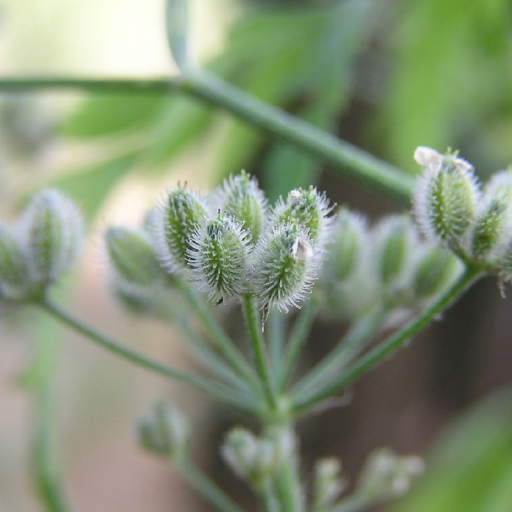
Plant Overview
Often called the "Spreading Hedge Parsley," this delicate member of the carrot family looks like a miniature, airy version of Queen Anne’s Lace. It is a common sight in meadows and along sun-drenched roadsides, appearing like a fine, lacy white veil over the landscape during the mid-summer months. While it possesses a dainty, wildflower charm, it is most famous among hikers for its "hitchhiking" seeds that stubbornly cling to socks and fur.
🔍 How to Identify
- 🌿 Flower Clusters: It produces small, flat-topped umbels of tiny white or pale pink flowers that appear to "float" on slender, branched stalks.
- 🍃 Fern-like Foliage: The leaves are grayish-green, deeply divided, and feathery, closely resembling the foliage of a domestic carrot or parsley plant.
- 🧶 Bristly Burrs: The most distinct feature is the fruit; small, oval seeds covered in tiny, hooked prickles that act like nature's Velcro to ensure seed dispersal.
🏡 In Your Garden
- ☀️ Opportunistic Growth: This plant thrives in disturbed soil and sunny edges. If it suddenly appears in your garden, it likely arrived via a pet’s fur or your own hiking gear after a walk in the woods.
- 🌱 The Taproot Challenge: Because it grows a sturdy, singular taproot, it is difficult to transplant once established. If you wish to remove it, it is best to pull it early in the spring while the soil is moist and before the "velcro" seeds have a chance to develop.
⚠️ Safety & Toxicity
- 🚫 Identification Warning: While Torilis arvensis is not considered highly toxic, it belongs to the Apiaceae family, which includes the deadly Poison Hemlock. Never ingest any wild plant that looks like parsley unless you are an expert, as the visual differences can be subtle.
- 🐕 Physical Nuisance: The hooked seeds (burrs) are a significant irritant for long-haired dogs. They can cause painful matting or become lodged in sensitive areas like paw pads, ears, or even nostrils.
✨ Fun Fact
The hooked bristles on the seeds of the Hedge Parsley are a perfect example of zoochory—the botanical strategy of using animals for transport. These hooks are so efficient that they served as one of the primary natural inspirations for the invention of Velcro!

Detailed Care Instructions
| Humidity | Normal |
| Lighting | Part Sun |
| Difficulty | Easy |
| Hibernation | Cold Period |
To grow Torilis Arvensis, also known as hedge parsley or field hedge parsley, follow these steps:
- Choose the right location: Torilis Arvensis prefers full sun to partial shade and well-draining soil. Ensure that the area has sufficient sunlight and good drainage.
- Determine the growing season: Torilis Arvensis is an annual plant, so it is best to sow the seeds in spring or early summer when the soil temperature reaches about 15°C (60°F).
- Prepare the soil: Before sowing the seeds, prepare the soil by removing any weeds or rocks and loosening it with a garden fork. Torilis Arvensis tolerates a wide range of soil pH levels but prefers neutral to slightly alkaline soil.
- Sow the seeds: Scatter the Torilis Arvensis seeds evenly over the prepared soil. Lightly press the seeds into the soil so that they make good contact but are not buried too deep. The recommended sowing depth is about 1/4 inch (0.6 cm).
- Watering: After sowing, water the soil gently to ensure that it is moist. Avoid overwatering as excessive moisture may cause the seeds to rot. Keep the soil slightly moist until the seeds germinate.
- Germination: The seeds generally take around one to two weeks to germinate. Once the seedlings emerge, thin them out by removing the weaker ones, leaving about 8 to 12 inches (20 to 30 cm) of spacing between each plant.
- Maintenance: Torilis Arvensis requires minimal maintenance. Water the plants regularly to keep the soil slightly moist, especially during dry periods. Weeding around the plants regularly will prevent competition for nutrients and water.
- Harvesting: Torilis Arvensis typically produces small white flowers in late summer. If desired, you can harvest the seeds for culinary or medicinal purposes. The seeds usually mature in late summer or early autumn and can be collected by cutting the seed heads and allowing them to dry in a paper bag.
By following these steps, you should be able to grow Torilis Arvensis successfully.

Place in a window with dappled sun or a spot in the middle of a room. Or directly in a window facing west or east.

The Torilis Arvensis plant should be watered regularly to keep the soil moist but not waterlogged. Overwatering can cause root rot and wilted leaves, while underwatering can cause the plant to dry out and die. It is best to water the plant deeply once or twice a week, depending on the soil type and weather conditions. When watering, make sure to water the soil around the plant and avoid getting water on the leaves. It is best to water in the morning or late afternoon when the sun is not too intense to avoid scorching the leaves. Check the soil regularly to make sure it is not too dry or too wet and adjust watering accordingly.
To fertilize this plant, use a balanced fertilizer with equal amounts of nitrogen, phosphorus, and potassium. Apply the fertilizer according to the package instructions, avoiding direct contact with the leaves and stems. Water the plant thoroughly after fertilizing to help the nutrients reach the roots. If the plant is grown in a container, fertilize more frequently but with a diluted solution. Always follow the recommended dosages and avoid over-fertilization, as it can damage the plant.
The ideal soil for the Torilis Arvensis plant is a well-draining soil that is rich in organic matter. The pH level of the soil should be neutral to slightly acidic. It should also be loose and loamy to allow the plant's roots to spread out easily.
If the soil in the planting area is heavy clay or sandy, it should be amended with compost or other organic matter to improve its texture, drainage, and fertility. Adding organic matter will also help the soil hold moisture, which is crucial for the Torilis Arvensis plant's growth and survival.
To ensure optimal growth and health of the plant, regular soil testing should be performed to check for any nutrient deficiencies or imbalances. If any issues are identified, appropriate fertilizers or soil amendments can be applied to correct the problem.
To propagate this plant, collect the seeds in the fall after they have dried and turned brown. Store the seeds in a cool, dry place until spring. When spring comes, prepare a seedbed by loosening the soil and removing any debris. Sow the seeds thinly on top of the soil and cover with a thin layer of soil. Water gently to moisten the soil. Keep the soil consistently moist until the seeds have germinated, which typically takes around two weeks. After germination, thin the seedlings to one every few inches. Once the seedlings have grown to a few inches tall, they can be transplanted to a permanent location.








