Plant Overview
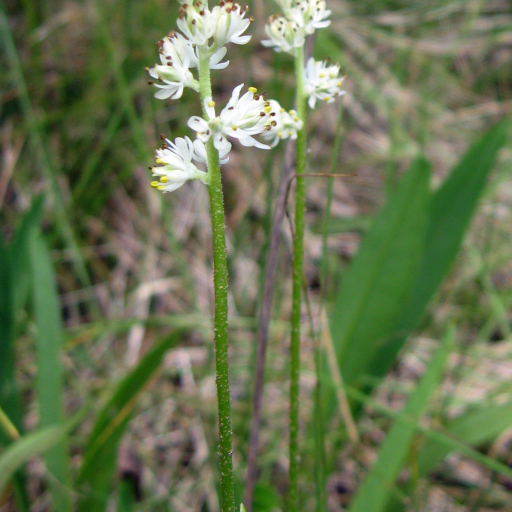
Known as the Sticky Tofieldia or False Asphodel, this unassuming wildflower hid a "deadly" secret for centuries. While it looks like a typical meadow beauty, scientists recently discovered it is actually protocarnivorous, using its sticky stem to ensnare tiny insects for food. It is a resilient dweller of damp, lime-rich wetlands across North America, from the icy reaches of Alaska to the Appalachian mountains.
🔍 How to Identify
- 🌸 Flower Clusters: Dense, rounded clusters of small, six-petaled white or cream-colored flowers bloom at the very top of the stalk during mid-summer.
- 🧪 Glandular Stems: The most famous feature—the upper portion of the flower stem is covered in tiny, reddish, sticky hairs that feel like glue to the touch.
- 🌿 Basal Leaves: Long, narrow, grass-like leaves are arranged in a flat, fan-like shape at the very base of the plant, much like a miniature Iris.
🏡 In Your Garden
- 💧 Wetland Specialist: This is not a typical "backyard" plant. It requires "wet feet" and thrives exclusively in bogs, fens, and marshes. If you are building a bog garden, it needs nutrient-poor but mineral-rich (alkaline) soil.
- 🦟 The Nutrient Hunter: Because it grows in habitats where the soil lacks nitrogen, it has evolved to trap small gnats and midges on its stem. It then secretes enzymes to digest them, "eating" through its skin rather than through a trap like a Venus Flytrap.
⚠️ Safety & Toxicity
- 🟢 Non-Toxic: There are no known toxicities associated with Triantha glutinosa for humans or domestic pets.
- 🛡️ Sticky Residue: The "glue" on the stems is not an irritant, but it can be difficult to wash off your fingers if you handle the plant directly. It is best to leave it undisturbed to protect its delicate hunting mechanism.
✨ Fun Fact
For decades, botanists knew the plant was sticky but assumed it was just a defense to keep ants from stealing nectar. It wasn't until 2021 that researchers confirmed it was actually a carnivore, making it the first new carnivorous plant lineage discovered by science in nearly 20 years!

Detailed Care Instructions
To grow Triantha Glutinosa, also known as sticky tofieldia, follow these steps:
- Collect seeds or obtain young plants from a nursery.
- Choose a suitable location for planting, preferably with partial shade or filtered sunlight.
- Prepare the soil by removing any weeds or grass and loosening it with a garden fork or tiller.
- Mix organic matter such as compost or well-rotted manure into the soil to improve its structure and fertility.
- Sow the seeds in early spring, barely covering them with a thin layer of soil. Alternatively, plant the young plants a few inches apart in the prepared soil.
- Water the seeds or young plants gently to keep the soil moist but not waterlogged. Avoid letting the soil dry out completely.
- Weed the area around the plants regularly to prevent competition for nutrients and space.
- Provide some shade or light mulch in regions with hot summers to protect the plants.
- Monitor the moisture levels and water the plants during dry spells, but be cautious not to overwater.
- Fertilize the plants once or twice a year with a balanced, all-purpose fertilizer to promote healthy growth.
- Monitor for pest infestations or diseases, and take appropriate measures to address them.
- Enjoy the beautiful flowers that typically bloom in mid-summer.
- After the flowering season, let the plant go to seed. Collect the seeds and store them in a cool, dry place if you wish to propagate more plants in the future.
- Repeat the process in subsequent years to maintain and expand your Triantha Glutinosa plant population.

Place in a window with dappled sun or a spot in the middle of a room. Or directly in a window facing west or east.

To properly water this plant, it is important to understand its water needs and the soil it requires. This plant prefers moist but well-drained soil, so it is important to not overwater it. Before watering, check the top inch of soil to see if it is dry. If it is, then it is time to water.
When watering, pour water onto the soil slowly and evenly until the entire root zone is moist. Avoid wetting the foliage as this can lead to fungal diseases. It is better to water deeply and less frequently than to water shallowly and frequently.
During the growing season, this plant may require more frequent watering as it actively grows and sets blooms. However, during the dormant season, it may require less water. Adjust your watering schedule accordingly.
Overall, it is best to monitor the soil moisture and the plant's overall health to determine when it needs watering.
The Triantha Glutinosa plant prefers a moist and nutrient-rich soil. Fertilize it once a month during the growing season using a balanced, water-soluble fertilizer. Mix the fertilizer following the package instructions and apply it to the soil around the plant, avoiding the leaves. Water thoroughly after fertilizing. Do not fertilize during the dormant season.
For optimal growth and health, Triantha Glutinosa requires a well-draining soil with a pH between 5.0 to 7.0. The soil should be fertile, with a healthy amount of organic matter. It is recommended to mix the soil with sand or perlite to improve drainage and aeration. Additionally, the plant prefers a moist environment, so it is essential to ensure that the soil is adequately hydrated throughout the growing season. It is recommended to avoid using heavy clay soils or soils that are too compacted, as this can impede root growth and cause drainage issues. Regular fertilization with a balanced fertilizer can also promote healthy growth and flowering.
Propagation of this plant can be done through division of its rhizomes. To do so, carefully dig out the plant and separate the rhizomes. Each rhizome should have at least one shoot and a healthy root system. Plant the divided rhizomes in well-draining soil and keep them moist until they establish themselves. The best time to divide and transplant the plant is in the early spring or fall when the plant is dormant.








