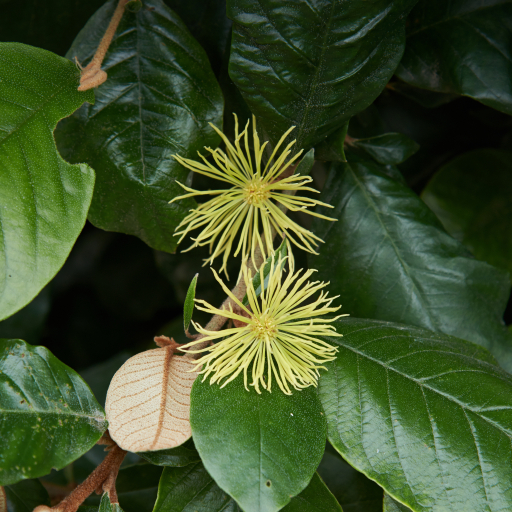
Plant Overview
The Trichocladus ellipticus, commonly known as the White Witch-hazel, is a hidden gem of the South African forest. While not a true witch-hazel (which belongs to the genus Hamamelis), it shares the same "shaggy" floral charm and woody resilience. Often found clinging to riverbanks or nestled in misty mountain forests, this plant is a master of subtle beauty, flashing its silver-lined leaves whenever a breeze passes through the garden.
🔍 How to Identify
- 🍃 The Leaf Contrast: The leaves are distinctively elliptical with a glossy, dark green upper surface and a striking, velvety silver or rusty-cream underside.
- 🌼 Spider-like Blooms: It produces small, unconventional flowers that look like tufts of yellowish-green thread or tiny fireworks, appearing in dense axillary heads.
- 🎋 Fuzzy Stems: Young twigs and buds are often covered in a dense layer of fine, velvety hairs, giving the plant a soft, touchable texture.
🏡 In Your Garden
- 🛡️ Natural Privacy: Due to its dense, evergreen growth habit, it makes an excellent screening plant or a "living fence" that provides year-round privacy without looking messy.
- 🌊 Coastal Warrior: This species is remarkably wind-tolerant and can handle the salt-laden air of coastal regions, provided it has a bit of protection from the harshest direct spray.
- 💧 Thirst for Context: While it is hardy once established, it prefers "cool feet"—meaning it thrives when the soil is kept mulched and moist, mimicking its natural home near forest streams.
⚠️ Safety & Toxicity
- ✅ General Safety: There are no documented reports of high toxicity for humans or common household pets regarding Trichocladus ellipticus.
- 🖐️ Mild Irritation: Some sensitive individuals may find the fine hairs on the stems and leaf undersides slightly itchy or irritating to the skin if handled frequently without gloves.
✨ Fun Fact
The name Trichocladus is derived from the Greek words trichos (hair) and klados (branch). This is a literal description of the plant's signature "fuzzy" branches, which are covered in specialized star-shaped hairs that help protect the plant from water loss and hungry insects!

Detailed Care Instructions
To grow Trichocladus Ellipticus, also known as the glory bower, follow these steps:
- Climate: Ensure you live in a suitable climate for the plant. Trichocladus Ellipticus thrives in tropical and subtropical regions. It prefers warm temperatures and cannot tolerate frost.
- Sunlight: Provide the plant with partial shade or filtered sunlight. It can tolerate full sun but may require extra care to prevent heat stress.
- Soil: Choose well-draining soil rich in organic matter. A mix of garden soil, compost, and sand works well. Avoid heavy clay soils that can retain water and cause root rot.
- Watering: Water the plant regularly, keeping the soil moist but not waterlogged. Avoid overwatering, which can lead to root rot. During hot summers, increase watering frequency to prevent the soil from drying out.
- Fertilizer: Apply a balanced slow-release fertilizer during the growing season. Follow the manufacturer's instructions for dosage and frequency. Additionally, organic fertilizers like compost can be added to enrich the soil.
- Pruning: Trichocladus Ellipticus tends to grow vigorously, so occasional pruning may be necessary to maintain its shape and size. Prune in late winter or early spring before new growth occurs. Remove dead or damaged branches and prune lightly to encourage bushier growth.
- Pests and diseases: Keep an eye out for common pests like aphids, mealybugs, and scale insects. Treat infestations with organic insecticides or insecticidal soap. Ensure good air circulation around the plant to reduce the risk of fungal diseases.
- Propagation: Trichocladus Ellipticus can be propagated by seeds or cuttings. Collect ripe seeds and sow them in a well-draining potting mix. Keep the soil moist and provide warmth for germination. Alternatively, take semi-hardwood cuttings in spring or early summer and place them in a rooting hormone before planting in a container filled with a propagation mix.
By following these guidelines, you should be able to successfully grow Trichocladus Ellipticus. Happy gardening!
To ensure proper watering for this plant, it is important to consider several factors. The first is the soil type and drainage of the pot or planting area. It is best to use well-draining soil to prevent water from accumulating around the roots.
The second factor to consider is the climate and environment in which the plant is growing. If the plant is in a hot or dry area, it may require more frequent watering. Conversely, in a cooler or more humid environment, it may require less water.
It is also important to observe the plant and check for signs of dehydration or over-watering. If the leaves are wilted or turning yellow, it may be a sign of under-watering. If the leaves are brown or black and the soil is overly damp, it may be a sign of over-watering.
When watering this plant, it is best to water deeply but infrequently. Allow the soil to dry slightly between waterings to prevent standing water around the roots. It is also important to water at the base of the plant rather than from above to prevent water from accumulating on the leaves and causing fungal growth.
Overall, proper watering is essential to the health and growth of this plant. By considering its environment, soil, and watering habits, you can help to ensure that it thrives and produces beautiful foliage or blooms.
For optimal growth, fertilize the plant every 2-3 weeks during the growing season with a balanced fertilizer (10-10-10) diluted to half strength. Be sure to water thoroughly before and after fertilizing to prevent root burn. Avoid over-fertilization, as this can cause excessive foliage growth at the expense of flowering. During the dormant season, reduce fertilization to once a month or stop altogether.
When planting the Trichocladus Ellipticus plant, it is recommended to use well-draining, nutrient-rich soil with a slightly acidic pH level. The ideal soil composition should contain organic matter, such as compost or leaf litter, to promote healthy root growth and nutrient absorption. The plant prefers soil that is moist but not waterlogged, so it is important to ensure proper drainage when planting. Additionally, adding perlite or sand to the soil mix can further enhance drainage. It is also important to avoid using soil that is heavy in clay, as this can inhibit root growth and lead to waterlogging. Overall, it is essential to select a high-quality soil mix that provides the necessary nutrients and growing conditions to support the Trichocladus Ellipticus plant's health and growth.
Propagation of this plant can be achieved through vegetative means. The plant can be propagated through stem cuttings that are taken from a mature plant. The stem cutting should be about 10-15 cm in length and should have at least two nodes. It is essential to ensure that the cutting is taken from healthy plants and using clean, sterile tools. The cuttings are then planted in rooting hormone and placed in moist soil for rooting.
The plant can also be propagated through seeds, which should be collected from mature and healthy plants. The seeds should be cleaned and dried before planting. They should be sown in a well-draining soil mix, and watered regularly. The seeds generally take a few weeks to germinate, and it is important to maintain the right moisture level.
Propagation through division is also possible with Trichocladus Ellipticus. This involves dividing the mature plant into smaller sections and replanting them. The plant should be carefully dug up, and the roots should be separated by gently pulling them apart with your hands. Each section should have a good amount of root mass and a healthy stem. The divided plants can then be replanted in fresh soil.
Overall, propagation of Trichocladus Ellipticus can be done easily through vegetative cuttings, seeds, and division. It is essential to ensure that the parent plant is healthy and using clean, sterile tools to promote successful propagation.








