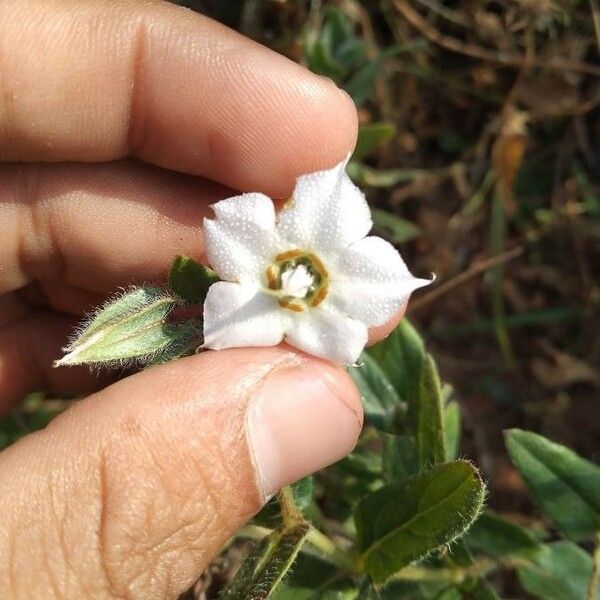
Plant Overview
Known affectionately as the Indian Borage or Handi-phul, this resilient wildflower is a common sight across the sun-drenched plains of South Asia and Africa. While it is often dismissed as a mere "weed," it is a survivor that thrives where other plants wither, earning a place in traditional Ayurvedic medicine for its supposed cooling properties. Its most enchanting feature is its "nodding" habit, where the delicate flowers hang their heads as if in quiet contemplation.
🔍 How to Identify
- 🌸 Nodding Blossoms: The flowers are pale blue, violet, or occasionally white, featuring five petals that curve backward to reveal a prominent, pointed cone of golden-brown anthers.
- 🌿 Bristly Texture: The entire plant is covered in stiff, white, bulbous-based hairs (hispid). This gives the foliage a silvery-green appearance and a rough, sandpaper-like feel.
- 🍃 Stalkless Leaves: The leaves are lance-shaped and "sessile," meaning they grow directly from the stem without a petiole, often appearing to clasp the stalk.
🏡 In Your Garden
- ☀️ Drought Warrior: This plant is an expert at moisture conservation. It prefers sandy, well-draining soil and full overhead sun, making it a "set-it-and-forget-it" addition to rock gardens or wild meadow patches.
- 🌱 Deep Taproot: Because it develops a long, stubborn taproot to find water deep underground, it hates being transplanted. If you want to grow it, sow seeds directly into the soil rather than moving a mature plant.
⚠️ Safety & Toxicity
- 🐾 Pet Warning: As a member of the Boraginaceae family, it may contain pyrrolizidine alkaloids. While not typically a "poisonous" plant in small contact, it should not be ingested by cats, dogs, or horses, as long-term consumption can lead to liver issues.
- 🌵 Mechanical Irritant: The stiff hairs on the stems are not chemically toxic, but they can cause "prickly" skin irritation or redness for gardeners with sensitive skin. It is best handled with light gloves.
✨ Fun Fact
The specific name indicum points to its Indian origins, but the genus name Trichodesma comes from the Greek words thrix (hair) and desmos (band), referring to the way the hairs on the anthers are bound together in a unique, twisted bundle!

Detailed Care Instructions
To water this particular plant, it is important to keep the soil evenly moist, but not waterlogged. It is recommended to allow the top inch of soil to dry out before watering again. When watering, use room temperature water and water at the base of the plant, being careful not to get water on the foliage. Avoid letting the plant sit in standing water, as this can lead to root rot. It is also important to not let the soil completely dry out, as this can stress the plant and prevent it from growing properly.
Trichodesma Indicum plant thrives in well-draining soil that is rich in nutrients and organic matter. The ideal soil type for this plant is a mixture of sand, loam, and clay. It is important to avoid using soil that is too heavy or dense, as this can lead to poor drainage and root rot. The plant benefits from a pH level of 6.5 to 7.5. Adding compost or other organic matter to the soil can help improve its texture and fertility. Additionally, the plant prefers slightly acidic soil and can benefit from periodic applications of an all-purpose fertilizer. It is essential to ensure that the soil is properly drained to prevent waterlogging, which can be detrimental to the plant's health.








